. 2016 Nov 7;17(1):887.
doi: 10.1186/s12864-016-3167-3.

Stringent comparative sequence analysis reveals SOX10 as a putative inhibitor of glial cell differentiation

Affiliations

Stringent comparative sequence analysis reveals SOX10 as a putative inhibitor of glial cell differentiation

Chetna Gopinath et al. BMC Genomics. .

Abstract

Background: The transcription factor SOX10 is essential for all stages of Schwann cell development including myelination. SOX10 cooperates with other transcription factors to activate the expression of key myelin genes in Schwann cells and is therefore a context-dependent, pro-myelination transcription factor. As such, the identification of genes regulated by SOX10 will provide insight into Schwann cell biology and related diseases. While genome-wide studies have successfully revealed SOX10 target genes, these efforts mainly focused on myelinating stages of Schwann cell development. We propose that less-biased approaches will reveal novel functions of SOX10 outside of myelination.

Results: We developed a stringent, computational-based screen for genome-wide identification of SOX10 response elements. Experimental validation of a pilot set of predicted binding sites in multiple systems revealed that SOX10 directly regulates a previously unreported alternative promoter at SOX6, which encodes a transcription factor that inhibits glial cell differentiation. We further explored the utility of our computational approach by combining it with DNase-seq analysis in cultured Schwann cells and previously published SOX10 ChIP-seq data from rat sciatic nerve. Remarkably, this analysis enriched for genomic segments that map to loci involved in the negative regulation of gliogenesis including SOX5, SOX6, NOTCH1, HMGA2, HES1, MYCN, ID4, and ID2. Functional studies in Schwann cells revealed that: (1) all eight loci are expressed prior to myelination and down-regulated subsequent to myelination; (2) seven of the eight loci harbor validated SOX10 binding sites; and (3) seven of the eight loci are down-regulated upon repressing SOX10 function.

Conclusions: Our computational strategy revealed a putative novel function for SOX10 in Schwann cells, which suggests a model where SOX10 activates the expression of genes that inhibit myelination during non-myelinating stages of Schwann cell development. Importantly, the computational and functional datasets we present here will be valuable for the study of transcriptional regulation, SOX protein function, and glial cell biology.

Keywords: Comparative sequence analysis; Myelination; SOX10; Schwann cells; Transcriptional regulation; Ultra-conserved sequences.


Figures

Fig. 1
Fig. 1
Seven regions demonstrate regulatory activity in Schwann cells. Each of the 57 genomic segments containing prioritized SOX10 consensus sequences was cloned upstream of a luciferase reporter gene and tested for enhancer activity in cultured Schwann (S16) cells. Luciferase data are expressed relative to a control vector that does not harbor a genomic insert (‘Empty’). Regions that display a greater than 2.5-fold increase (red line) in luciferase activity are indicated in red text and by an arrow. Error bars indicate standard deviations
Fig. 2
Fig. 2
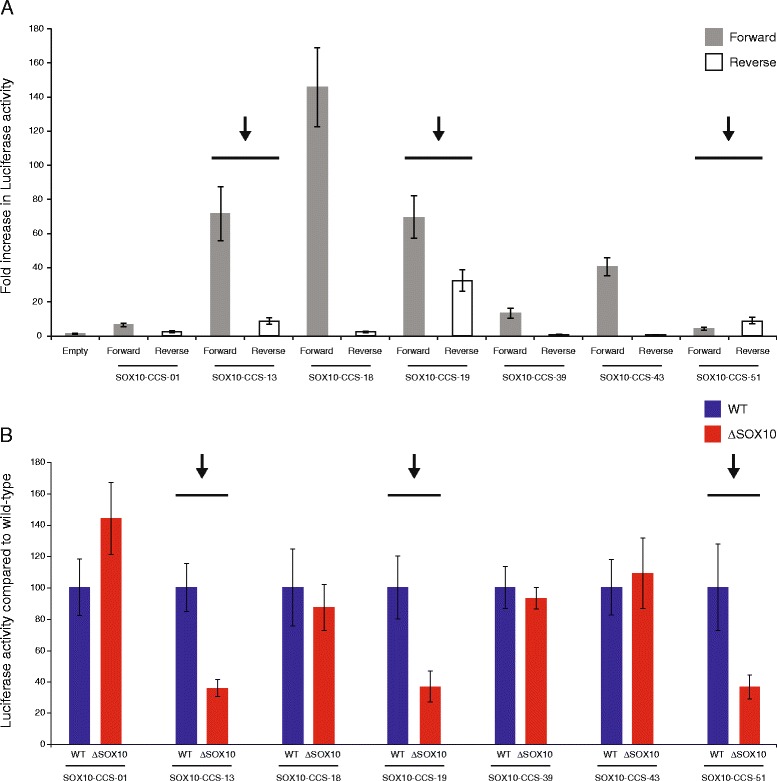
Three genomic segments require the SOX10 consensus sequence for activity in Schwann cells. a The seven active regions from Fig. 1 were tested in forward and reverse orientation in rat Schwann (S16) cells. Luciferase data are expressed relative to a control vector without a genomic segment (‘Empty’). Error bars indicate standard deviations and arrows and lines indicate genomic segments that are active in both orientations. b Luciferase reporter gene constructs containing either the wild-type sequence (WT) or the sequence lacking the SOX10 consensus sequence(s) (ΔSOX10) were transfected into S16 cells and tested in luciferase assays. The luciferase activity associated with each ΔSOX10 construct is expressed relative to the respective wild-type construct. Error bars indicate standard deviations and arrows and lines indicate genomic segments with a required SOX10 consensus sequence
Fig. 3
Fig. 3
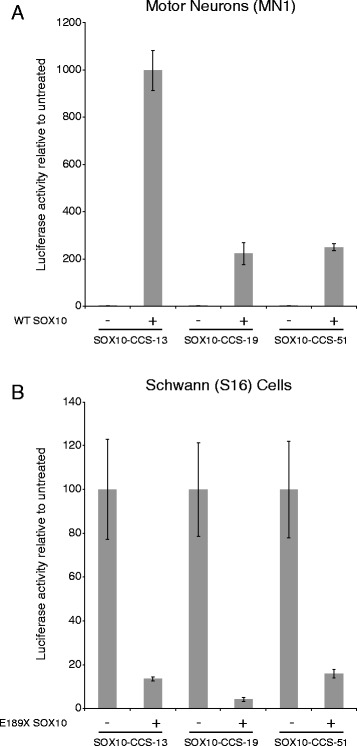
SOX10 is required for the regulatory activities of SOX10-CCS-13, SOX10-CCS-19 and SOX10-CCS-51. a Luciferase reporter gene constructs harboring SOX10-CCS-13, SOX10-CCS-19 or SOX10-CCS-51 were transfected into mouse motor neurons (MN1) with or without a construct to express wild-type SOX10. The luciferase activity associated with each construct in the presence of SOX10 is expressed relative to that of the construct in the absence of SOX10. b Luciferase reporter gene constructs harboring SOX10-CCS-13, SOX10-CCS-19 or SOX10-CCS-51 were transfected into rat Schwann (S16) cells with or without a construct to express dominant-negative (E189X) SOX10. The luciferase activity associated with each construct in the presence of E189X SOX10 is expressed relative to that of the construct in the absence of E189X SOX10. Error bars indicate standard deviations in both panels
Fig. 4
Fig. 4
SOX10-CCS-13 is an alternative promoter at the Sox6 locus. The ~579 kb rat Sox6 locus is shown on the UCSC Rat Genome Browser. SOX10-CCS-13 is indicated in red along with the seven human, mouse, and rat SOX6 RefSeq mRNAs (blue). Sox6-specific 5’ RACE was performed on RNA from S16 cells and the five distinct Sox6 sequences were mapped to the rat genome. Please note that SOX10-CCS-13 maps to both the 5’ end of the seventh Sox6 mRNA and the fifth unique 5’ RACE-generated sequence. RNA-Seq data from S16 cells were mapped to Sox6 (the y-axis indicates sequence read depth) as was a PCR-amplified, full-length mRNA that contains Sox6 exon 1G. Genome-wide regulatory marks were also mapped to Sox6 with the Y-axes indicating normalized sequence read depths (both SOX10 ChIP-seq data sets) and F-Seq scores (DNase-seq). The green highlighted region marks the general position of SOX10-CCS-13 across all data sets and the brown highlighted region marks another potential SOX10 response element at Sox6
Fig. 5
Fig. 5
SOX10 is necessary and sufficient for SOX6 expression. a RT-PCR was performed to detect the expression of Sox6 transcripts harboring exon 1G using cDNA isolated from S16 cells, MN1 cells, or MN1 cells transfected with no expression construct (mock) or a construct to express wild-type or dominant-negative (E189X) SOX10. Base pair (bp) ladders are indicated on the left. RT-PCR for β-actin and samples including no cDNA (‘Blank’) were employed as positive and negative controls, respectively. Please note that while the same primers were used for each reaction, the rat (S16) PCR product was 402 base pairs and the mouse (MN1) PCR product was 349 bp; the rat genome harbors a 53 base pair rat-specific insertion, which we confirmed via DNA sequence analysis. b Rat Schwann (S16) cells were treated with a control siRNA (left side) or a siRNA targeted against Sox10 (right side). Quantitative RT-PCR was used to measure expression levels of total Sox6 (green bars) or Sox6 exon 1G-containing (purple bars) transcripts. Error bars indicate standard deviations
Fig. 6
Fig. 6
SOX10 regulates the expression of genes that inhibit glial cell differentiation. a Eight genomic segments at the rat Notch1, Hmga2, Hes1, Mycn, Id4, and Id2 loci were cloned upstream of a luciferase reporter gene in both the forward and reverse orientations and tested for luciferase activity in rat Schwann (S16) cells. Luciferase data are expressed relative to a control vector with no genomic insert (‘Empty’). Error bars represent standard deviations. b The conserved SOX10 consensus sequence(s) were deleted in each of the seven regions that were active in a (see text for details). Luciferase reporter gene constructs containing the wild-type sequence (WT) or the sequence lacking the SOX10 consensus sequence(s) (ΔSOX10) were transfected into S16 cells and luciferase assays performed. Luciferase activities are expressed relative to the wild-type expression constructs and error bars represent standard deviations. c Rat Schwann (S16) cells were treated with a control siRNA or a siRNA targeted against Sox10. Quantitative RT-PCR was used to measure expression levels of each indicated gene. Asterisks indicate a p-value smaller than 0.001 and error bars indicate standard deviations. d RNA was purified from three independent rat sciatic nerves at the P1, P15, and adult timepoints. Quantitative RT-PCR was used to measure expression levels of each indicated gene with values expressed relative to expression levels at P1. Asterisks indicate a p-value smaller than 0.005 and error bars indicate standard deviations
Fig. 7
Fig. 7
A model for the role of SOX10 in maintaining a pre-myelinating state. Previous to myelination (anti-myelination; left side), SOX10 activates the expression of negative regulators of myelination, which inhibit the expression of myelin genes such as MBP and MPZ. During activation of the myelination program (pro-myelination; right side), EGR2 and micro RNAs (miRs) inhibit the expression of negative regulators of myelination, which allows SOX10 (and EGR2) to positively regulate the expression of myelin genes

References

    1. Jessen KR, Mirsky R. The origin and development of glial cells in peripheral nerves. Nat. Rev. Neurosci. 2005;6:671–82. doi: 10.1038/nrn1746. - DOI - PubMed
    1. Stolt CC, Wegner M. Schwann cells and their transcriptional network: Evolution of key regulators of peripheral myelination. Brain Res. 2016;1641:101–10. doi: 10.1016/j.brainres.2015.09.025. - DOI - PubMed
    1. Kuhlbrodt K, Herbarth B, Sock E, Hermans-Borgmeyer I, Wegner M. Sox10, a novel transcriptional modulator in glial cells. J. Neurosci. 1998;18:237–50. - PMC - PubMed
    1. Britsch S, Goerich DE, Riethmacher D, Peirano RI, Rossner M, Nave KA, et al. The transcription factor Sox10 is a key regulator of peripheral glial development. Genes Dev. 2001;15:66–78. doi: 10.1101/gad.186601. - DOI - PMC - PubMed
    1. Finzsch M, Schreiner S, Kichko T, Reeh P, Tamm ER, Bösl MR, et al. Sox10 is required for Schwann cell identity and progression beyond the immature Schwann cell stage. J. Cell Biol. 2010;189:701–12. doi: 10.1083/jcb.200912142. - DOI - PMC - PubMed

Publication types

Substances