


The UCL low-density lipoprotein receptor gene variant database: pathogenicity update
- PMID: 27821657
- PMCID: PMC5502305
- DOI: 10.1136/jmedgenet-2016-104054
The UCL low-density lipoprotein receptor gene variant database: pathogenicity update
Abstract
Background: Familial hypercholesterolaemia (OMIM 143890) is most frequently caused by variations in the low-density lipoprotein receptor (LDLR) gene. Predicting whether novel variants are pathogenic may not be straightforward, especially for missense and synonymous variants. In 2013, the Association of Clinical Genetic Scientists published guidelines for the classification of variants, with categories 1 and 2 representing clearly not or unlikely pathogenic, respectively, 3 representing variants of unknown significance (VUS), and 4 and 5 representing likely to be or clearly pathogenic, respectively. Here, we update the University College London (UCL) LDLR variant database according to these guidelines.
Methods: PubMed searches and alerts were used to identify novel LDLR variants for inclusion in the database. Standard in silico tools were used to predict potential pathogenicity. Variants were designated as class 4/5 only when the predictions from the different programs were concordant and as class 3 when predictions were discordant.
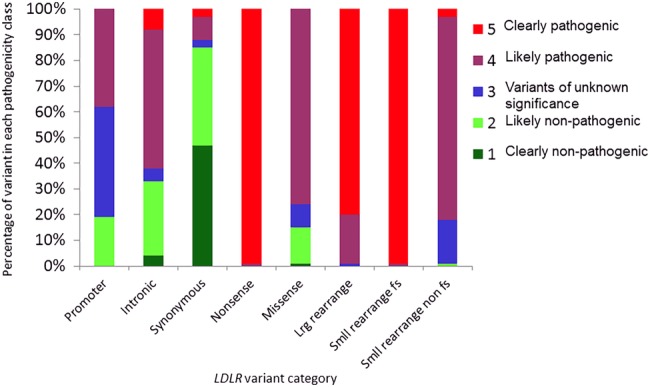
Results: The updated database (http://www.lovd.nl/LDLR) now includes 2925 curated variants, representing 1707 independent events. All 129 nonsense variants, 337 small frame-shifting and 117/118 large rearrangements were classified as 4 or 5. Of the 795 missense variants, 115 were in classes 1 and 2, 605 in class 4 and 75 in class 3. 111/181 intronic variants, 4/34 synonymous variants and 14/37 promoter variants were assigned to classes 4 or 5. Overall, 112 (7%) of reported variants were class 3.
Conclusions: This study updates the LDLR variant database and identifies a number of reported VUS where additional family and in vitro studies will be required to confirm or refute their pathogenicity.
Keywords: Familial Hypercholesterolemia; LDLR; database; in silico pathogenicity predictions; locus specific variant.
Published by the BMJ Publishing Group Limited. For permission to use (where not already granted under a licence) please go to http://www.bmj.com/company/products-services/rights-and-licensing/.
Conflict of interest statement
Figures
References
-
- Neil A, Cooper J, Betteridge J, Capps N, McDowell I, Durrington P, Seed M, Humphries SE. Reductions in all-cause, cancer, and coronary mortality in statin-treated patients with heterozygous familial hypercholesterolaemia: a prospective registry study. Eur Heart J 2008;29:2625–33. 10.1093/eurheartj/ehn422 - DOI - PMC - PubMed
-
- Nordestgaard BG, Chapman MJ, Humphries SE, Ginsberg HN, Masana L, Descamps OS, Wiklund O, Hegele RA, Raal FJ, Defesche JC, Wiegman A, Santos RD, Watts GF, Parhofer KG, Hovingh GK, Kovanen PT, Boileau C, Averna M, Borén J, Bruckert E, Catapano AL, Kuivenhoven JA, Pajukanta P, Ray K, Stalenhoef AF, Stroes E, Taskinen MR, Tybjærg-Hansen A, European Atherosclerosis Society Consensus Panel. Familial hypercholesterolaemia is underdiagnosed and undertreated in the general population: guidance for clinicians to prevent coronary heart disease: consensus statement of the European Atherosclerosis Society. Eur Heart J 2013;34:3478–90a. 10.1093/eurheartj/eht273 - DOI - PMC - PubMed
Publication types
MeSH terms
Substances
Grants and funding
LinkOut - more resources
Full Text Sources
Other Literature Sources
