Ehlers-Danlos Syndrome-Hypermobility Type: A Much Neglected Multisystemic Disorder
- PMID: 27824552
- PMCID: PMC5101008
- DOI: 10.5041/RMMJ.10261
Ehlers-Danlos Syndrome-Hypermobility Type: A Much Neglected Multisystemic Disorder
Abstract
Ehlers-Danlos syndrome (EDS)-hypermobility type (HT) is considered to be the most common subtype of EDS and the least severe one; EDS-HT is considered to be identical to the joint hypermobility syndrome and manifests with musculoskeletal complaints, joint instability, and soft tissue overuse injury. Musculoskeletal complaints manifest with joint pain of non-inflammatory origin and/or spinal pain. Joint instability leads to dislocation or subluxation and involves peripheral joints as well as central joints, including the temporomandibular joints, sacroiliac joints, and hip joints. Soft tissue overuse injury may lead to tendonitis and bursitis without joint inflammation in most cases. Ehlers-Danlos syndrome-HT carries a high potential for disability due to recurrent dislocations and subluxations and chronic pain. Throughout the years, extra-articular manifestations have been described, including cardiovascular, autonomic nervous system, gastrointestinal, hematologic, ocular, gynecologic, neurologic, and psychiatric manifestations, emphasizing the multisystemic nature of EDS-HT. Unfortunately, EDS-HT is under-recognized and inadequately managed, leading to neglect of these patients, which may lead to severe disability that almost certainly could have been avoided. In this review article we will describe the known manifestations of the extra-articular systems.
Conflict of interest statement
No potential conflict of interest relevant to this article was reported.
Figures
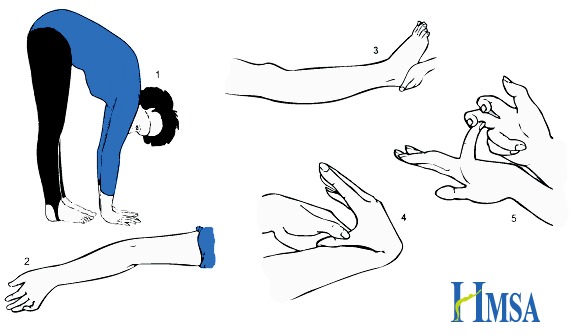
One point if while standing forward bending you can place palms on the ground with legs straight
One point for each elbow that bends backwards
One point for each knee that bends backwards
One point for each thumb that touches the forearm when bent backwards
One point for each little finger that bends backwards beyond 90 degrees
References
-
- Beighton P, De Paepe A, Steinmann B, Tsipouras P, Wenstrup RJ. Ehlers-Danlos syndromes: revised nosology, Villefranche, 1997. Ehlers-Danlos National Foundation (USA) and Ehlers-Danlos Support Group (UK) Am J Med Genet. 1998;77:31–7. https://doi.org/10.1002/(SICI)1096-8628(19980428)77:1%3C31::AID-AJMG8%3E.... - DOI - PubMed
-
- Grahame R. Ehlers-Danlos syndrome. S Afr Med J. 2016;106:S45–6. https://doi.org/10.7196/SAMJ.2016.v106i6.10991. - DOI - PubMed
-
- Levy HP. Ehlers Danlos Syndrome, Hypermobility Type. In: Pagon RA, Adam MP, Ardinger HH, et al., editors. GeneReviews [Internet] Seattle, WA: University of Washington, Seattle; 1993–2016. [accessed October 7, 2016]. Updated March 31, 2016. Available at: http://bit.ly/2ePdTyk.
-
- De Paepe A, Malfait F. The Ehler-Danlos syndrome, a disorder with many faces. Clin Genet. 2012;82:1–11. https://doi.org/10.1111/j.1399-0004.2012.01858.x. - DOI - PubMed
-
- Pepin MG, Murray ML, Byers PH. Vascular Ehlers-Danlos Syndrome. In: Pagon RA, Adam MP, Ardinger HH, et al., editors. GeneReviews [Internet] Seattle, WA: University of Washington, Seattle; 1993–2016. [accessed October 7, 2016]. Updated Nov 19, 2015. Available at: http://bit.ly/2fiszsr. - PubMed
Publication types
LinkOut - more resources
Full Text Sources
Other Literature Sources