. 2016 Nov 8;11(11):e0165964.
doi: 10.1371/journal.pone.0165964. eCollection 2016.

Bifunctional Anti-Non-Amyloid Component α-Synuclein Nanobodies Are Protective In Situ

Affiliations

Bifunctional Anti-Non-Amyloid Component α-Synuclein Nanobodies Are Protective In Situ

David C Butler et al. PLoS One. .

Abstract

Misfolding, abnormal accumulation, and secretion of α-Synuclein (α-Syn) are closely associated with synucleinopathies, including Parkinson's disease (PD). VH14 is a human single domain intrabody selected against the non-amyloid component (NAC) hydrophobic interaction region of α-Syn, which is critical for initial aggregation. Using neuronal cell lines, we show that as a bifunctional nanobody fused to a proteasome targeting signal, VH14PEST can counteract heterologous proteostatic effects of mutant α-Syn on mutant huntingtin Exon1 and protect against α-Syn toxicity using propidium iodide or Annexin V readouts. We compared this anti-NAC candidate to NbSyn87, which binds to the C-terminus of α-Syn. NbSyn87PEST degrades α-Syn as well or better than VH14PEST. However, while both candidates reduced toxicity, VH14PEST appears more effective in both proteostatic stress and toxicity assays. These results show that the approach of reducing intracellular monomeric targets with novel antibody engineering technology should allow in vivo modulation of proteostatic pathologies.


Conflict of interest statement

The authors have declared that no competing interests exist.

Figures
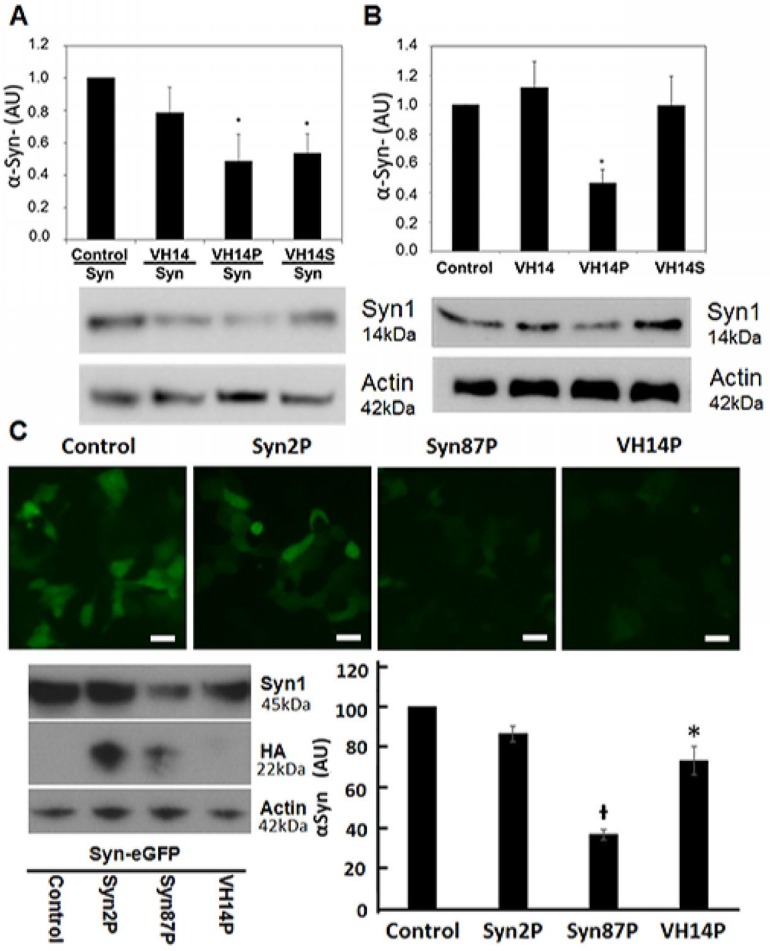
Fig 1
Fig 1. Bifunctional nanobody-PEST reductions of α-Syn levels.
(A) Dual transfection of wild type α-Syn plus VH14 constructs in ST14A cells. VH14PEST (VH14P) and VH14 with a scrambled PEST degron (VH14S) significantly reduced (*p<0.05, n = 5) α-Syn based on Western blot densitometry of α-Syn compared with VH14 and empty vector control. (B) Endogenous α-Syn after transfection of VH14PEST constructs in SH-SY5Y cells. Western blot densitometry shows that α-Syn is significantly (*p<0.05, n = 4) reduced by VH14P compared with empty vector control, VH14 and VH14S control (C) Live cell imaging, Western blot, and densitometry for Syn with anti-Syn1. Syn87PEST (Syn87P) significantly reduced empty vector control Syn~GFP protein levels compared to VH14P and Syn2P (Mean ± SEM. *p<0.05 compared to Control and Syn87PEST; ᵻ p<0.05 compared to all groups; n = 3).
Fig 2
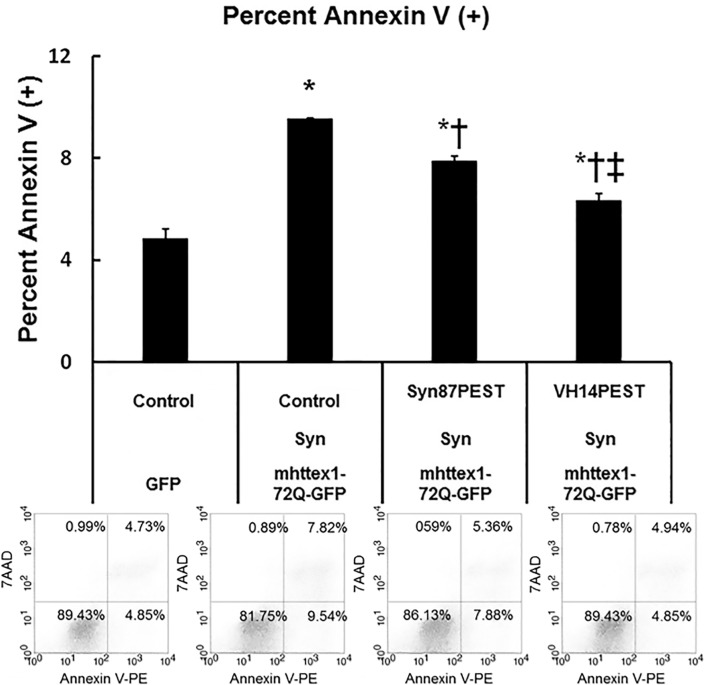
Fig 2. VH14PEST decreases the toxicity of α-Syn as measured by a proteostatic assay with mhttex1-72QGFP.
VH14PEST reduced toxicity induced by proteostatic stress of co-expressing mhttex1-72Q-GFP with WT α-Syn overexpression. Overexpression of empty vector control plus mhttex1-72Q-GFP and WT Syn significantly increased early apoptotic cell death compared to empty vector GFP control [Mean ± SEM. *p<0.05 significantly different from all groups; n = 3]. VH14PEST significantly (‡p<0.05) reduced the percentage of apoptotic cell death to a greater extent than Syn87PEST [Mean ± SEM. *p<0.05 compared to Empty Vector control GFP; ‡p<0.05 comparing VH14PEST vs. Syn87PEST; †p<0.05 comparing Syn87PEST vs empty vector control-Syn-mhttex1-72Q-GFP.]. Lower Panel: Representative scatter plots showing the percentage of cells in each quadrant.
Fig 3
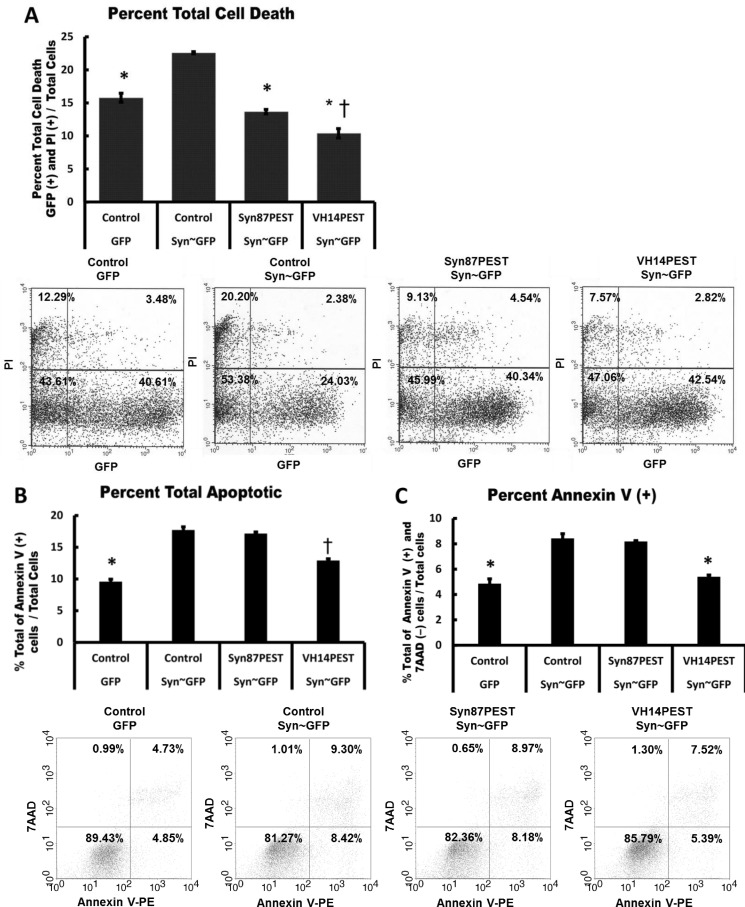
Fig 3. Overexpression of Syn87PEST and VH14PEST reduced total cell death to control levels in ST14A cells.
(A) VH14PEST reduced the percentage of total cell death to a greater extent than Syn87PEST. [Mean ± SEM. * p<0.05 compared to Syn-GFP; † p<0.05 compared to Syn87PEST; n = 3]. (B & C) Representative scatter plots showing the percentage of cells in each quadrant. Viable cells are annexin V (−) and 7-AAD (−); annexin V (+) and 7-AAD (−) cells are in early apoptosis; annexin V (+) and 7-AAD (+) cells are in late apoptosis; necrotic cells are annexin V (−) and 7-AAD (+). (B) The percent total of cells undergoing late apoptosis was significantly reduced by VH14PEST compared to empty vector control co-transfected GFP levels. (Mean ± SEM. *p<0.05 comparing control GFP, to other groups; ᵻ p<0.05 compared VH14PEST/SYNGFP to other groups; n = 3). (C) The percent Annexin V positive cells undergoing early apoptosis was significantly reduced to empty vector control co-transfected GFP levels. (Mean ± SEM. *p<0.05 comparing control GFP, VH14PEST Syn-GFP to other groups; n = 3).

References

    1. Hornykiewicz O. Biochemical aspects of Parkinson's disease. Neurology. 1998;51(2 Suppl 2):S2–9. . - PubMed
    1. Forno LS. Neuropathology of Parkinson's disease. Journal of neuropathology and experimental neurology. 1996;55(3):259–72. . - PubMed
    1. Mezey E, Dehejia AM, Harta G, Tresser N, Suchy SF, Nussbaum RL, et al. Alpha synuclein is present in Lewy bodies in sporadic Parkinson's disease. Molecular psychiatry. 1998;3(6):493–9. . - PubMed
    1. Spillantini MG, Schmidt ML, Lee VM, Trojanowski JQ, Jakes R, Goedert M. Alpha-synuclein in Lewy bodies. Nature. 1997;388(6645):839–40. 10.1038/42166 - DOI - PubMed
    1. Giasson BI, Murray IV, Trojanowski JQ, Lee VM. A hydrophobic stretch of 12 amino acid residues in the middle of alpha-synuclein is essential for filament assembly. The Journal of biological chemistry. 2001;276(4):2380–6. 10.1074/jbc.M008919200 - DOI - PubMed