


Epidemiology and outcome of Clostridium difficile infections in patients hospitalized in Internal Medicine: findings from the nationwide FADOI-PRACTICE study
- PMID: 27825317
- PMCID: PMC5101712
- DOI: 10.1186/s12879-016-1961-9
Epidemiology and outcome of Clostridium difficile infections in patients hospitalized in Internal Medicine: findings from the nationwide FADOI-PRACTICE study
Abstract
Background: Clostridium difficile (CD) is a leading cause of diarrhoea among hospitalized patients. The objective of this study was to evaluate the rate, the optimal diagnostic work-up, and outcome of CD infections (CDI) in Internal Medicine (IM) wards in Italy.
Methods: PRACTICE is an observational prospective study, involving 40 IM Units and evaluating all consecutive patients hospitalized during a 4-month period. CDI were defined in case of diarrhoea when both enzyme immunoassay for GDH, and test for A/B toxin were positive. Patients with CDI were followed-up for recurrences for 4 weeks after the end of therapy.
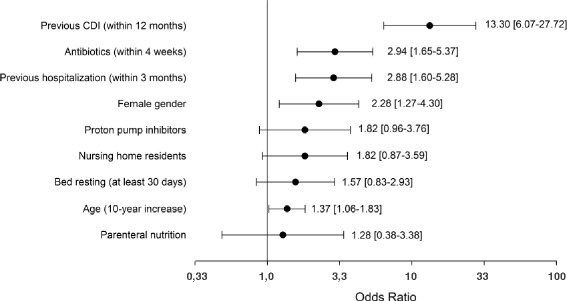
Results: Among the 10,780 patients observed, 103 (0.96 %) showed CDI, at admission or during hospitalization. A positive history for CD, antibiotics in the previous 4 weeks, recent hospitalization, female gender and age were significantly associated with CDI (multivariable analysis). In-hospital mortality was 16.5 % in CD group vs 6.7 % in No-CD group (p < 0.001), whereas median length of hospital stay was 16 (IQR = 13) vs 8 (IQR = 8) days (p < 0.001) among patients with or without CDI, respectively. Rate of CD recurrences was 14.6 %. As a post-hoc evaluation, 23 out of 34 GDH+/Tox- samples were toxin positive, when analysed by molecular method (a real-time PCR assay). The overall CD incidence rate was 5.3/10,000 patient-days.
Conclusions: Our results confirm the severity of CDI in medical wards, showing high in-hospital mortality, prolonged hospitalization and frequent short-term recurrences. Further, our survey supports a 2-3 step algorithm for CD diagnosis: EIA for detecting GDH, A and B toxin, followed by a molecular method in case of toxin-negative samples.
Keywords: Clostridium difficile; Incidence; Internal Medicine; Outcome; Predictors.
Figures


References
-
- Debast SB, Bauer MP, Kuijper EJ, for the Committee of the European Society of Clinical Microbiological and Infectious Diseases European Society of Clinical Microbiological and Infectious Diseases: update of the treatment guidance document for Clostridium difficile infection. Clin Microbiol Infect. 2014;20(Suppl.2):1–26. doi: 10.1111/1469-0691.12418. - DOI - PubMed
Publication types
MeSH terms
Substances
LinkOut - more resources
Full Text Sources
Other Literature Sources
Research Materials
