


Why Harmless Sensations Might Hurt in Individuals with Chronic Pain: About Heightened Prediction and Perception of Pain in the Mind
- PMID: 27826271
- PMCID: PMC5078757
- DOI: 10.3389/fpsyg.2016.01638
Why Harmless Sensations Might Hurt in Individuals with Chronic Pain: About Heightened Prediction and Perception of Pain in the Mind
Abstract
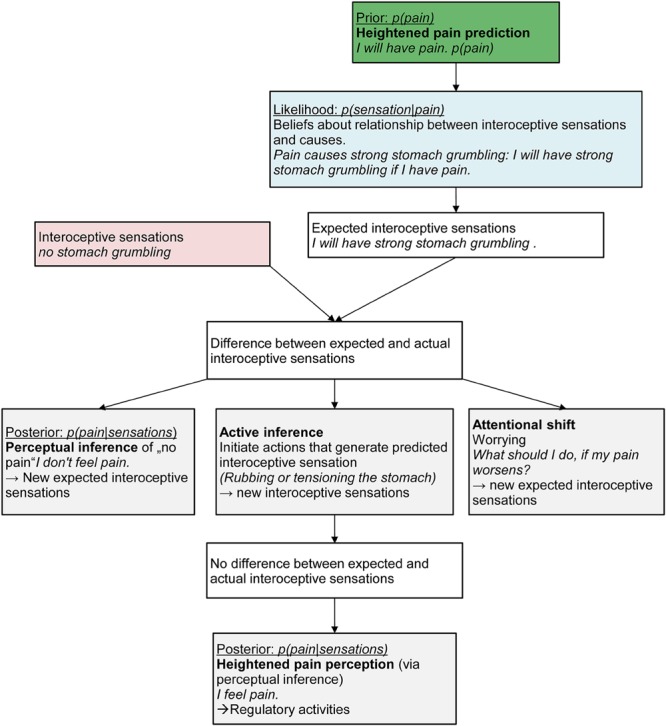
In individuals with chronic pain harmless bodily sensations can elicit anticipatory fear of pain resulting in maladaptive responses such as taking pain medication. Here, we aim to broaden the perspective taking into account recent evidence that suggests that interoceptive perception is largely a construction of beliefs, which are based on past experience and that are kept in check by the actual state of the body. Taking a Bayesian perspective, we propose that individuals with chronic pain display a heightened prediction of pain [prior probability p(pain)], which results in heightened pain perception [posterior probability p(pain|sensation)] due to an assumed link between pain and a harmless bodily sensation [p(sensation|pain)]. This pain perception emerges because their mind infers pain as the most likely cause for the sensation. When confronted with a mismatch between predicted pain and a (harmless bodily) sensation, individuals with chronic pain try to minimize the mismatch most likely by active inference of pain or alternatively by an attentional shift away from the sensation. The active inference results in activities that produce a stronger sensation that will match with the prediction, allowing subsequent perceptual inference of pain. Here, we depict heightened pain perception in individuals with chronic pain by reformulating and extending the assumptions of the interoceptive predictive coding model from a Bayesian perspective. The review concludes with a research agenda and clinical considerations.
Keywords: Bayes theorem; active inference; chronic pain; interoception; interoceptive predictive coding; pain perception.
Figures
References
-
- Borkovec T. D., Alcaine O., Behar E. (2004). “Avoidance theory of worry and generalized anxiety disorder,” in Generalized Anxiety Disorder: Advances in Research and Practice eds Heimberg R., Mennin D., Turk C. (New York, NY: Guilford; ) 77–108.
LinkOut - more resources
Full Text Sources
Other Literature Sources
Miscellaneous
