. 2016 Nov 8:8:51.
doi: 10.1186/s13099-016-0136-y. eCollection 2016.

Modeling human enteric dysbiosis and rotavirus immunity in gnotobiotic pigs

Affiliations

Modeling human enteric dysbiosis and rotavirus immunity in gnotobiotic pigs

Erica L Twitchell et al. Gut Pathog. .

Abstract

Background: Rotavirus vaccines have poor efficacy in infants from low- and middle-income countries. Gut microbiota is thought to influence the immune response to oral vaccines. Thus, we developed a gnotobiotic (Gn) pig model of enteric dysbiosis to study the effects of human gut microbiota (HGM) on immune responses to rotavirus vaccination, and the effects of rotavirus challenge on the HGM by colonizing Gn pigs with healthy HGM (HHGM) or unhealthy HGM (UHGM). The UHGM was from a Nicaraguan infant with a high enteropathy score (ES) and no seroconversion following administration of oral rotavirus vaccine, while the converse was characteristic of the HHGM. Pigs were vaccinated, a subset was challenged, and immune responses and gut microbiota were evaluated.

Results: Significantly more rotavirus-specific IFN-γ producing T cells were in the ileum, spleen, and blood of HHGM than those in UHGM pigs after three vaccine doses, suggesting HHGM induces stronger cell-mediated immunity than UHGM. There were significant correlations between multiple Operational Taxonomic Units (OTUs) and frequencies of IFN-γ producing T cells at the time of challenge. There were significant positive correlations between Collinsella and CD8+ T cells in blood and ileum, as well as CD4+ T cells in blood, whereas significant negative correlations between Clostridium and Anaerococcus, and ileal CD8+ and CD4+ T cells. Differences in alpha diversity and relative abundances of OTUs were detected between the groups both before and after rotavirus challenge.

Conclusion: Alterations in microbiome diversity and composition along with correlations between certain microbial taxa and T cell responses warrant further investigation into the role of the gut microbiota and certain microbial species on enteric immunity. Our results support the use of HGM transplanted Gn pigs as a model of human dysbiosis during enteric infection, and oral vaccine responses.

Keywords: Enteric dysbiosis; Enteric immunity; Gnotobiotic pig; Rotavirus; Vaccine.


Figures
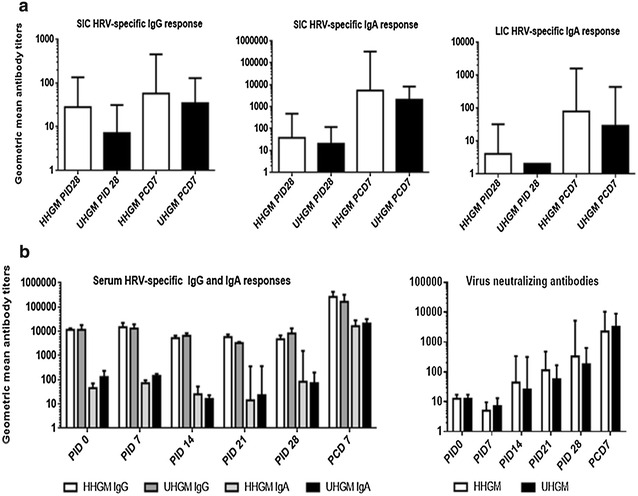
Fig. 1
Fig. 1
Rotavirus-specific antibody responses. Rotavirus-specific IgG and IgA antibody responses in small and large intestinal contents (a) and IgG, IgA and virus neutralizing antibody response in serum (b). Error bars are represented as standard error of mean. Kruskal–Wallis rank sum test was used for comparisons. There are no significant differences between the groups. SIC small intestinal contents; LIC large intestinal contents; PID post-inoculation day; PCD post-challenge day
Fig. 2
Fig. 2
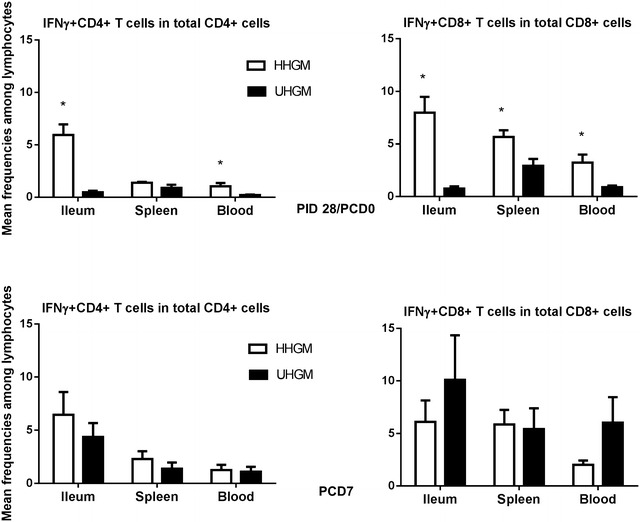
Frequencies of IFN-γ producing CD8+ and CD4+ T cells. Frequencies of IFN-γ producing CD8+ and CD4+ T cells among total CD3+CD8+ and CD3+CD4+ cells on PID28/PCD0 (upper panel) and PCD7 (lower panel) in ileum, spleen and blood of HHGM verses UHGM colonized pigs. Error bars indicate standard errors of the mean. Asterisks indicate significant differences when compared to PM25 pigs (Kruskal–Wallis rank sum test, p < 0.05; n = 5–7)
Fig. 3
Fig. 3
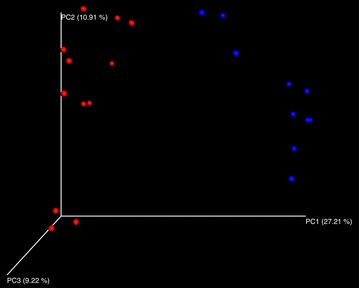
PCoA plot of the microbial communities in the large intestinal contents of Gn pigs. Communities were plotted based on unweighted UniFrac. Blue dots represent HHGM and red dots represent UHGM
Fig. 4
Fig. 4
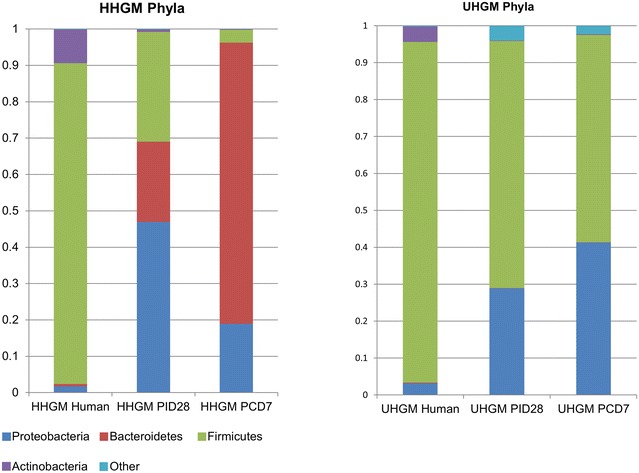
Mean relative abundance of phyla in the microbial community of large intestinal contents. Mean relative abundance of phyla in the microbial community of large intestinal contents of HGM-colonized Gn pigs before HRV challenge (PID28/PCD0) and postchallenge (PCD7) compared to infant HGM. Numbers represent the single stool sample from infant HGM and averages for the pig groups (n = 5–6)
Fig. 5
Fig. 5
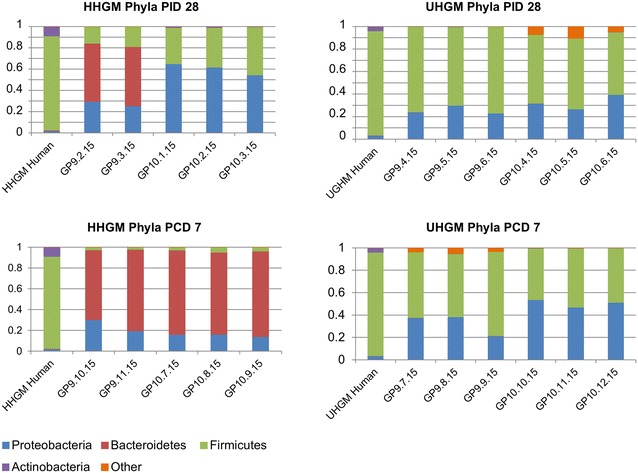
Relative abundance of phyla in the microbial community of large intestinal contents of individual pigs. Relative abundance of phyla in the microbial community of large intestinal contents of individual HGM-colonized Gn pigs before VirHRV challenge (PID28/PCD0) and postchallenge (PCD7). The HHGM human sample is included for reference in each panel. HHGM human is the sample from child SV14 and UHGM human is the sample from child PM25
Fig. 6
Fig. 6
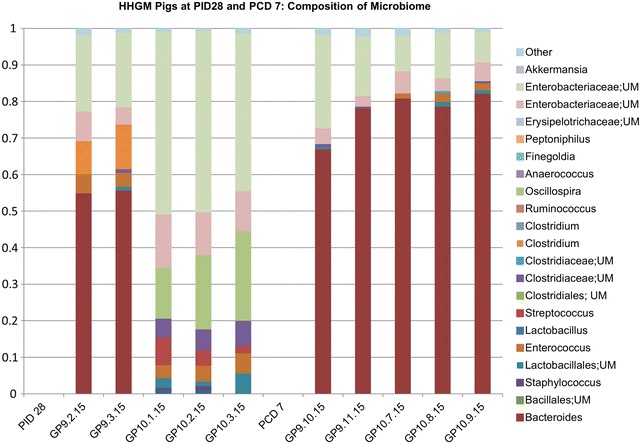
Relative abundance of specified bacterial taxa in the microbial community of large intestinal contents in HHGM pigs. Relative abundance of order, family, or genera of bacteria in the large intestinal contents at specified time points in HHGM pigs. Bars to the right of PID 28 are pigs euthanized on PID 28. Bars to the right of PCD 7 are pigs euthanized on PCD 7
Fig. 7
Fig. 7
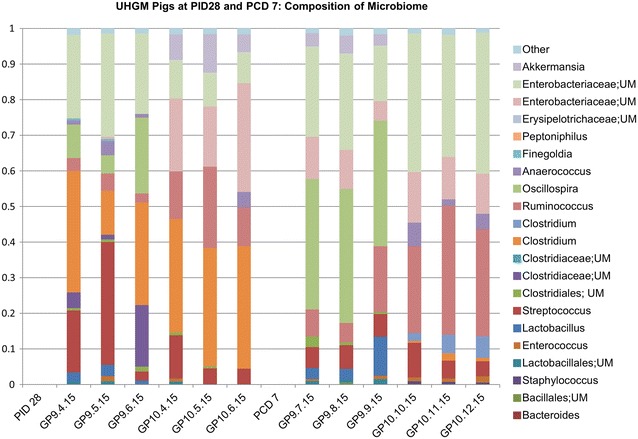
Relative abundance of specified bacterial taxa in the microbial community of large intestinal contents in UHGM pigs. Relative abundance of order, family, or genera of bacteria in the large intestinal contents at specified time points in UHGM pigs. Bars to the right of PID 28 are pigs euthanized on PID 28. Bars to the right of PCD 7 are pigs euthanized on PCD 7
Fig. 8
Fig. 8
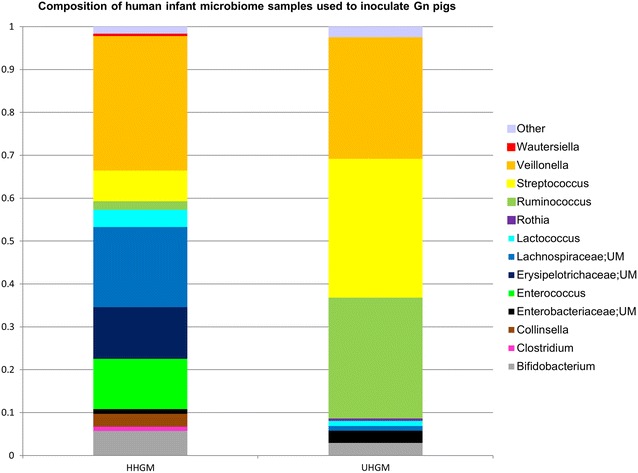
Composition of human infant microbiome samples used to inoculate Gn pigs. UM indicates unclassified member. Relative abundance is on the y-axis

References

    1. Rotavirus vaccines. WHO position paper—January 2013. Wkly Epidemiol Rec. 2013, 88(5):49–64. - PubMed
    1. Tate JE, Burton AH, Boschi-Pinto C, Steele AD, Duque J, Parashar UD. Network WH-cGRS: 2008 estimate of worldwide rotavirus-associated mortality in children younger than 5 years before the introduction of universal rotavirus vaccination programmes: a systematic review and meta-analysis. Lancet Infect Dis. 2012;12(2):136–141. doi: 10.1016/S1473-3099(11)70253-5. - DOI - PubMed
    1. Gilmartin AA, Petri WA., Jr Exploring the role of environmental enteropathy in malnutrition, infant development and oral vaccine response. Philos Trans R Soc Lond B Biol Sci. 2015;370(1671):20140143. doi: 10.1098/rstb.2014.0143. - DOI - PMC - PubMed
    1. Valdez Y, Brown EM, Finlay BB. Influence of the microbiota on vaccine effectiveness. Trends Immunol. 2014;35(11):526–537. doi: 10.1016/j.it.2014.07.003. - DOI - PubMed
    1. Armah GE, Sow SO, Breiman RF, Dallas MJ, Tapia MD, Feikin DR, Binka FN, Steele AD, Laserson KF, Ansah NA, et al. Efficacy of pentavalent rotavirus vaccine against severe rotavirus gastroenteritis in infants in developing countries in sub-Saharan Africa: a randomised, double-blind, placebo-controlled trial. Lancet. 2010;376(9741):606–614. doi: 10.1016/S0140-6736(10)60889-6. - DOI - PubMed

LinkOut - more resources