


Surgical management of breast cancer in China: A 15-year single-center retrospective study of 18,502 patients
- PMID: 27828839
- PMCID: PMC5106045
- DOI: 10.1097/MD.0000000000004201
Surgical management of breast cancer in China: A 15-year single-center retrospective study of 18,502 patients
Abstract
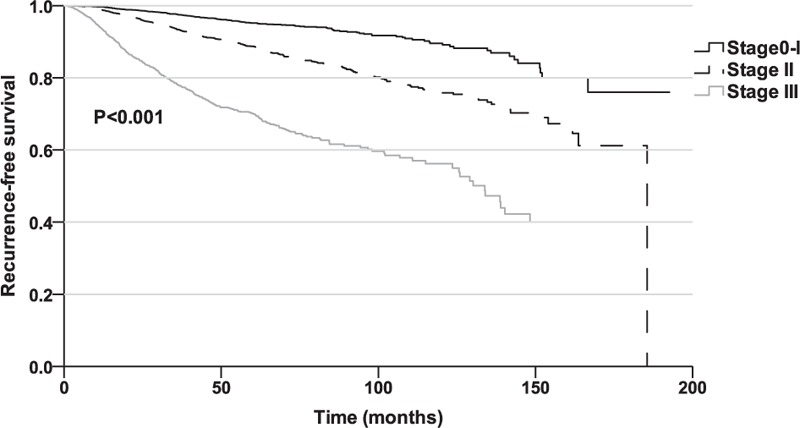
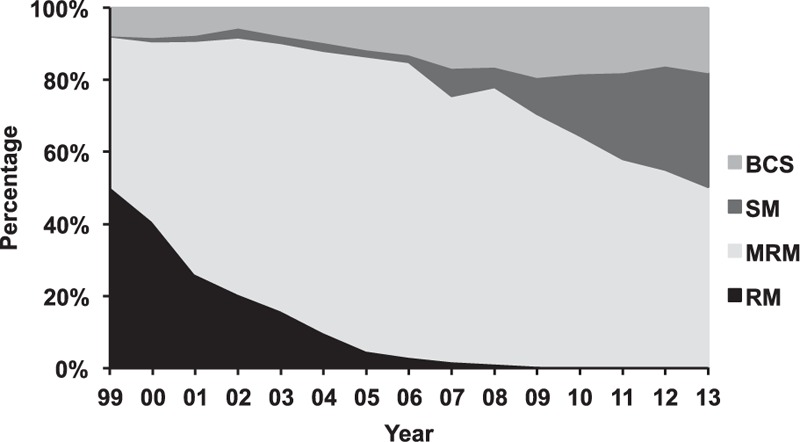
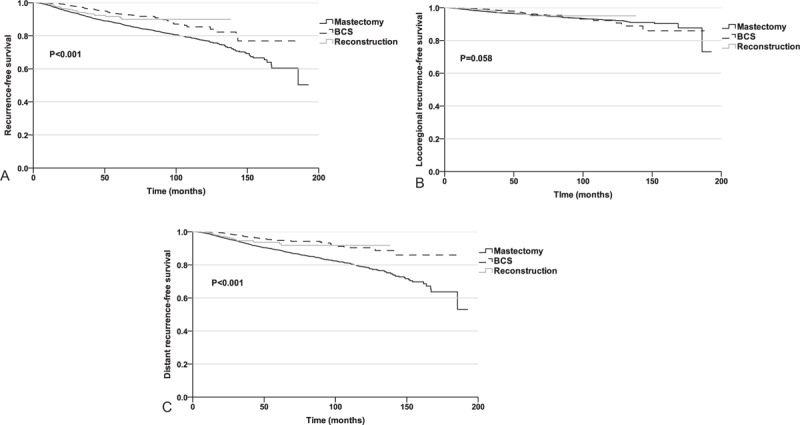
The aim of the study was to review the surgical trends in breast cancer treatment in China over the past 15 years and to explore the possible factors related to the choice of surgical modality.The medical records of 18,502 patients with unilateral early stage breast cancer who underwent surgery from January 1999 to December 2013 at our institute were retrospectively reviewed. The utilization of different surgical modalities and the associated clinicopathological factors were analyzed. Furthermore, the prognostic role of surgical modality was also evaluated.The median patient age was 50.0 years. According to the pTNM staging system, 12.5% of the patients were classified as stage 0; 30.2% as stage I; 40.0% as stage II; and 17.3% as stage III. In total, 9.3% of the patients could not be staged. Overall, 67.1% of the breast cancer cases were estrogen receptor (ER) positive. The pattern of breast cancer surgery has changed tremendously over the past 15 years (P < 0.001). The pattern of mastectomy has shifted from radical mastectomy to modified radical mastectomy and simple mastectomy + sentinel lymph node biopsy. A total of 81.7% of the patients underwent mastectomy without immediate reconstruction, 15.2% underwent breast-conserving surgery (BCS), and 3.7% received immediate breast reconstruction after mastectomy. Age, TNM staging, and pathological characteristics greatly affected the choice of surgical modality. The 5-year recurrence-free survival (RFS) rates for the mastectomy, BCS, and reconstruction groups were 87.6%, 93.2%, and 91.7%, respectively (P < 0.001); the RFS rate was likely affected by distant recurrence instead of loco-regional recurrence. We also identified improved RFS over time, stratified by surgical modality and tumor stage. Multivariate Cox-regression analysis revealed that time of treatment, tumor stage, tumor grade, LVI status, and ER status were independent prognostic factors for RFS in our cohort, whereas surgical modality was not.Mastectomy remains the most prevalent surgical modality used to manage early stage breast cancer in China, although the utilization of BCS has increased in the past decade. However, surgical management was not a prognostic factor for RFS. The selection of appropriate patients depended on the assessment of multiple clinicopathological factors, which is essential for making surgical decisions.
Conflict of interest statement
The authors have no funding and conflicts of interest to disclose.
Figures
References
-
- Ferlay J, Shin HR, Bray F, et al. Estimates of worldwide burden of cancer in 2008: GLOBOCAN 2008. Int J Cancer 2010; 127:2893–2917. - PubMed
-
- Veronesi U, Cascinelli N, Mariani L, et al. Twenty-year follow-up of a randomized study comparing breast-conserving surgery with radical mastectomy for early breast cancer. N Engl J Med 2002; 347:1227–1232. - PubMed
-
- Bouganim N, Tsvetkova E, Clemons M, et al. Evolution of sites of recurrence after early breast cancer over the last 20 years: implications for patient care and future research. Breast Cancer Res Treat 2013; 139:603–606. - PubMed
-
- McGuire KP, Santillan AA, Kaur P, et al. Are mastectomies on the rise? A 13-year trend analysis of the selection of mastectomy versus breast conservation therapy in 5865 patients. Ann Surg Oncol 2009; 16:2682–2690. - PubMed
MeSH terms
LinkOut - more resources
Full Text Sources
Other Literature Sources
Medical
Miscellaneous
