. 2016 Nov 9;11(11):e0166187.
doi: 10.1371/journal.pone.0166187. eCollection 2016.

Early and Non-Invasive Detection of Chronic Wasting Disease Prions in Elk Feces by Real-Time Quaking Induced Conversion

Affiliations

Early and Non-Invasive Detection of Chronic Wasting Disease Prions in Elk Feces by Real-Time Quaking Induced Conversion

Yo Ching Cheng et al. PLoS One. .

Abstract

Chronic wasting disease (CWD) is a fatal prion disease of wild and captive cervids in North America. Prions are infectious agents composed of a misfolded version of a host-encoded protein, termed PrPSc. Infected cervids excrete and secrete prions, contributing to lateral transmission. Geographical distribution is expanding and case numbers in wild cervids are increasing. Recently, the first European cases of CWD have been reported in a wild reindeer and two moose from Norway. Therefore, methods to detect the infection early in the incubation time using easily available samples are desirable to facilitate effective disease management. We have adapted the real-time quaking induced conversion (RT-QuIC) assay, a sensitive in vitro prion amplification method, for pre-clinical detection of prion seeding activity in elk feces. Testing fecal samples from orally inoculated elk taken at various time points post infection revealed early shedding and detectable prion seeding activity throughout the disease course. Early shedding was also found in two elk encoding a PrP genotype associated with reduced susceptibility for CWD. In summary, we suggest that detection of CWD prions in feces by RT-QuIC may become a useful tool to support CWD surveillance in wild and captive cervids. The finding of early shedding independent of the elk's prion protein genotype raises the question whether prolonged survival is beneficial, considering accumulation of environmental prions and its contribution to CWD transmission upon extended duration of shedding.


Conflict of interest statement

The authors have declared that no competing interests exist.

Figures
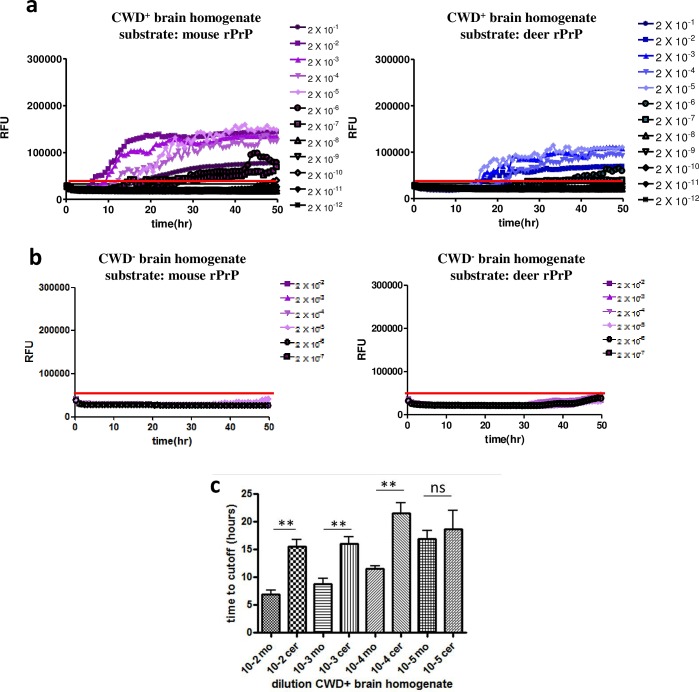
Fig 1
Fig 1. Mouse rPrP is a more efficient substrate for amplification of CWD seeding activity.
Serial dilutions of CWD-positive (a) or negative (b) elk brain homogenates were used as seeds for RT-QuIC reactions. As a substrate, either mouse (left panel) or deer rPrP (right panel) were used. Y-axes indicate the relative ThT fluorescence units, x-axes show the reaction time. A threshold to determine positive reactions was calculated by using the average baseline fluorescence plus 5 standard deviations, which is indicated as a solid line at app. 50,000 RFU. (c) The time to reach the threshold (y-axis) was determined for each individual reaction. Dilutions of 2x10⁻² to 2x10⁻⁵ of reactions with either mouse or deer rPrP were included, and the averages of the time to reach the threshold are shown. Bars represent standard deviations. For each dilution mouse and deer rPrP were compared and the difference between the two groups was statistically evaluated using unpaired student’s t-test (GraphPad Prism software; ** = p-value < 0.01; ns = not significant).
Fig 2
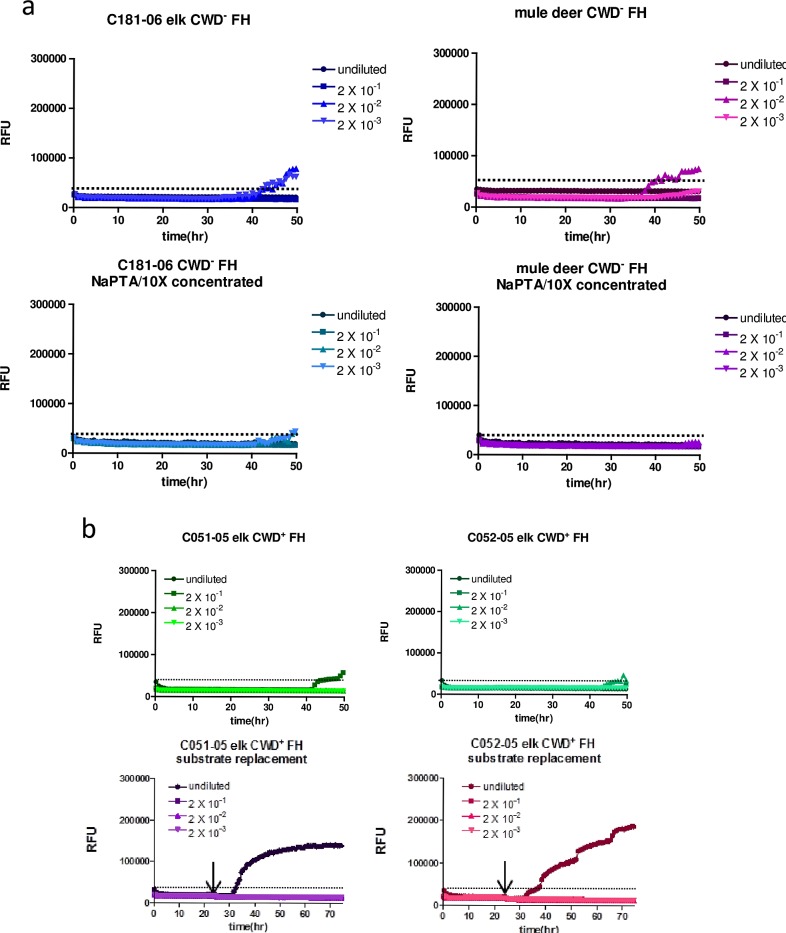
Fig 2. NaPTA precipitation and substrate replacement enable detection of CWD seeding activity in feces.
(a) Fecal homogenates (10% w/v) of non-infected elk or mule deer were subjected to NaPTA precipitation and 10fold concentration (lower panel) or not (upper panel). These samples were either used undiluted or in dilutions as indicated for seeding RT-QuIC reactions with mouse rPrP as a substrate. The y-axes show relative ThT fluorescence units, the x-axes depict the reaction time. (b) Fecal homogenates of two individual elk which were orally infected with CWD were subjected to NaPTA precipitation and 10fold concentration. RT-QuIC reactions with mouse rPrP as a substrate were run for 50 hours (upper panel), or for 75 hours (lower panel). For the latter, the reaction was stopped after 25 hours, and 90% of the reaction volume was removed and replaced by freshly prepared RT-QuIC mix containing rPrP substrate and ThT. Then the RT-QuIC assay was continued.
Fig 3
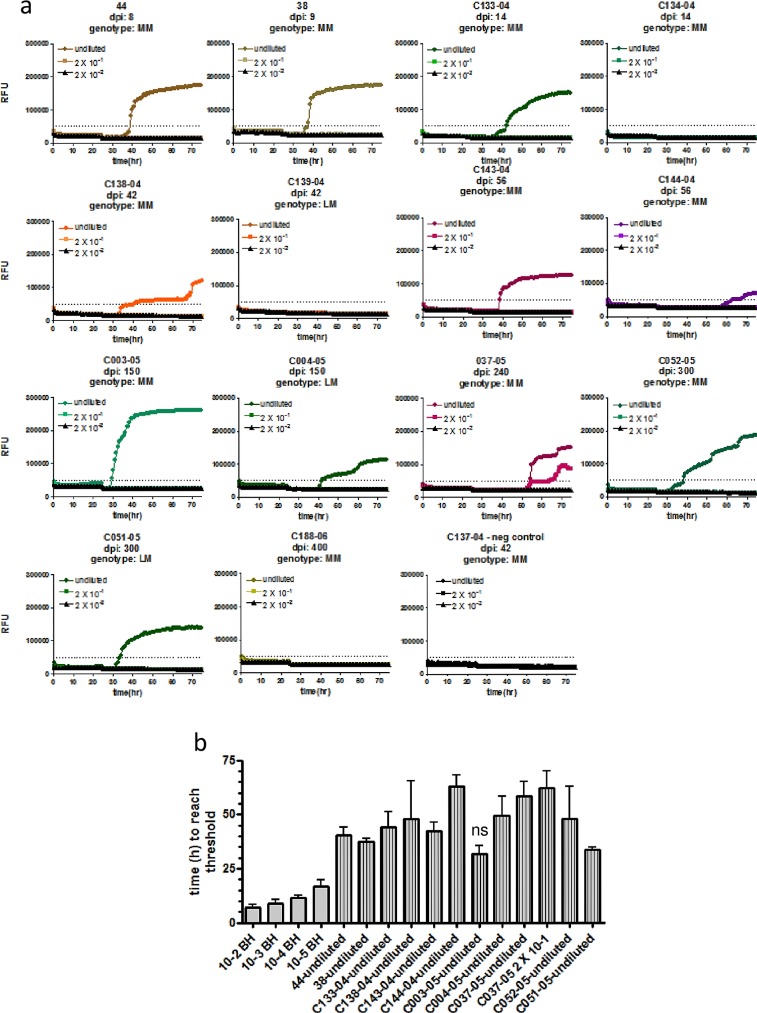
Fig 3. CWD seeding activity is detectable in fecal samples of elk at the pre-clinical stage of disease.
(a) Fecal homogenates (10% w/v) of elk orally infected with CWD prions and taken after different time points post infection (dpi) were subjected to NaPTA precipitation and 10fold concentration. These samples were either used undiluted or in two serial dilutions as indicated to seed RT-QuIC reactions with mouse rPrP as a substrate. Substrate replacement was done after a reaction time of 25 hours. The Prnp genotype is indicated, with MM animals being homozygous for methionine at amino acid 132, LM indicates heterozygosity for methionine/leucine. (b) The time to reach the threshold (lag time) was determined for each positive sample and dilutions of 2x10⁻² to 2x10⁻⁵ of the CWD-positive elk brain homogenate. Averages of 4 replicates are shown, bars represent the standard deviation. Statistical analysis was done using ANOVA and post-hoc analysis by Dunnett’s Multiple Comparison Test (ns: p-value > 0.05; GraphPad Prism software).
Fig 4
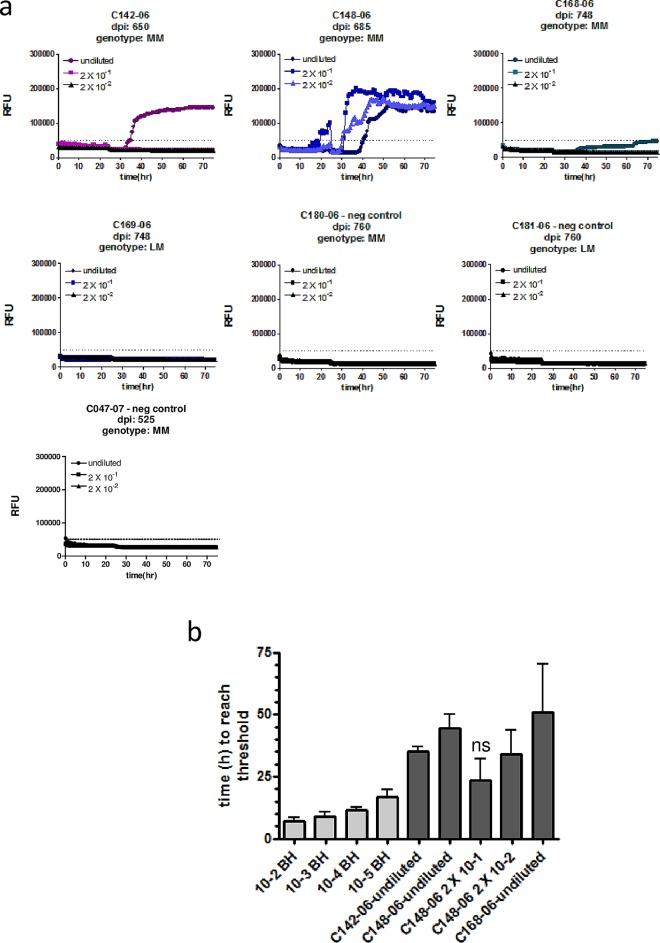
Fig 4. CWD seeding activity is detectable in fecal samples of elk at the clinical stage of disease.
(a) Fecal homogenates (10% w/v) of elk orally infected with CWD prions and taken after different time points post infection (dpi) were subjected to NaPTA precipitation and 10fold concentration. These samples were either used undiluted or in two serial dilutions as indicated to seed RT-QuIC reactions with mouse rPrP as a substrate. Substrate replacement was done after a reaction time of 25 hours. The Prnp genotype is indicated, with MM animals being homozygous for methionine at amino acid 132, LM indicates heterozygosity for methionine/leucine. (b) The time to reach the threshold (lag time) was determined for each positive sample and dilutions of 2x10⁻² to 2x10⁻⁵ of the CWD-positive elk brain homogenate. Averages of 4 replicates are shown, bars represent the standard deviation. Statistical analysis was done using ANOVA and post-hoc analysis by Dunnett’s Multiple Comparison Test (ns: p-value > 0.05; GraphPad Prism software).
Fig 5
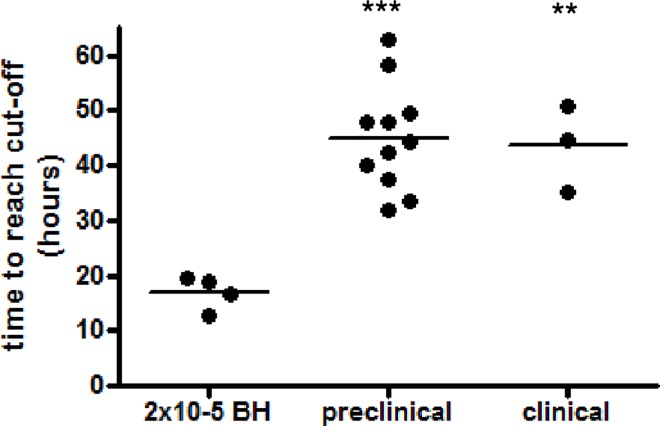
Fig 5. Significantly prolonged lag times in RT-QuIC positive feces from pre-clinical and clinical elk.
The average lag time of undiluted RT-QuIC positive samples from individual animals was compared to the lag time of a 2x10⁻⁵ dilution of CWD-positive brain homogenate. Statistical analysis was done using ANOVA and post-hoc analysis by Bonferroni Multiple Comparison Test (ns: p-value > 0.05; **: p-value <0.05; GraphPad Prism software).

References

    1. Gilch S, Chitoor N, Taguchi Y, Stuart M, Jewell JE, Schatzl HM. Chronic wasting disease. Top Curr Chem 2011;305:51–77. 10.1007/128_2011_159 - DOI - PubMed
    1. Williams ES, Miller MW. Chronic wasting disease in deer and elk in North America. Rev Sci Tech 2002. August;21(2):305–16. - PubMed
    1. Benestad SL, Mitchell G, Simmons M, Ytrehus B, Vikoren T. First case of chronic wasting disease in Europe in a Norwegian free-ranging reindeer. Vet Res 2016. September 15;47(1):88 10.1186/s13567-016-0375-4 - DOI - PMC - PubMed
    1. Prusiner SB. Novel proteinaceous infectious particles cause scrapie. Science 1982. April 9;216(4542):136–44. - PubMed
    1. Lansbury PT. Mechanism of scrapie replication. Science 1994. September 9;265(5178):1510. - PubMed