. 2016 Dec;28(14):658-669.
doi: 10.1080/08958378.2016.1246628. Epub 2016 Nov 10.

Development and characterization of electronic-cigarette exposure generation system (Ecig-EGS) for the physico-chemical and toxicological assessment of electronic cigarette emissions

Affiliations

Development and characterization of electronic-cigarette exposure generation system (Ecig-EGS) for the physico-chemical and toxicological assessment of electronic cigarette emissions

Jiayuan Zhao et al. Inhal Toxicol. 2016 Dec.

Abstract

Electronic cigarettes (e-cig) have been introduced as a nicotine replacement therapy and have gained increasing attention and popularity. However, while findings on possible toxicological implications continue to grow, major knowledge gaps on both the complex chemistry of the exposure and toxicity exist, prohibiting public health assessors from assessing risks. Here, a versatile electronic cigarette exposure generation system (Ecig-EGS) has been developed and characterized. Ecig-EGS allows generation of real world e-cig emission profiles under controlled operational conditions, real time monitoring and time-integrated particle/gas sampling for physico-chemical characterization, and toxicological assessment (both in vitro and in vivo). The platform is highly versatile and can be used with all e-cig types. It enables generation of precisely controlled e-cig exposure while critical operational parameters and environmental mixing conditions can be adjusted in a systematic manner to assess their impact on complex chemistry and toxicity of emissions. Results proved the versatility and reproducibility of Ecig-EGS. E-cig emission was found to contain 106-107 particles/cm3 with the mode diameter around 200 nm, under air change rate of 60/h. Elevated CO2 and volatile organic specie generation was also observed. Furthermore, environmental mixing conditions also influenced e-cig emission profile. The versatility of Ecig-EGS will enable linking of operational and environmental parameters with exposure chemistry and toxicology and help in assessing health risks.

Keywords: Electronic cigarette; exposure assessment; exposure platform; particulate matter; smoking; vaping.


Conflict of interest statement

Declaration of interest statement

The authors declare no conflicts of interest.

Figures
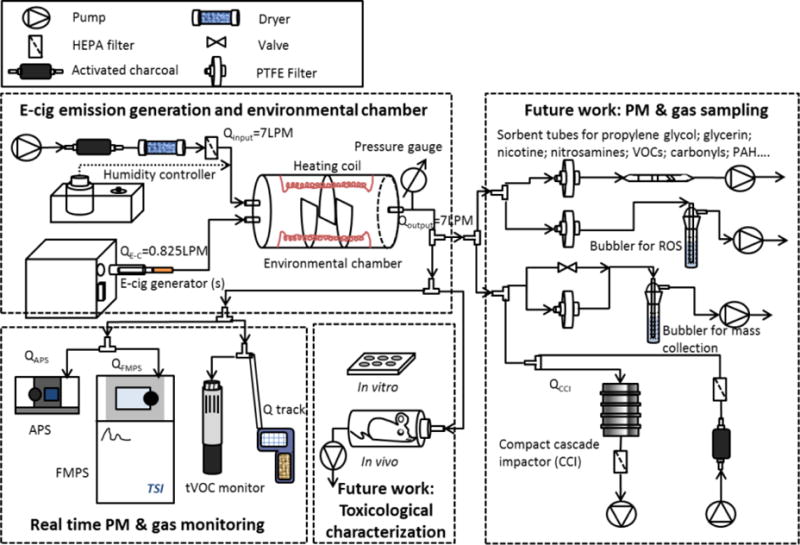
Figure 1
Figure 1
Electronic cigarette exposure generation system (Ecig-EGS).
Figure 2
Figure 2
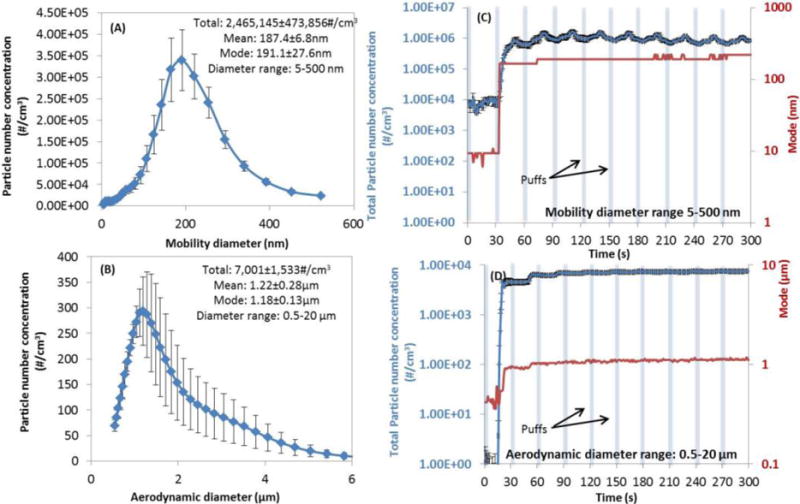
Reproducibility and stability of Ecig-EGS demonstrated by particle number concentration and mode. Reproducibility (data from four replicates on different days): (A) mobility diameter range of 5–500 nm; (B) aerodynamic diameter range of 0.5–20 μm; stability over first five minutes: (C) mobility diameter range of 5–500 nm; (D) aerodynamic diameter range of 0.5–20 μm. (Parameters: e-cig type: refillable APV with tobacco flavor; puffing protocol: MPP protocol; applied voltage: 3.7V; environmental condition: 24°C and 35%RH; chamber residence time: 60s).
Figure 3
Figure 3
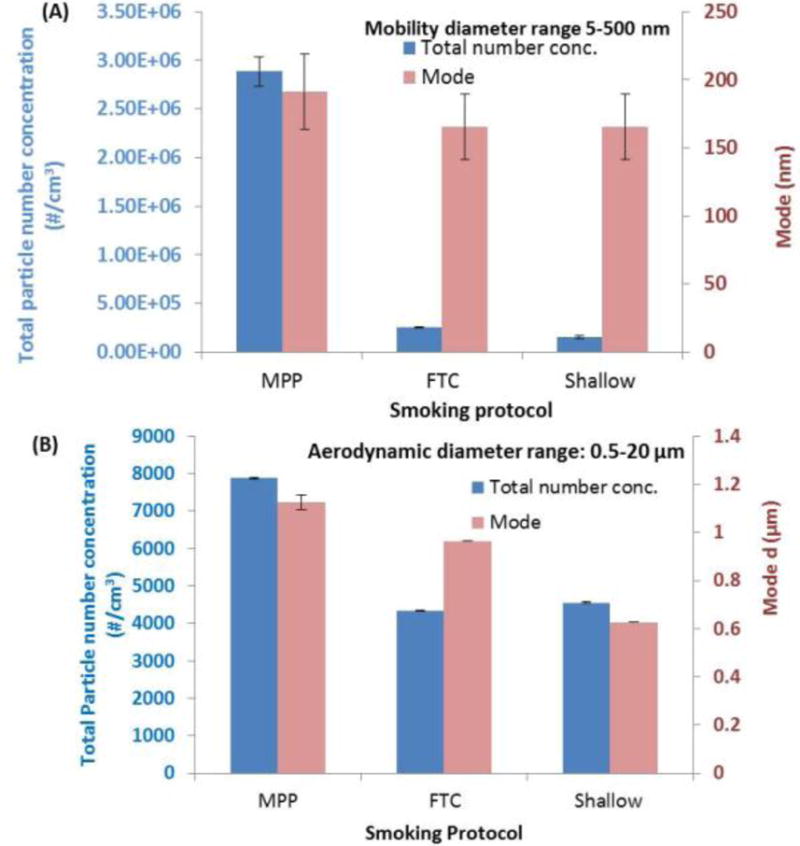
Total particle concentration and mode under three puffing protocols. MPP: Modified puffing protocol; puff volume 55ml, puff duration 4s, puff interval 30s. FTC: Federal Trade Commission protocol; puff volume 35ml, puff duration 2s, puff interval 60s. Shallow smoking protocol: puff volume 20ml, puff duration 1s, puff interval 10s. (A) mobility diameter range of 5–500 nm; (B) aerodynamic diameter range of 0.5–20 μm. (Other parameters: e-cig type: refillable APV with tobacco flavor; applied voltage: 3.7V; environmental condition: 24°C and 35%RH; chamber residence time: 60s).
Figure 4
Figure 4
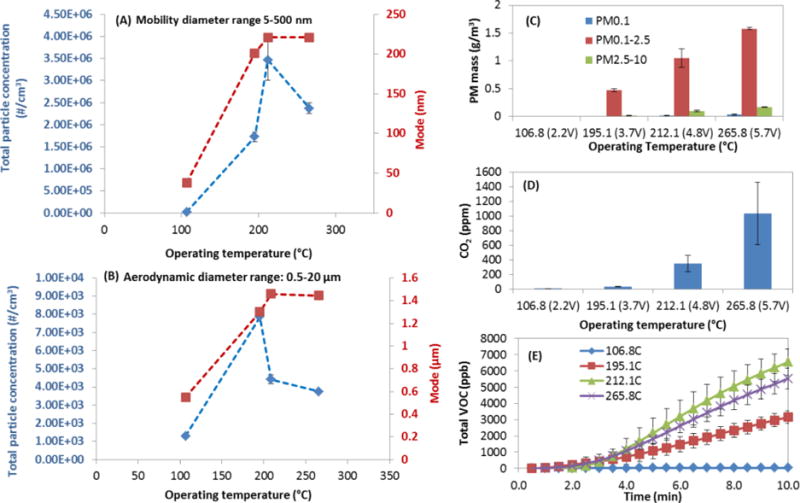
E-cig PM and gas generation under different operating temperatures (controlled by adjusting applied voltage). (A) particle number concentration and mode in mobility diameter range of 5–500 nm; (B) particle number concentration and mode in aerodynamic diameter range of 0.5–20 μm; (C) size-fractioned particle mass collection for 15 minutes by CCI; (D) CO2 generation monitored for 15 minutes by Qtrak; (E) total VOC monitored for 10 minutes by tVOC monitor. (Other parameters: e-cig type: refillable APV with tobacco flavor; puffing protocol: MPP protocol; environmental condition: 24°C and 35%RH; chamber residence time: 60s).
Figure 5
Figure 5
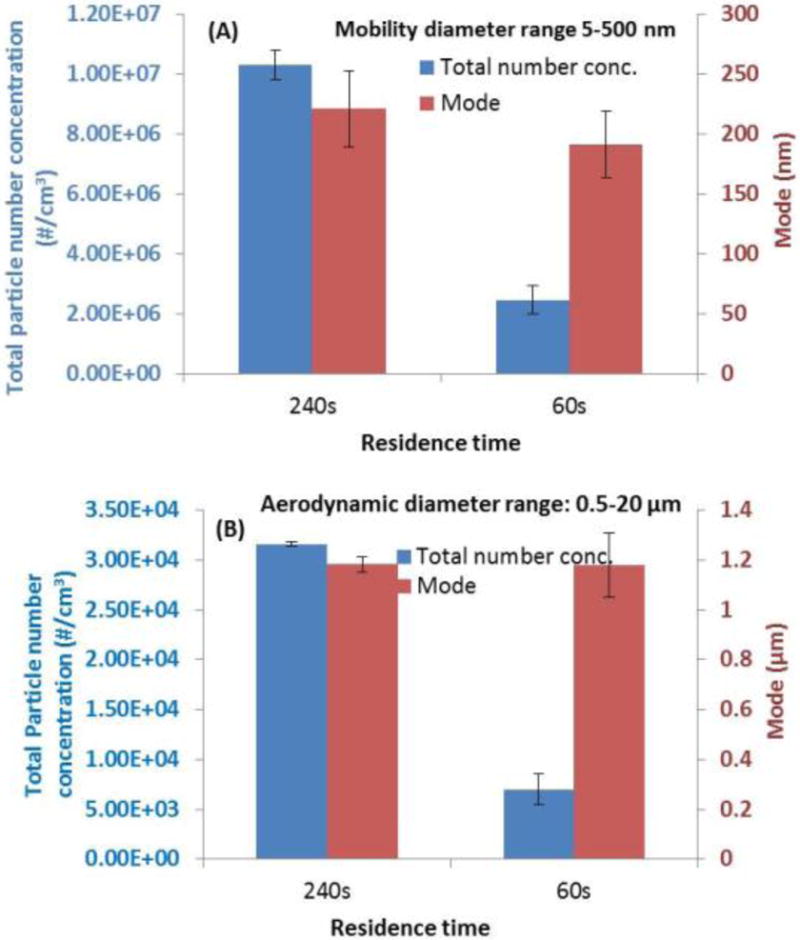
Total particle concentration and mode under two residence time/air exchange rates. Scenario 1: 240s residence time/air exchange rate 15/h; scenario 2: 60s residence time/air exchange rate 60/h. (A) mobility diameter range of 5–500 nm; (B) aerodynamic diameter range of 0.5–20 μm. (Other parameters: e-cig type: refillable APV with tobacco flavor; puffing protocol: MPP protocol; applied voltage: 3.7V; environmental condition: 24°C and 35%RH).
Figure 6
Figure 6
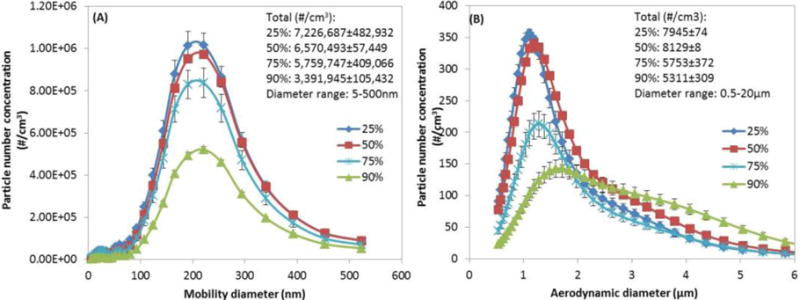
Particle number concentration generated at 37°C and four relative humidity. (A) mobility diameter range of 5–500 nm; (B) aerodynamic diameter range of 0.5–20 μm. (Other parameters: e-cig type: refillable APV with tobacco flavor; puffing protocol: MPP protocol; applied voltage: 3.7V; chamber residence time: 60s).

References

    1. Allen JG, Flanigan SS, Leblanc M, et al. Flavoring chemicals in E-cigarettes: diacetyl, 2,3-pentanedione, and acetoin in a sample of 51 products, including fruit-, candy-, and cocktail-flavored E-cigarettes. Env Heal Perspect. 2016;124:733–9. - PMC - PubMed
    1. American Society of Heating, Refrigerating and Air-Conditioning Engineers. ANSI/ASHRAE Standard 62-2001. Ventilation for Acceptable Indoor Air Quality 2003
    1. Behar RZ, Davis B, Wang Y, Bahl V, Lin S, Talbot P. Identification of toxicants in cinnamon-flavored electronic cigarette refill fluids. Toxicol Vitr [Internet] 2014;28:198–208. Available from: http://dx.doi.org/10.1016/j.tiv.2013.10.006. - DOI - PubMed
    1. Berg CJ, Haardoerfer R, Escoffery C, Zheng P, Kegler M. Cigarette users’ interest in using or switching to electronic nicotine delivery systems for smokeless tobacco for harm reduction, cessation, or novelty: A cross-sectional survey of US adults. Nicotine Tob Res. 2015;17:245–255. - PMC - PubMed
    1. Brobell D, Tröller S, Dziurowitz N, Plitzko S, Linsel G, Asbach C, Azong-Wara N, Fissan H, Schmidt-Ott A. A thermal precipitator for the deposition of airborne nanoparticles onto living cells-Rationale and development. J Aerosol Sci [Internet] 2013;63:75–86. Available from: http://dx.doi.org/10.1016/j.jaerosci.2013.04.012. - DOI

Publication types