


Mitotic entry: The interplay between Cdk1, Plk1 and Bora
- PMID: 27831827
- PMCID: PMC5176151
- DOI: 10.1080/15384101.2016.1249544
Mitotic entry: The interplay between Cdk1, Plk1 and Bora
Abstract
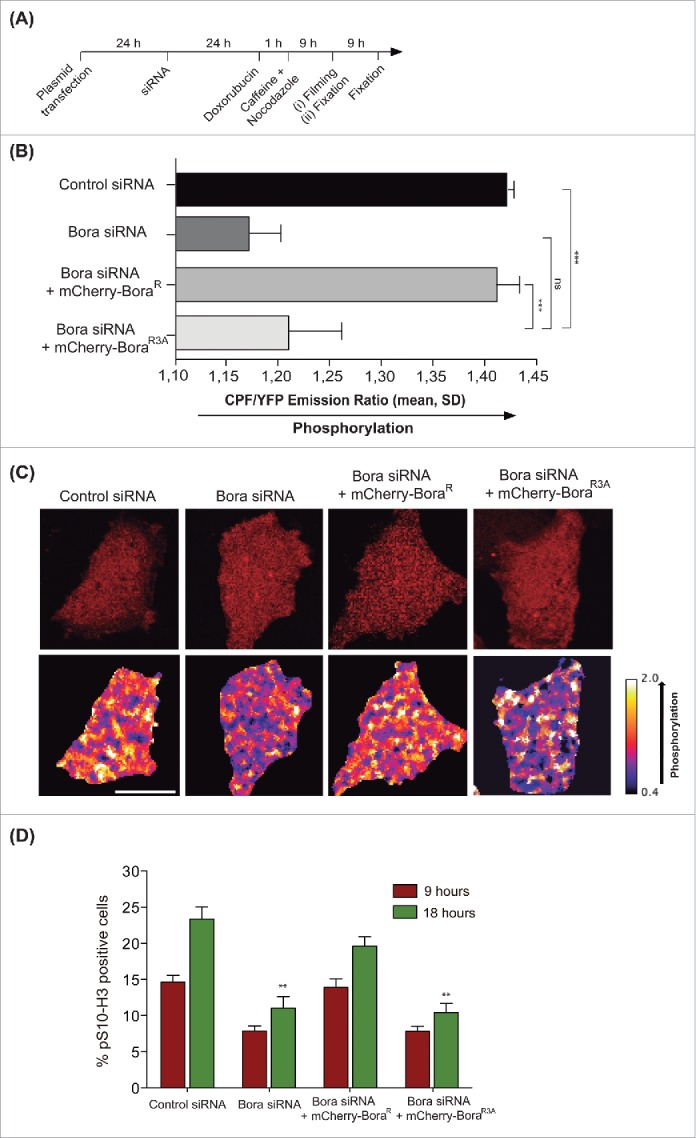
Polo-like kinase 1 (Plk1) is an important mitotic kinase that is crucial for entry into mitosis after recovery from DNA damage-induced cell cycle arrest. Plk1 activation is promoted by the conserved protein Bora (SPAT-1 in C. elegans), which stimulates the phosphorylation of a conserved residue in the activation loop by the Aurora A kinase. In a recent article published in Cell Reports, we show that the master mitotic kinase Cdk1 contributes to Plk1 activation through SPAT-1/Bora phosphorylation. We identified 3 conserved Sp/Tp residues that are located in the N-terminal, most conserved part, of SPAT-1/Bora. Phosphorylation of these sites by Cdk1 is essential for Plk1 function in mitotic entry in C. elegans embryos and during DNA damage checkpoint recovery in mammalian cells. Here, using an untargeted Förster Resonance Energy Transfer (FRET) biosensor to monitor Plk1 activation, we provide additional experimental evidence supporting the importance of these phosphorylation sites for Plk1 activation and subsequent mitotic entry after DNA damage. We also briefly discuss the mechanism of Plk1 activation and the potential role of Bora phosphorylation by Cdk1 in this process. As Plk1 is overexpressed in cancer cells and this correlates with poor prognosis, understanding how Bora contributes to Plk1 activation is paramount for the development of innovative therapeutical approaches.
Keywords: Bora; Cdk1; FRET; Plk1 activation.
Figures
References
-
- Sunkel CE, Glover DM. polo, a mitotic mutant of Drosophila displaying abnormal spindle poles. J Cell Sci 1988; 89:25-38; PMID:3417791 - PubMed
-
- Zitouni S, Nabais C, Jana SC, Guerrero A, Bettencourt-Dias M. Polo-like kinases: structural variations lead to multiple functions. Nat Rev Mol Cell Biol 2014; 15:433-52; PMID:24954208; http://dx.doi.org/10.1038/nrm3819 - DOI - PubMed
-
- Archambault V, Lépine G, Kachaner D. Understanding the Polo Kinase machine. Oncogene 2015; 34:4799-807; PMID:25619835; http://dx.doi.org/10.1038/onc.2014.451 - DOI - PubMed
-
- Mueller PR, Coleman TR, Kumagai A, Dunphy WG. Myt1: a membrane-associated inhibitory kinase that phosphorylates Cdc2 on both threonine-14 and tyrosine-15. Science 1995; 270:86-90; PMID:7569953; http://dx.doi.org/10.1126/science.270.5233.86 - DOI - PubMed
MeSH terms
Substances
LinkOut - more resources
Full Text Sources
Other Literature Sources
Research Materials
Miscellaneous
