


The Global Burden of Journal Peer Review in the Biomedical Literature: Strong Imbalance in the Collective Enterprise
- PMID: 27832157
- PMCID: PMC5104353
- DOI: 10.1371/journal.pone.0166387
The Global Burden of Journal Peer Review in the Biomedical Literature: Strong Imbalance in the Collective Enterprise
Abstract
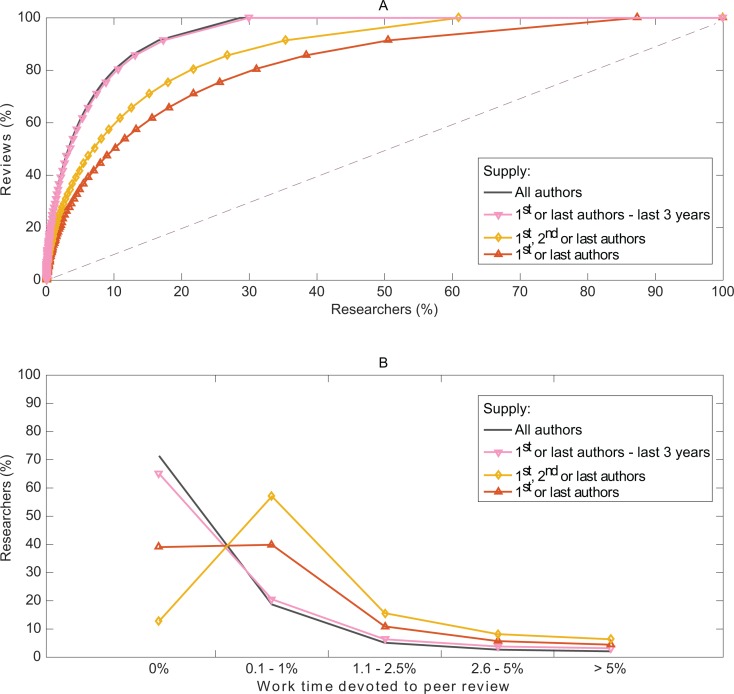
The growth in scientific production may threaten the capacity for the scientific community to handle the ever-increasing demand for peer review of scientific publications. There is little evidence regarding the sustainability of the peer-review system and how the scientific community copes with the burden it poses. We used mathematical modeling to estimate the overall quantitative annual demand for peer review and the supply in biomedical research. The modeling was informed by empirical data from various sources in the biomedical domain, including all articles indexed at MEDLINE. We found that for 2015, across a range of scenarios, the supply exceeded by 15% to 249% the demand for reviewers and reviews. However, 20% of the researchers performed 69% to 94% of the reviews. Among researchers actually contributing to peer review, 70% dedicated 1% or less of their research work-time to peer review while 5% dedicated 13% or more of it. An estimated 63.4 million hours were devoted to peer review in 2015, among which 18.9 million hours were provided by the top 5% contributing reviewers. Our results support that the system is sustainable in terms of volume but emphasizes a considerable imbalance in the distribution of the peer-review effort across the scientific community. Finally, various individual interactions between authors, editors and reviewers may reduce to some extent the number of reviewers who are available to editors at any point.
Conflict of interest statement
The authors have declared that no competing interests exist.
Figures
Comment in
-
Peer review: Award bonus points to motivate reviewers.Nature. 2017 Feb 22;542(7642):414. doi: 10.1038/542414d. Nature. 2017. PMID: 28230115 No abstract available.
References
-
- Lock S. A difficult balance: editorial peer review in medicine London: Nuffield Provincial Hospitals Trust; 1985.
-
- Godlee F, Jefferson T, Callaham M, Clarke J, Altman D, Bastian H, et al. Peer review in health sciences 2nd ed. London: BMJ books; 2003.
MeSH terms
LinkOut - more resources
Full Text Sources
Other Literature Sources
