


Inequality in the use of maternal and child health services in the Philippines: do pro-poor health policies result in more equitable use of services?
- PMID: 27832778
- PMCID: PMC5105289
- DOI: 10.1186/s12939-016-0473-y
Inequality in the use of maternal and child health services in the Philippines: do pro-poor health policies result in more equitable use of services?
Abstract
Background: The Philippines failed to achieve its Millennium Development Goal (MDG) commitment to reduce maternal deaths by three quarters. This, together with the recently launched Sustainable Development Goals (SDGs), reinforces the need for the country to keep up in improving reach of maternal and child health (MCH) services. Inequitable use of health services is a risk factor for the differences in health outcomes across socio-economic groups. This study aims to explore the extent of inequities in the use of MCH services in the Philippines after pro-poor national health policy reforms.
Methods: This paper uses data from the 2008 and 2013 Demographic and Health Survey (DHS) in the Philippines. Socio-economic inequality in MCH services use was measured using the concentration index. The concentration index was also decomposed in order to examine the contribution of different factors to the inequalities in the use of MCH services.
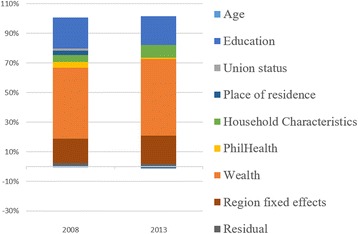
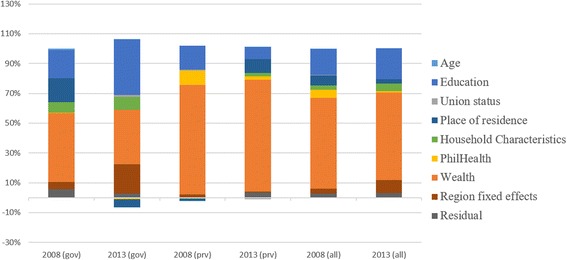
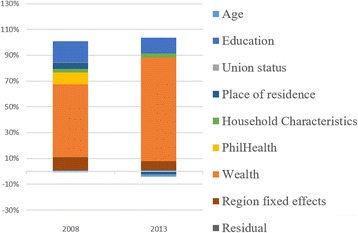
Results: In absolute figures, women who delivered in facilities increased from 2008 to 2013. Little change was noted for women who received complete antenatal care and caesarean births. Facility deliveries remain pro-rich although a pro-poor shift was noted. Women who received complete antenatal care services also remain concentrated to the rich. Further, there is a highly pro-rich inequality in caesarean deliveries which did not change much from 2008 to 2013. Household income remains as the most important contributor to the resulting inequalities in health services use, followed by maternal education. For complete antenatal care use and deliveries in government facilities, regional differences also showed to have important contribution.
Conclusion: The findings suggest inequality in the use of MCH services had limited pro-poor improvements. Household income remains to be the major driver of inequities in MCH services use in the Philippines. This is despite the recent national government-led subsidy for the health insurance of the poor. The highly pro-rich caesarean deliveries may also warrant the need for future studies to determine the prevalence of medically unindicated caesarean births among high-income women.
Trial registration: Not applicable.
Keywords: Concentration index; Inequality; Maternal and child health; Philippines.
Figures
Similar articles
-
Inequity of maternal-child health services in ASEAN member states from 1993 to 2021.Int J Equity Health. 2023 Aug 7;22(1):149. doi: 10.1186/s12939-023-01974-8. Int J Equity Health. 2023. PMID: 37550702 Free PMC article.
-
Towards an understanding of regional disparities in social inequities in maternal health in Malawi.Afr Health Sci. 2009 Dec;9(4):234-41. Afr Health Sci. 2009. PMID: 21503174 Free PMC article.
-
Impact of the community healthcare plan and the free maternity services programme on maternal and child healthcare utilisation in rural Kenya: a dairy farmer population-based study.Afr Health Sci. 2019 Sep;19(3):2600-2614. doi: 10.4314/ahs.v19i3.36. Afr Health Sci. 2019. PMID: 32127833 Free PMC article.
-
Effective nutrition education and communication for sustainable maternal and child health.Proc Nutr Soc. 2017 Nov;76(4):504-515. doi: 10.1017/S0029665117001070. Epub 2017 Jun 30. Proc Nutr Soc. 2017. PMID: 28662730 Review.
-
Equity in maternal, newborn, and child health interventions in Countdown to 2015: a retrospective review of survey data from 54 countries.Lancet. 2012 Mar 31;379(9822):1225-33. doi: 10.1016/S0140-6736(12)60113-5. Lancet. 2012. PMID: 22464386 Review.
Cited by
-
Addressing the huge poor-rich gap of inequalities in accessing safe childbirth care: A first step to achieving universal maternal health coverage in Tanzania.PLoS One. 2021 Feb 16;16(2):e0246995. doi: 10.1371/journal.pone.0246995. eCollection 2021. PLoS One. 2021. PMID: 33592017 Free PMC article.
-
Wealth-based equity in maternal, neonatal, and child health services utilization: a cross-sectional study from Ethiopia.Int J Equity Health. 2019 Dec 23;18(1):201. doi: 10.1186/s12939-019-1111-2. Int J Equity Health. 2019. PMID: 31870447 Free PMC article.
-
Financing for equity for women's, children's and adolescents' health in low- and middle-income countries: A scoping review.PLOS Glob Public Health. 2024 Sep 12;4(9):e0003573. doi: 10.1371/journal.pgph.0003573. eCollection 2024. PLOS Glob Public Health. 2024. PMID: 39264949 Free PMC article.
-
Socioeconomic inequality and determinants of postnatal home visits made by public health midwives: An analysis of the Sri Lanka Demographic and Health Survey.PLoS One. 2019 Apr 24;14(4):e0215816. doi: 10.1371/journal.pone.0215816. eCollection 2019. PLoS One. 2019. PMID: 31017956 Free PMC article.
-
Prevalence and determinants of home delivery in urban and rural Philippines: Evidence from the 2017 National Demographic and Health Survey.Womens Health (Lond). 2022 Jan-Dec;18:17455057221117957. doi: 10.1177/17455057221117957. Womens Health (Lond). 2022. PMID: 35959869 Free PMC article.
References
-
- United Nations . The millenium development goals report. New York: United Nations; 2015.
-
- Association of Southeast Asian Nations. Report of the ASEAN Regional Assessment of MDG achievement and Post-2015 Development Priorities. Jakarta, Indonesia; 2015
-
- WHO Global Health Observatory. Philippines Maternal mortality in 1990–2015: WHO; 2016 Available from: http://www.who.int/gho/maternal_health/countries/phl.pdf
-
- Kalusugan Pangkalahatan Execution Plan and Implementation Arrangements, 2011
MeSH terms
LinkOut - more resources
Full Text Sources
Other Literature Sources
Medical
