


Metabolite pools and carbon flow during C4 photosynthesis in maize: 13CO2 labeling kinetics and cell type fractionation
- PMID: 27834209
- PMCID: PMC5853532
- DOI: 10.1093/jxb/erw414
Metabolite pools and carbon flow during C4 photosynthesis in maize: 13CO2 labeling kinetics and cell type fractionation
Abstract
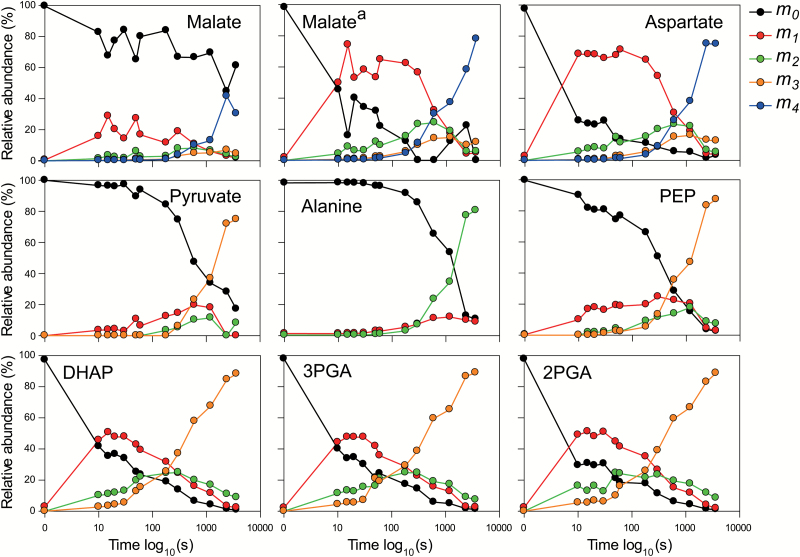
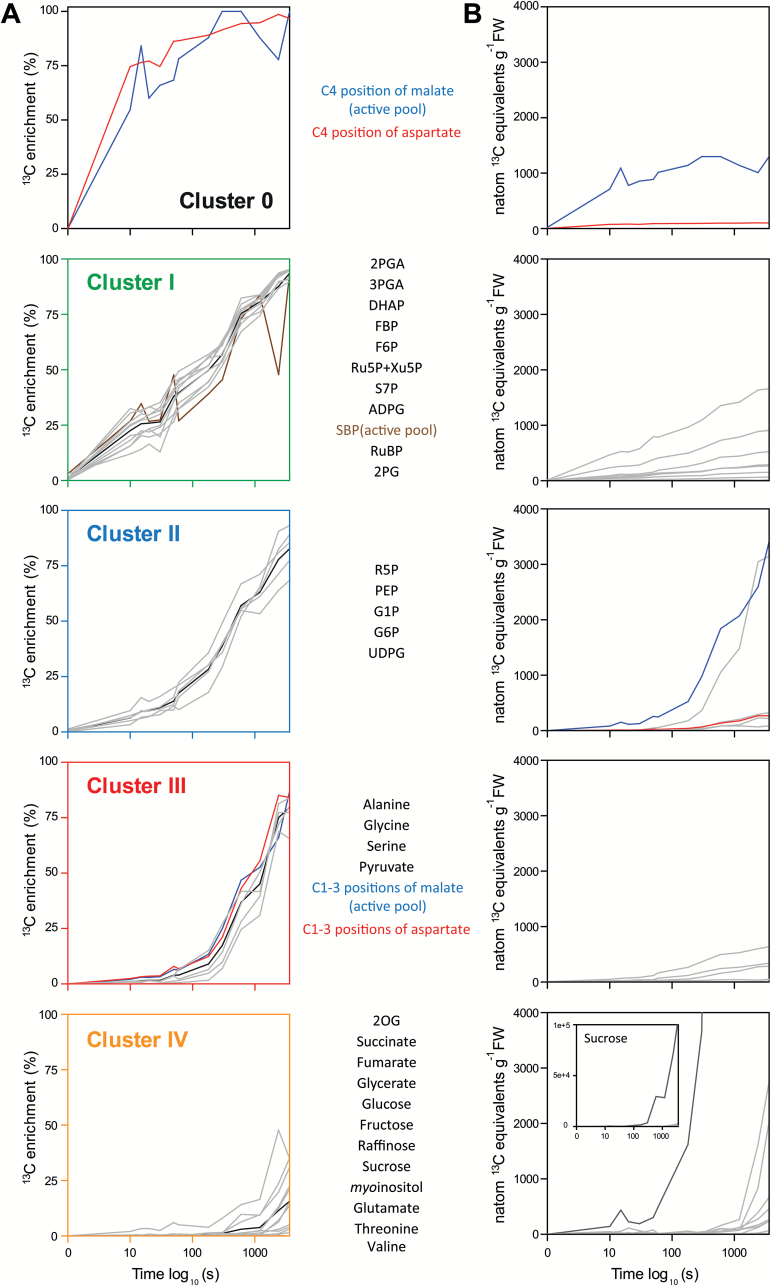
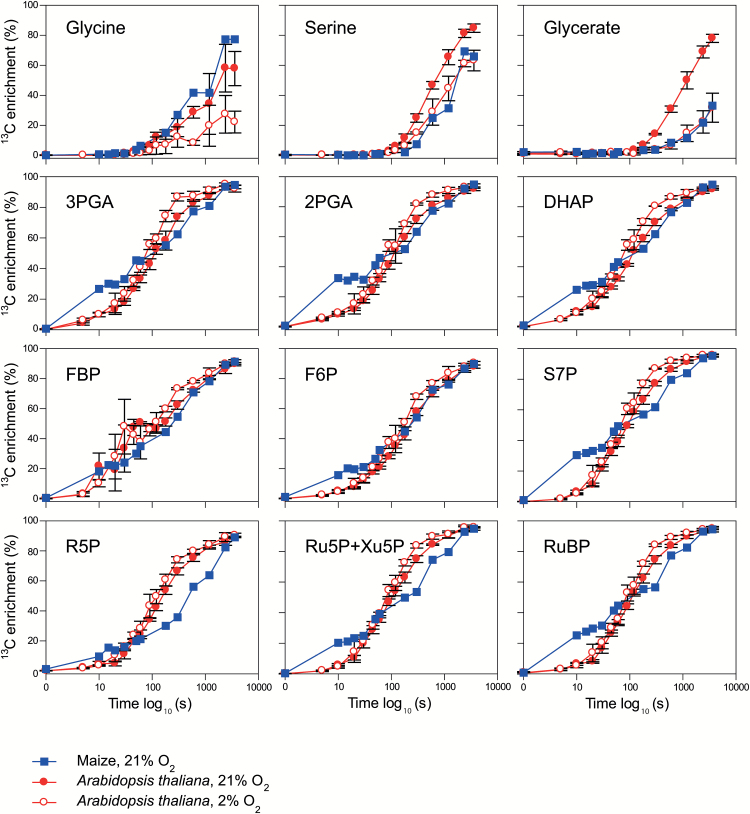
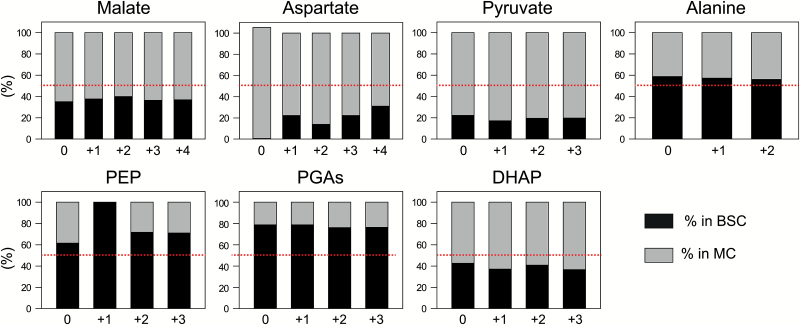
Worldwide efforts to engineer C4 photosynthesis into C3 crops require a deep understanding of how this complex pathway operates. CO2 is incorporated into four-carbon metabolites in the mesophyll, which move to the bundle sheath where they are decarboxylated to concentrate CO2 around RuBisCO. We performed dynamic 13CO2 labeling in maize to analyze C flow in C4 photosynthesis. The overall labeling kinetics reflected the topology of C4 photosynthesis. Analyses of cell-specific labeling patterns after fractionation to enrich bundle sheath and mesophyll cells revealed concentration gradients to drive intercellular diffusion of malate, but not pyruvate, in the major CO2-concentrating shuttle. They also revealed intercellular concentration gradients of aspartate, alanine, and phosphenolpyruvate to drive a second phosphoenolpyruvate carboxykinase (PEPCK)-type shuttle, which carries 10-14% of the carbon into the bundle sheath. Gradients also exist to drive intercellular exchange of 3-phosphoglycerate and triose-phosphate. There is rapid carbon exchange between the Calvin-Benson cycle and the CO2-concentrating shuttle, equivalent to ~10% of carbon gain. In contrast, very little C leaks from the large pools of metabolites in the C concentration shuttle into respiratory metabolism. We postulate that the presence of multiple shuttles, alongside carbon transfer between them and the Calvin-Benson cycle, confers great flexibility in C4 photosynthesis.
Keywords: 13C labeling; C4 photosynthesis; CO2-concentrating shuttle; carbon flow; maize..
© The Author 2016. Published by Oxford University Press on behalf of the Society for Experimental Biology.
Figures
References
-
- Antoniewicz MR, Kelleher JK, Stephanopoulos G. 2006. Determination of confidence intervals of metabolic fluxes estimated from stable isotope measurements. Metabolic Engineering 8, 324–337. - PubMed
-
- Aoki N, Ohnishi J-I, Kanai R. 1992. Two different mechanisms for transport of pyruvate into mesophyll chloroplasts of C4 plants—a comparative study. Plant and Cell Physiology 33, 805–809.
-
- Arrivault S, Guenther M, Ivakov A, Feil R, Vosloh D, van Dongen JT, Sulpice R, Stitt M. 2009. Use of reverse-phase liquid chromatography, linked to tandem mass spectrometry, to profile the Calvin cycle and other metabolic intermediates in Arabidopsis rosettes at different carbon dioxide concentrations. The Plant Journal 59, 824–839. - PubMed
Publication types
MeSH terms
Substances
LinkOut - more resources
Full Text Sources
Other Literature Sources
Molecular Biology Databases
Miscellaneous
