


Gonorrhea Control, United States, 1972-2015, A Narrative Review
- PMID: 27835623
- PMCID: PMC6106780
- DOI: 10.1097/OLQ.0000000000000515
Gonorrhea Control, United States, 1972-2015, A Narrative Review
Abstract
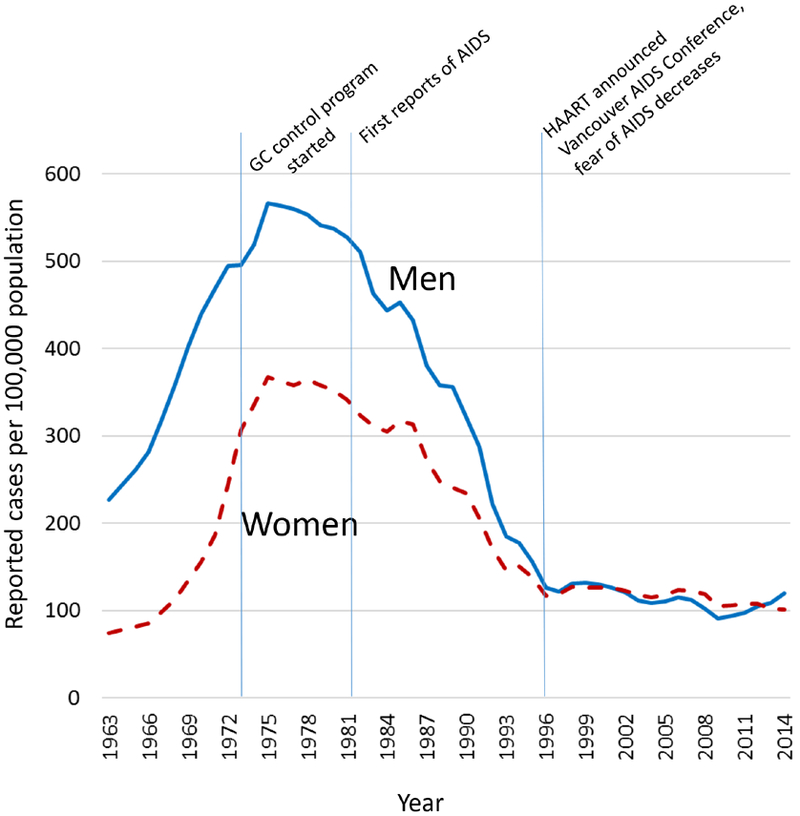
Gonorrhea is the second most commonly reported infection. It can lead to pelvic inflammatory disease, ectopic pregnancy, and infertility. Rates of gonorrhea decreased after the National Gonorrhea Control Program began in 1972, but stabilized in the mid 1990s. The emergence of antimicrobial resistant strains increases the urgency for enhanced gonorrhea control efforts. To identify possible approaches for improving gonorrhea control, we reviewed historic protocols, reports, and other documents related to the activities of the National Gonorrhea Control Program using Centers for Disease Control and Prevention records and the published literature. The Program was a massive effort that annually tested up to 9.3 million women, and treated up to 85,000 infected partners and 100,000 additional exposed partners. Reported gonorrhea rates fell by 74% between 1976 and 1996, then stabilized. Testing positivity was 1.6-4.2% in different settings in 1976. In 1999-2008, the test positivity of a random sample of 14- to 25-year-olds was 0.4%. Gonorrhea testing rates remain high, however, partner notification efforts decreased in the 1990s as attention shifted to human immunodeficiency virus and other sexually transmitted diseases. The decrease and subsequent stabilization of gonorrhea rates was likely also influenced by changes in behavior, such as increases in condom use in response to acquired immune deficiency syndrome. Renewed emphasis on partner treatment might lead to further decreases in rates of gonorrhea.
Figures
Comment in
-
Gonorrhea Prevention in the United States: Where Do We Go From Here?Sex Transm Dis. 2016 Dec;43(12):731-732. doi: 10.1097/OLQ.0000000000000548. Sex Transm Dis. 2016. PMID: 27832024 No abstract available.
References
-
- Centers for Disease Control and Prevention. Sexually Transmitted Disease Surveillance 2014 Atlanta: U.S. Department of Health and Human Services; 2015.
-
- Farley TA, Cohen DA, Elkins W. Asymptomatic sexually transmitted diseases: the case for screening. Preventive Medicine 2003;36:502–509. - PubMed
-
- Brunham RC, Gottlieb SL, Paavonen J. Pelvic inflammatory disease. N Engl J Med 2015;372:2039–48. - PubMed
-
- Henderson RH. Venereal disease: a national health problem. Clin Obstet Gynecol 1975;18:223–232. - PubMed
Publication types
MeSH terms
Grants and funding
LinkOut - more resources
Full Text Sources
Other Literature Sources
Medical
