


Review
doi: 10.1016/j.coph.2016.10.006.
Epub 2016 Nov 9.
Contribution of heteromerization to G protein-coupled receptor function
Affiliations
- PMID: 27835800
- PMCID: PMC5395348
- DOI: 10.1016/j.coph.2016.10.006
Item in Clipboard
Review
Contribution of heteromerization to G protein-coupled receptor function
Curr Opin Pharmacol.
2017 Feb.
Abstract
G protein-coupled receptors (GPCRs) are a remarkably multifaceted family of transmembrane proteins that exert a variety of physiological effects. Although family A GPCRs are able to operate as monomers, there is increasing evidence that heteromerization represents a fundamental aspect of receptor function, trafficking and pharmacology. Most recently, it has been suggested that GPCR heteromers may play a crucial role as new molecular targets of heteromer-selective and bivalent ligands. The current review summarizes key recent developments in these topics.
Published by Elsevier Ltd.
Conflict of interest statement
The authors declare that there is no conflict of interest
Figures
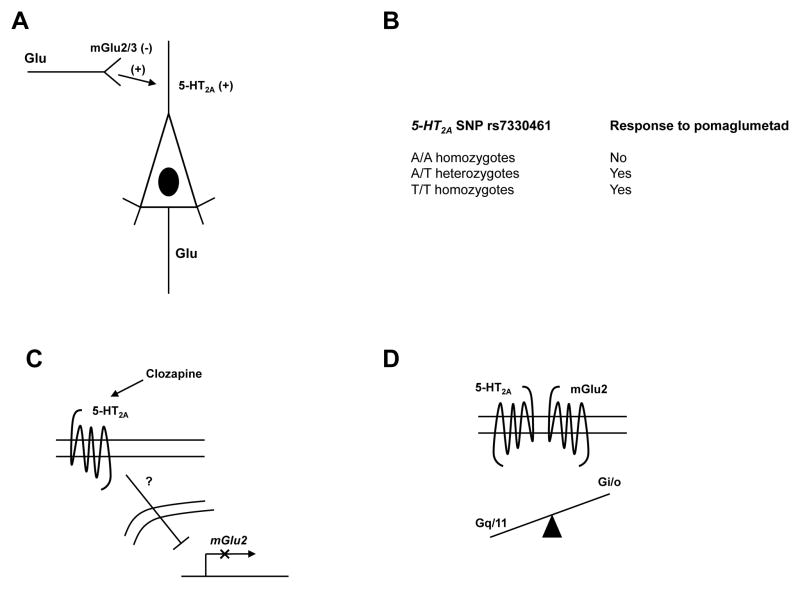
Schematic diagram of the crosstalk mechanisms between 5-HT2A and mGlu2 receptors. A, Activation of the 5-HT2A receptor produces an increase of glutamate release in the frontal cortex. It has been suggested that activation of pre-synaptic mGlu2/3 receptors located at glutamatergic terminals modulates negatively this 5-HT2A receptor-dependent glutamate release. B, Schizophrenia patients carrying the T/T genotype at the 5-HT2A receptor SNP rs7330461 showed significantly greater improvement in positive and negative syndrome scale (PANSS) total scores during treatment with the mGlu2/3 receptor agonist pomaglumetad compared to A/A homozygous patients. C, Chronic treatment with atypical antipsychotic drugs, such as clozapine, induces repressive histone modifications at the promoter region of the mGlu2 gene via 5-HT2A receptor-dependent signaling. D, Gq/11-coupled 5-HT2A and Gi/o-coupled mGlu2 receptors form a specific GPCR heteromeric complex though which serotonin and glutamate ligands modulate the pattern of G protein coupling in a way that predicts their psychoactive behavioral effects.
References
-
- Lefkowitz RJ. A brief history of G-protein coupled receptors (Nobel Lecture) Angew Chem Int Ed Engl. 2013;52:6366–6378. - PubMed
-
- Heng BC, Aubel D, Fussenegger M. An overview of the diverse roles of G-protein coupled receptors (GPCRs) in the pathophysiology of various human diseases. Biotechnol Adv. 2013;31:1676–1694. - PubMed
Publication types
MeSH terms
Substances
Grants and funding
LinkOut - more resources
Full Text Sources
Other Literature Sources
