


Associations between long chain polyunsaturated fatty acids and cardiovascular lipid risk factors in youth with type 1 diabetes: SEARCH Nutrition Ancillary Study
- PMID: 27836680
- PMCID: PMC5384101
- DOI: 10.1016/j.jdiacomp.2016.10.002
Associations between long chain polyunsaturated fatty acids and cardiovascular lipid risk factors in youth with type 1 diabetes: SEARCH Nutrition Ancillary Study
Abstract
Purpose: In this longitudinal study we explored the relationships between plasma n-3 and n-6 polyunsaturated fatty acids (PUFAs) and Δ5 and Δ6 desaturase activities (D5D and D6D, respectively) and fasting lipids in youth with type 1 diabetes (T1D).
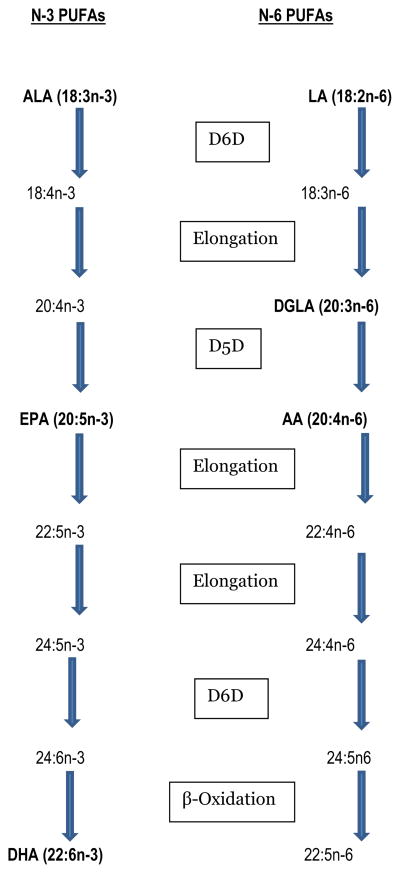
Methods: Incident cases of T1D in youth <20years of age who were seen for a baseline study visit (N=914) and a 1-year follow-up visit (N=416) were included. Fasting blood samples were obtained at each visit and plasma phospholipid n-6 PUFAs were measured, which included linoleic acid (LA), dihomo-γ-linolenic acid (DGLA) and arachidonic acid (AA); n-3 PUFAs included α-linolenic acid (ALA), eicosapentaenoic acid (EPA), and docosahexaenoic acid (DHA). Estimated D5D and D6D were calculated as FA product-to-precursor ratios, where D5D=AA/DGLA and D6D=DGLA/LA. To examine the longitudinal relationships between long chain PUFAs, desaturase activities and fasting plasma lipids in youth with T1D mixed effects models were used for each individual PUFAs, D5D and D6D, adjusted for demographics, clinic site, diabetes duration, insulin regimen, insulin dose/kg, HbA1c, insulin sensitivity score, and body mass index with random effects to account for the repeated measurements.
Findings: Favorable lipid associations were found between LA and low-density lipoprotein (LDL) cholesterol (β=-0.58, p<0.05); AA, plasma triglycerides (TG) (β=-0.04, p<0.05) and TG/high-density lipoprotein (HDL)-C ratio (β=-0.04, p<0.05); and D5D, plasma TG (β=-0.2, p<0.05) and TG/HDL-cholesterol ratio (β=-0.23, p<0.05). Findings were mixed for the n-3 PUFAs and DGLA: ALA was positively associated with plasma TG (β=0.33, p<0.05) and HDL cholesterol (β=9.86, p<0.05); EPA was positively associated with total cholesterol (β=8.17, p<0.05), LDL cholesterol (β=5.74, p<0.01) and HDL cholesterol (β=2.27, p<0.01); and DGLA was positively associated with TG/HDL-cholesterol ratio (β=0.05, P<0.05).
Conclusion: Findings suggest that the most abundant PUFA, LA as well as its metabolic bi-product AA, may be important targets for CVD lipid risk factor reduction in youth with T1D.
Keywords: Cardiovascular disease; Desaturase; Lipids; Polyunsaturated fatty acids; Type 1 diabetes.
Copyright © 2017 Elsevier Inc. All rights reserved.
Conflict of interest statement
Figures
References
-
- Riediger ND, Othman RA, Suh M, Moghadasian MH. A systematic review of the roles of n-3 fatty acids in health and disease. J Am Diet Assoc. 2009;109:668–679. - PubMed
-
- Cottin SC, Sanders TA, Hall WL. The differential effects of EPA and DHA on cardiovascular risk factors. Proc Nutr Soc. 2011;70:215–231. - PubMed
-
- Czernichow S, Thomas D, Bruckert N-6 fatty acids and cardiovascular health: a review of the evidence for dietary intake recommendations. Br J Nutr. 2010;104:788–796. - PubMed
-
- American Diabetes Association. Standards of medical care in diabetes–2014. V. Part E. Medical Nutrition Therapy. Diabetes Care. 2014;37(Suppl 1):S28–S30. - PubMed
Publication types
MeSH terms
Substances
Grants and funding
- U18 DP002710/DP/NCCDPHP CDC HHS/United States
- U18 DP006134/DP/NCCDPHP CDC HHS/United States
- UL1 TR000154/TR/NCATS NIH HHS/United States
- U18 DP002714/DP/NCCDPHP CDC HHS/United States
- U01 DP000248/DP/NCCDPHP CDC HHS/United States
- U01 DP000244/DP/NCCDPHP CDC HHS/United States
- UL1 RR029882/RR/NCRR NIH HHS/United States
- U18 DP002709/DP/NCCDPHP CDC HHS/United States
- P30 DK056350/DK/NIDDK NIH HHS/United States
- UL1 TR000077/TR/NCATS NIH HHS/United States
- UL1 TR000423/TR/NCATS NIH HHS/United States
- U01 DP000250/DP/NCCDPHP CDC HHS/United States
- U18 DP002708/DP/NCCDPHP CDC HHS/United States
- P30 DK057516/DK/NIDDK NIH HHS/United States
- HIR 10-001/HX/HSRD VA/United States
- U01 DP000247/DP/NCCDPHP CDC HHS/United States
- R01 DK077949/DK/NIDDK NIH HHS/United States
- UL1 TR001425/TR/NCATS NIH HHS/United States
- UL1 TR002319/TR/NCATS NIH HHS/United States
- U01 DP000246/DP/NCCDPHP CDC HHS/United States
- U01 DP000254/DP/NCCDPHP CDC HHS/United States
LinkOut - more resources
Full Text Sources
Other Literature Sources
Medical
Research Materials
Miscellaneous
