. 2016 Dec 30;83(2):e02361-16.
doi: 10.1128/AEM.02361-16. Print 2017 Jan 15.

Identification of a New Phosphatase Enzyme Potentially Involved in the Sugar Phosphate Stress Response in Pseudomonas fluorescens

Affiliations

Identification of a New Phosphatase Enzyme Potentially Involved in the Sugar Phosphate Stress Response in Pseudomonas fluorescens

Susan Maleki et al. Appl Environ Microbiol. .

Abstract

The alginate-producing bacterium Pseudomonas fluorescens utilizes the Entner-Doudoroff (ED) and pentose phosphate (PP) pathways to metabolize fructose, since the upper part of its Embden-Meyerhof-Parnas pathway is defective. Our previous study indicated that perturbation of the central carbon metabolism by diminishing glucose-6-phosphate dehydrogenase activity could lead to sugar phosphate stress when P. fluorescens was cultivated on fructose. In the present study, we demonstrate that PFLU2693, annotated as a haloacid dehalogenase-like enzyme, is a new sugar phosphate phosphatase, now designated Spp, which is able to dephosphorylate a range of phosphate substrates, including glucose 6-phosphate and fructose 6-phosphate, in vitro The effect of spp overexpression on growth and alginate production was investigated using both the wild type and several mutant strains. The results obtained suggested that sugar phosphate accumulation caused diminished growth in some of the mutant strains, since this was partially relieved by spp overexpression. On the other hand, overexpression of spp in fructose-grown alginate-producing strains negatively affected both growth and alginate production. The latter implies that Spp dephosphorylates the sugar phosphates, thus depleting the pool of these important metabolites. Deletion of the spp gene did not affect growth of the wild-type strain on fructose, but the gene could not be deleted in the alginate-producing strain. This indicates that Spp is essential for relieving the cells of sugar phosphate stress in P. fluorescens actively producing alginate.

Importance: In enteric bacteria, the sugar phosphate phosphatase YigL is known to play an important role in combating stress caused by sugar phosphate accumulation. In this study, we identified a sugar phosphate phosphatase, designated Spp, in Pseudomonas fluorescens Spp utilizes glucose 6-phosphate, fructose 6-phosphate, and ribose 5-phosphate as substrates, and overexpression of the gene had a positive effect on growth in P. fluorescens mutants experiencing sugar phosphate stress. The gene was localized downstream of gnd and zwf-2, which encode enzymes involved in the pentose phosphate and Entner-Doudoroff pathways. Genes encoding Spp homologues were identified in similar genetic contexts in some bacteria belonging to several phylogenetically diverse families, suggesting similar functions.

Keywords: PFLU2693; Pseudomonas fluorescens; YigL; alginate biosynthesis; phosphatase; sugar phosphate phosphatase; sugar phosphate stress response.


Figures

FIG 1
FIG 1
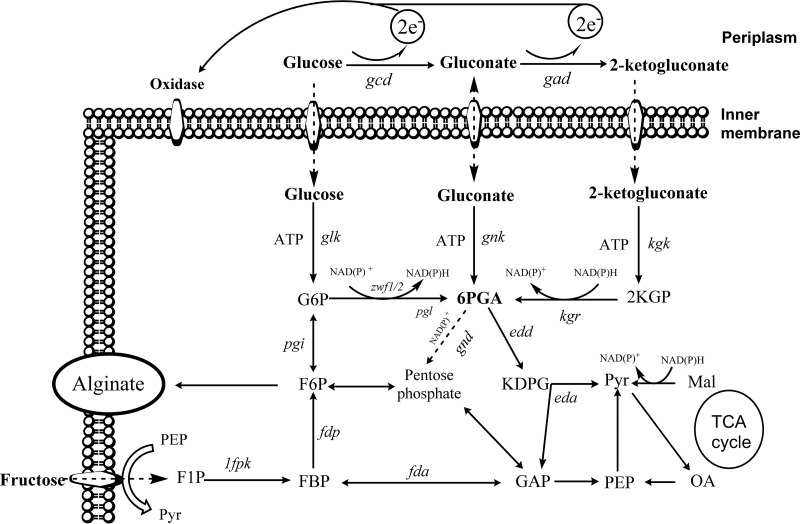
Glucose and fructose metabolic pathways in P. fluorescens. Abbreviations: G6P, glucose-6-phosphate; 6PGA, 6-phosphogluconate; 2KGP, 2-keto-6-phosphogluconate; KDPG, 2-keto-3-deoxy-6-phosphogluconate; F6P, fructose-6-phosphate; FBP, fructose-1,6-bisphosphate; F1P, fructose-1-phosphate; GAP, glyceraldehyde-3-phosphate; Pyr, pyruvate; DPGA, 1,3-diphosphoglycerate; 3PGA, 3-phosphoglycerate; 2PGA, 2-phosphoglycerate; PEP, phosphoenolpyruvate; OA, oxaloacetate; Mal, malate; Gad, gluconate dehydrogenase; Gcd, glucose dehydrogenase; Kgk, 2-ketogluconate kinase; Gnk, gluconokinase; Glk, glucokinase; Kgr, 2-KGP reductase; Gnd, 6PGA dehydrogenase; Zwf1-2, G6P dehydrogenases; Pgi, phosphoglucose isomerase; Pgl, 6-phosphogluconolaktonase: Edd, 6PGA dehydratase; Eda, KDPG aldolase; 1Fpk, 1-phosphofructokinase; Fdp, fructose-1,6-bisphosphatase; Fda, fructose-1,6-bisphosphate aldolase. Figure abridged from reference .
FIG 2
FIG 2
Gene contexts of Spp (COF) homolog-encoding genes. The 100 proteins most similar to the full-length amino acid sequence of Spp (COF family protein) were identified by a BLAST search (34) against GenBank. The genus Pseudomonas was excluded from the search. The gene contexts from representatives of each genus are displayed using standard gene names. Genes encoding enzymes involved in the ED or PP pathway are shown as colored boxes.
FIG 3
FIG 3
Purification and substrate specificities of Spp. (a) SDS-PAGE of purified Spp displaying a dominant protein band (lane 1) and protein standard (lane 2). The arrows mark the standard protein bands with the approximate sizes 35 and 27 kDa. (b) The phosphatase activity was measured using 0.1 mM ribose 5-phosphate (R5P), F6P, G6P, pyridoxal 5-phosphate (P5P), 6-phosphogluconate (6PG), and AMP as substrates. Samples from the reaction mixture (see Materials and Methods for details) were taken at different time points, and released Pi was quantified using MGR. The values represent the means from three different experiments, and standard deviations are indicated using error bars.
FIG 4
FIG 4
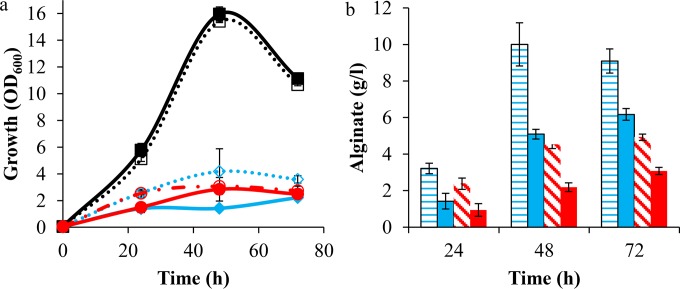
Effect of Spp overproduction from TnRH1 on growth (a) and alginate production (b) in P. fluorescens. Strains included NCIMB10525 (□ in panel a; alginate deficient), NCIMB10525::TnRH1 (■ in panel a; alginate deficient), Pf201 (♢ in panel a; horizontal stripes in panel b), Pf201::TnRH1 (◆ in panel a; solid blue bar in panel b), Pf201ΔalgC::TnKB60 (○ in panel a; diagonal stripes in panel b), and Pf201ΔalgC::TnKB60::TnRH1 (● in panel a; solid red bar in panel b). The growth values represent the means from at least two independent biological replicates, and standard deviations are indicated using error bars.
FIG 5
FIG 5
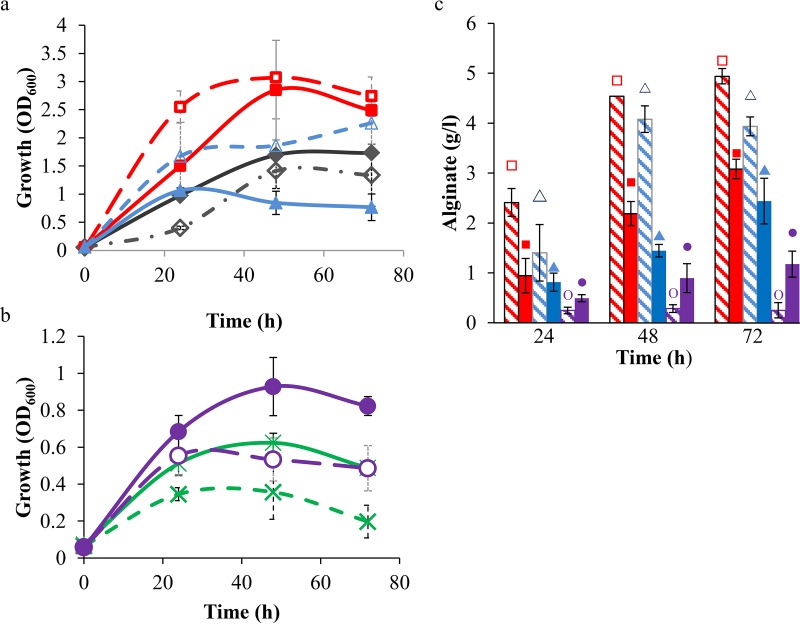
Effect of Spp overproduction from TnRH1 on growth and alginate production of P. fluorescens glucose 6-phosphate dehydrogenase mutants cultivated on fructose. (a and b) Growth profiles. The Δzwf-1Δzwf-2 double mutants were plotted in panel b using a different scale due to poorer growth. (c) Alginate production of the Pf201 derivatives. Symbols and colors: NCIMB10525Δzwf-1 (black, ◇ and ◆), NCIMB10525Δzwf-1Δzwf-2 (green, ×), Pf201ΔalgC::TnKB60 (red, □ and ■), Pf201ΔalgCΔzwf-1::TnKB60 (blue, △ and ▲), Pf201ΔalgCΔzwf-1Δzwf-2::TnKB60 (purple, ○ and ●). Strains without TnRH1 are displayed with open symbols and hatched lines and bars, and the corresponding strains containing TnRH1 are displayed using filled symbols and bars and solid lines. The presented data are averages from three biological replicates, and standard deviations are indicated using error bars.

References

    1. Lessie TG, Phibbs PV Jr. 1984. Alternative pathways of carbohydrate utilization in pseudomonads. Annu Rev Microbiol 38:1–12. doi: 10.1146/annurev.mi.38.100184.002043. - DOI - PubMed
    1. Lessmann D, Schimz KL, Kurz G. 1975. D-glucose-6-phosphate dehydrogenase (Entner-Doudoroff enzyme) from Pseudomonas fluorescens. Purification, properties and regulation. Eur J Biochem 59:545–559. - PubMed
    1. Chavarria M, Kleijn RJ, Sauer U, Pflüger-Grau K, de Lorenzo V. 2012. Regulatory tasks of the phosphoenolpyruvate-phosphotransferase system of Pseudomonas putida in central carbon metabolism. mBio 3:e00028-12. doi: 10.1128/mBio.00028-12. - DOI - PMC - PubMed
    1. Jahreis K, Pimentel-Schmitt EF, Bruckner R, Titgemeyer F. 2008. Ins and outs of glucose transport systems in eubacteria. FEMS Microbiol Rev 32:891–907. doi: 10.1111/j.1574-6976.2008.00125.x. - DOI - PubMed
    1. Midgley M, Dawes EA. 1973. The regulation of transport of glucose and methyl alpha-glucoside in Pseudomonas aeruginosa. Biochem J 132:141–154. doi: 10.1042/bj1320141. - DOI - PMC - PubMed

MeSH terms

LinkOut - more resources