. 2016 Dec 15;143(24):4749-4754.
doi: 10.1242/dev.144386. Epub 2016 Nov 11.

Insights from imaging the implanting embryo and the uterine environment in three dimensions

Affiliations

Insights from imaging the implanting embryo and the uterine environment in three dimensions

Ripla Arora et al. Development. .

Abstract

Although much is known about the embryo during implantation, the architecture of the uterine environment in which the early embryo develops is not well understood. We employed confocal imaging in combination with 3D analysis to identify and quantify dynamic changes to the luminal structure of murine uterus in preparation for implantation. When applied to mouse mutants with known implantation defects, this method detected striking peri-implantation abnormalities in uterine morphology that cannot be visualized by histology. We revealed 3D organization of uterine glands and found that they undergo a stereotypical reorientation concurrent with implantation. Furthermore, we extended this technique to generate a 3D rendering of the cycling human endometrium. Analyzing the uterine and embryo structure in 3D for different genetic mutants and pathological conditions will help uncover novel molecular pathways and global structural changes that contribute to successful implantation of an embryo.

Keywords: Blastocyst; Confocal Imaging; Embryo; Implantation; Receptivity; Surface curvature; Uterus; Wnt5a.


Conflict of interest statement

The authors declare no competing or financial interests.

Figures
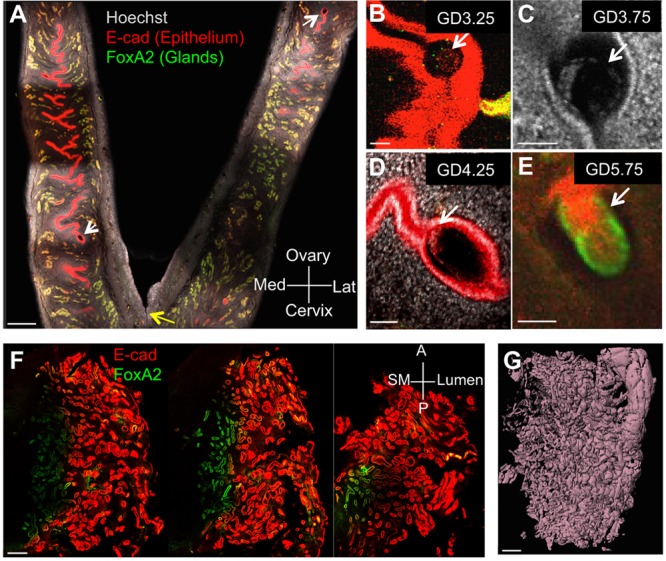
Fig. 1.
Fig. 1.
Confocal imaging of pregnant mouse uterus and cycling human endometrium. (A) Optical z slice showing two-thirds of both horns of a GD4.25 mouse uterus attached at the cervix (yellow arrow) stained with nuclear marker Hoechst (gray), epithelial marker E-CAD (red) and glandular marker FOXA2 (green). (B-D) Identification of blastocysts (white arrows) in optical slices of intact uteri at GD3.25 (B), GD3.75 (C) and GD4.25 (D). (E) Epiblast at GD5.75. (F,G) Three z slices (F) through a full-thickness segment of human endometrium stained for E-CAD (red) and FOXA2 (green), and corresponding surface rendering of the same specimen based on E-CAD staining (G). Scale bars: 500 μm in A,F,G; 50 μm in B-E. Lat, lateral; Med, medial; A, anterior; P, posterior; SM, smooth muscle.
Fig. 2.
Fig. 2.
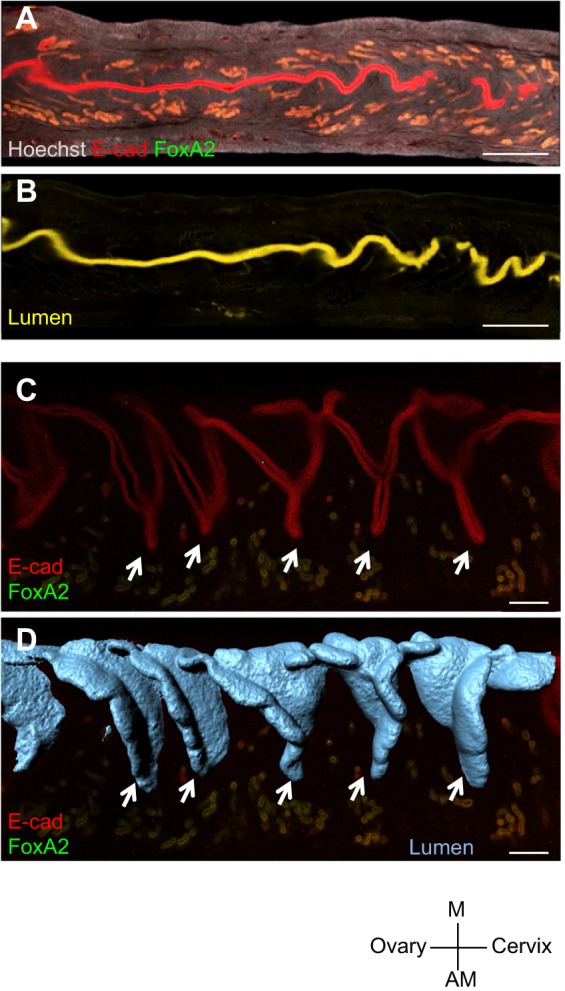
Uterine crypts are generated by folding the luminal epithelium. (A,B) Optical slices through a segment of the uterus at GD4.25 immunolabeled for FOXA2 signal (green) and ECAD signal (red) (A), and the resulting subtraction of FOXA2 from ECAD signal to obtain the uterine lumen (yellow) (B). (C) Optical slice showing uterine crypts (arrows) revealed by luminal epithelial staining at GD4.25. (D) Luminal folds (arrows) in the 3D surface model of the uterus coincide with crypts in the optical slice. Scale bars: 500 μm in A,B; 200 μm in C,D. M, mesometrial; AM, anti-mesometrial.
Fig. 3.
Fig. 3.
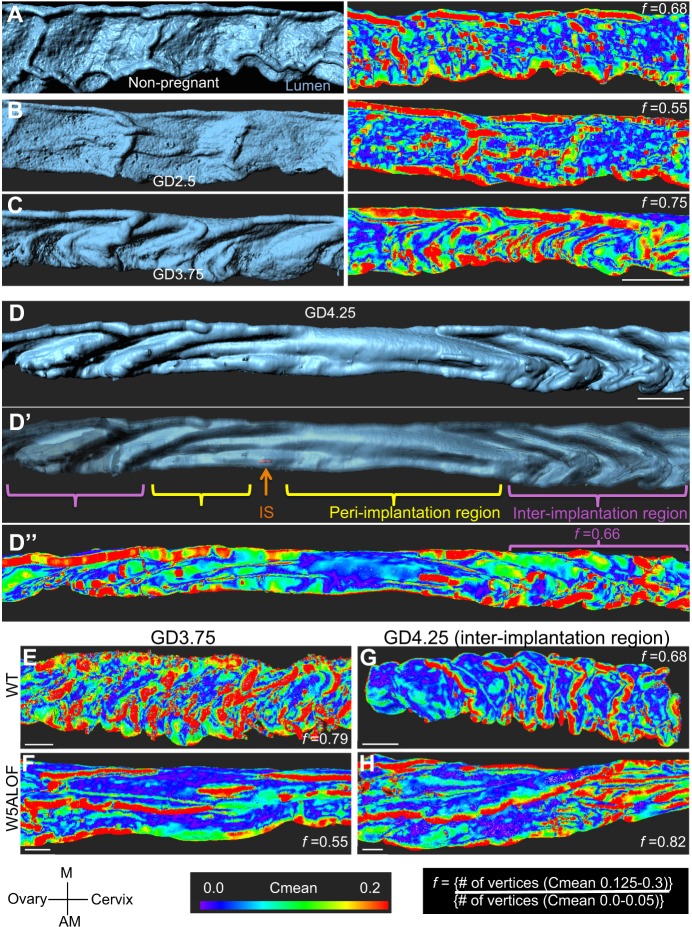
Dynamic folding of the mouse uterine lumen along the mesometrial–anti-mesometrial axis and aberrant folding in Wnt5acKO uteri. (A-C) Uterine luminal surfaces are on the left and folding heat maps are on the right. (A) Luminal structure of non-pregnant mouse uterus. (B,C) Luminal folds appear at GD2.5 (B) and become predominant at GD3.75 (C). (D) Surface model of a GD4.25 luminal segment containing an embryo. (D′) Increased translucence reveals the site where the embryo is present (orange arrow, embryo surface). (D″) Curvature analysis in the same uterine horn measured using Cmean shows flatness in the peri-implantation region (Cmean values are primarily less than 0.05, blue/purple), whereas higher values, indicated by green-yellow and red, are found distant from the implantation site in the inter-implantation region. (E-H) Whereas wild-type uteri show folding along the M-AM axis (E,G), Wnt5acKO uterine lumens fold along the oviductal-cervical axis throughout the lumen at GD 3.75 (F) and at inter-implantation sites at GD4.25 (H). Scale bars: 500 μm in A-C; 300 μm in D-D″; 200 μm in E-H. M, mesometrial; AM, anti-mesometrial; IS, implantation site.
Fig. 4.
Fig. 4.
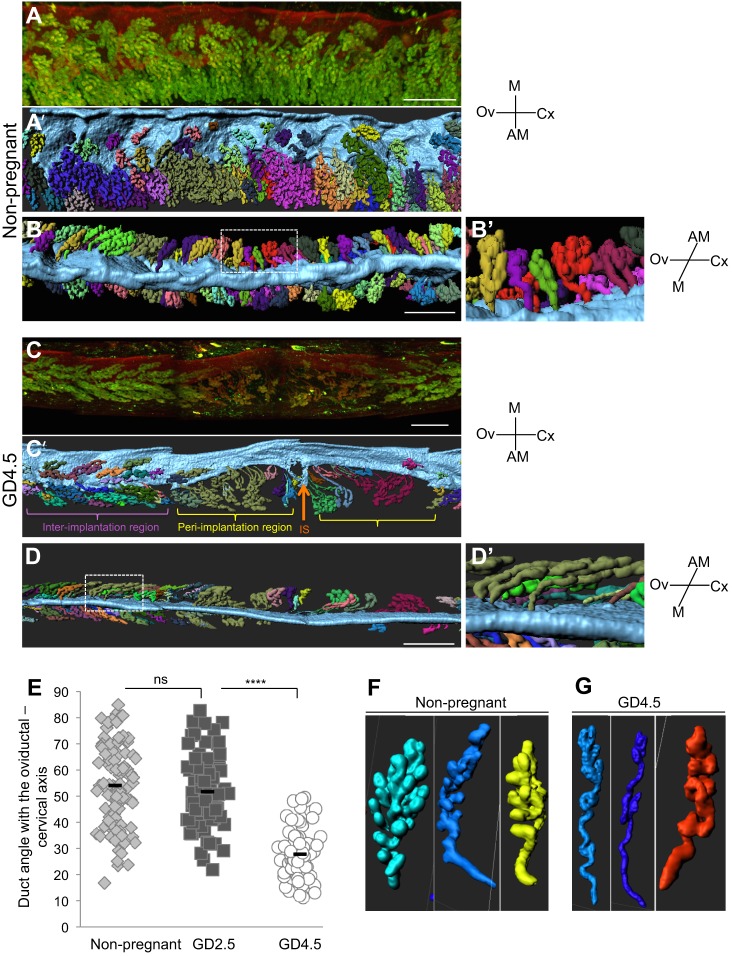
Glandular ducts reorient towards the site of implantation. (A-D′) 3D images and surface renderings of luminal segments and uterine glands, with separate glandular structures randomly pseudocolored for easy visualization. (A-B′) View from the ventral side (A,A′) and mesometrial side (B,B′) of non-pregnant uterine segment. (C-D′) View from the ventral side (C,C′) and mesometrial side (D,D′) of GD4.5 uterine segment. Boxed areas in B,D represent magnified regions in B′,D′, respectively. (E) The glandular ducts in non-pregnant uteri (B,B′) are at a mean angle of ∼54° to the uterine oviductal-cervical axis. (D,D′) With the introduction of the embryo (orange arrow) at the anti-mesometrial pole at GD4.5, the glandular ducts bend drastically until they are at a mean angle of ∼28° to the oviductal-cervical axis towards the site of implantation. The duct angle was measured in a total of 70-80 ducts from two different mice and around three embryos at GD4.5 (E). A t-test was used for statistical analysis and significance was defined as P<0.001. ****P<10−12; ns, not significant. (F,G) Representative examples of glandular branching in non-pregnant uteri (F), and glandular branching, coiling and duct elongation in GD4.5 uteri (G). Scale bars: 500 μm in A-D′. M, mesometrial; AM, anti-mesometrial; Ov, ovary; Cx, cervix; IS, implantation site.

References

    1. Besnard V., Wert S. E., Hull W. M. and Whitsett J. A. (2004). Immunohistochemical localization of Foxa1 and Foxa2 in mouse embryos and adult tissues. Gene Expr. Patterns 5, 193-208. 10.1016/j.modgep.2004.08.006 - DOI - PubMed
    1. Cha J., Sun X. and Dey S. K. (2012). Mechanisms of implantation: strategies for successful pregnancy. Nat. Med. 18, 1754-1767. 10.1038/nm.3012 - DOI - PMC - PubMed
    1. Cha J., Bartos A., Park C., Sun X., Li Y., Cha S.-W., Ajima R., Ho H.-Y. H., Yamaguchi T. P. and Dey S. K. (2014). Appropriate crypt formation in the uterus for embryo homing and implantation requires Wnt5a-ROR signaling. Cell Rep. 8, 382-392. 10.1016/j.celrep.2014.06.027 - DOI - PMC - PubMed
    1. Chen Q., Zhang Y., Elad D., Jaffa A. J., Cao Y., Ye X. and Duan E. (2013). Navigating the site for embryo implantation: biomechanical and molecular regulation of intrauterine embryo distribution. Mol. Aspects Med. 34, 1024-1042. 10.1016/j.mam.2012.07.017 - DOI - PubMed
    1. Daikoku T., Song H., Guo Y., Riesewijk A., Mosselman S., Das S. K. and Dey S. K. (2004). Uterine Msx-1 and Wnt4 signaling becomes aberrant in mice with the loss of leukemia inhibitory factor or Hoxa-10: evidence for a novel cytokine-homeobox-Wnt signaling in implantation. Mol. Endocrinol. 18, 1238-1250. 10.1210/me.2003-0403 - DOI - PubMed

Publication types