


An Assessment of the Cocooning Strategy for Preventing Infant Pertussis-United States, 2011
- PMID: 27838676
- PMCID: PMC5737012
- DOI: 10.1093/cid/ciw528
An Assessment of the Cocooning Strategy for Preventing Infant Pertussis-United States, 2011
Abstract
Background: Infants are at greatest risk for severe pertussis. In 2006, the Advisory Committee on Immunization Practices recommended that adolescents and adults, especially those with infant contact, receive a single dose of Tdap (tetanus toxoid, reduced diphtheria toxoid, and acellular pertussis vaccine). To assess the effectiveness of cocooning, we conducted a case-control evaluation of infant close contacts.
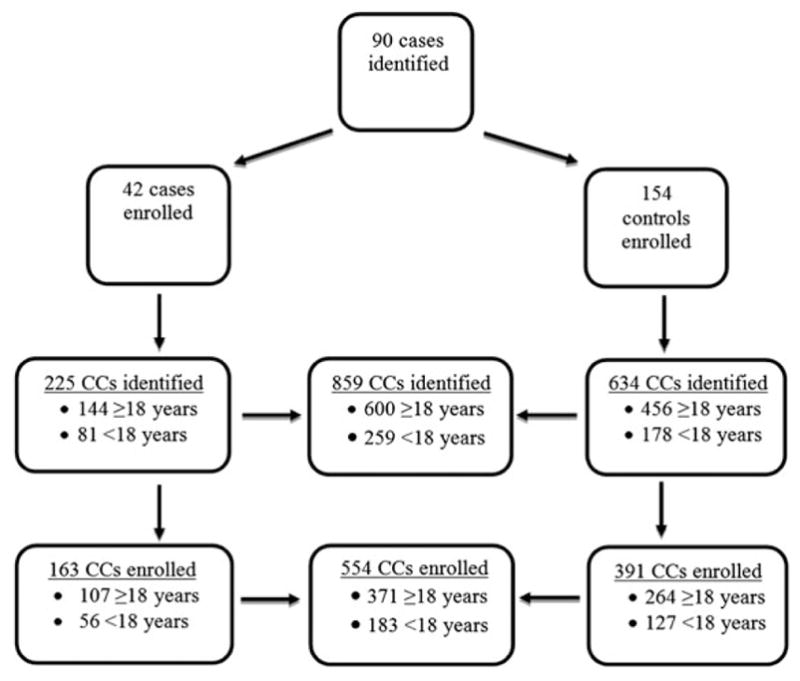
Methods: Pertussis cases aged <2 months with onset between 1 January 2011 and 31 December 2011 were identified in Emerging Infections Program Network sites. For each case, we recruited 3 controls from birth certificates and interviewed identified adult close contacts (CCs) or parents of CCs aged <18 years. Pertussis vaccination was verified through medical providers and/or immunization registries.
Results: Forty-two cases were enrolled, with 154 matched controls. Around enrolled infants, 859 CCs were identified (600 adult and 259 nonadult). An average of 5.4 CCs was identified per case and 4.1 CCs per control. Five hundred fifty-four (64.5%) CCs were enrolled (371 adult and 183 non-adult CCs); 119 (32.1% of enrolled) adult CCs had received Tdap. The proportion of Tdap-vaccinated adult CCs was similar between cases and controls (P = .89). The 600 identified adult CCs comprised 172 potential cocoons; 71 (41.3%) potential cocoons had all identified adult CCs enrolled. Of these, 9 were fully vaccinated and 43.7% contained no Tdap-vaccinated adults. The proportion of fully vaccinated case (4.8%) and control (10.0%) cocoons was similar (P = .43).
Conclusions: Low Tdap coverage among adult CCs reinforces the difficulty of implementing the cocooning strategy and the importance of vaccination during pregnancy to prevent infant pertussis.
Keywords: Tdap; cocooning; pertussis.
Published by Oxford University Press for the Infectious Diseases Society of America 2016. This work is written by (a) US Government employee(s) and is in the public domain in the US.
Conflict of interest statement
Figures
References
-
- Centers for Disease Control and Prevention. Nationally Notifiable Disease surveillance data. 2011.
-
- Wendelboe A, Njamkepo E, Bourillon A, et al. Transmission of Bordetella pertussis to young infants. Pediatr Infect Dis J. 2007;26:293. - PubMed
-
- Bisgard KM, Pascual FB, Ehresmann KR, et al. Infant pertussis: who was the source? Pediatr Infect Dis J. 2004;23:985–9. - PubMed
-
- Skoff TH, Kenyon C, Cocoros N, et al. Sources of infant pertussis infection in the United States. Pediatrics. 2015;136:635–41. - PubMed
MeSH terms
Substances
Grants and funding
LinkOut - more resources
Full Text Sources
Other Literature Sources
Medical
