


Role of Hip Abductor Muscle Composition and Torque in Protective Stepping for Lateral Balance Recovery in Older Adults
- PMID: 27840133
- PMCID: PMC5425306
- DOI: 10.1016/j.apmr.2016.10.009
Role of Hip Abductor Muscle Composition and Torque in Protective Stepping for Lateral Balance Recovery in Older Adults
Abstract
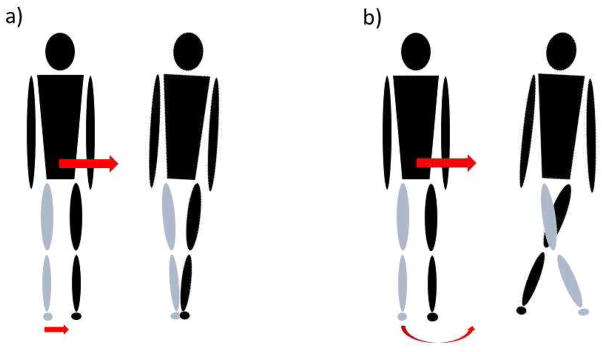
Objectives: To examine differences in hip abductor strength and composition between older adults who primarily use medial step versus cross-step recovery strategies to lateral balance perturbations.
Design: Cross-sectional.
Setting: University research laboratory.
Participants: Community-dwelling older adults (N=40) divided into medial steppers (n=14) and cross-steppers (n=26) based on the first step of balance recovery after a lateral balance perturbation.
Interventions: Not applicable.
Main outcome measures: Computed tomography scans to quantify lean tissue and intramuscular adipose tissue (IMAT) areas in the hip abductor, hip abductor isokinetic torque, and first step length.
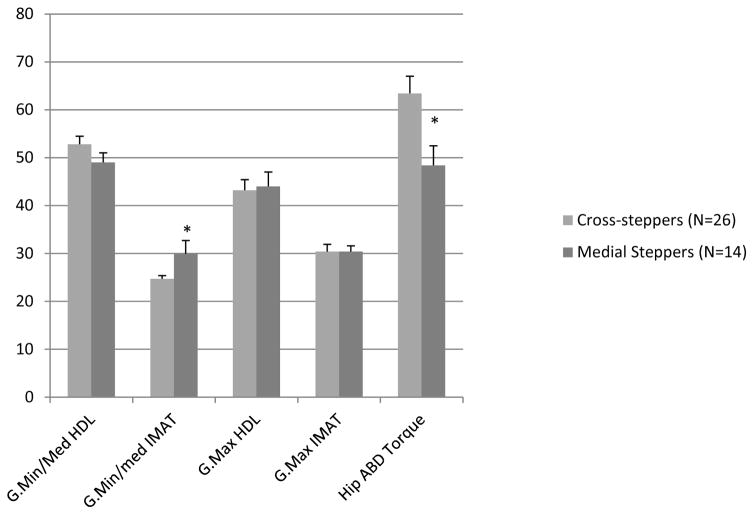
Results: Medial steppers took medial steps in 71.1% of trials versus 4.6% of trials with cross-steps. The cross-steppers when compared with medial steppers, had lower hip abductor IMAT (24.7±0.7% vs 29.9±2.8%; P<.05), greater abductor torque (63.3±3.6Nm vs 48.4±4.1Nm; P<.01), and greater normalized first step length (.75±.03 vs .43±.08; P<.001). There was no difference in hip abductor lean tissue between the groups (P>.05).
Conclusions: Our findings suggest that older adults who initially use a medial step to recover lateral balance have lower hip abductor torque and may be less able to execute a biomechanically more stable cross-step. This may be related to increased IMAT levels. Assessments and interventions for enhancing balance and decreasing fall risk should take the role of the hip abductor into account.
Keywords: Hip; Muscle strength; Muscle, skeletal; Postural balance; Rehabilitation.
Copyright © 2016 American Congress of Rehabilitation Medicine. Published by Elsevier Inc. All rights reserved.
Conflict of interest statement
The authors declare no conflict of interest
Figures
References
-
- Saveman BI, Bjornstig U. Unintentional injuries among older adults in northern Sweden--a one-year population-based study. Scand J Caring Sci. 2011;25(1):185–93. - PubMed
-
- Kiyoshige Y, Watanabe E. Fatty degeneration of gluteus minimus muscle as a predictor of falls. Arch Gerontol Geriatr. 2015;60(1):59–61. - PubMed
-
- Yoshida Y, Marcus RL, Lastayo PC. Intramuscular adipose tissue and central activation in older adults. Muscle Nerve. 2012;46(5):813–6. - PubMed
Publication types
MeSH terms
Grants and funding
LinkOut - more resources
Full Text Sources
Other Literature Sources
