


Association of Subjective and Objective Sleep Duration as well as Sleep Quality with Non-Invasive Markers of Sub-Clinical Cardiovascular Disease (CVD): A Systematic Review
- PMID: 27840384
- PMCID: PMC5383537
- DOI: 10.5551/jat.36194
Association of Subjective and Objective Sleep Duration as well as Sleep Quality with Non-Invasive Markers of Sub-Clinical Cardiovascular Disease (CVD): A Systematic Review
Abstract
Aim: Abnormal daily sleep duration and quality have been linked to hypertension, diabetes, stroke, and overall cardiovascular disease (CVD) morbidity& mortality. However, the relationship between daily sleep duration and quality with subclinical measures of CVD remains less well studied. This systematic review evaluated how daily sleep duration and quality affect burden of subclinical CVD in subjects free of symptomatic CVD.
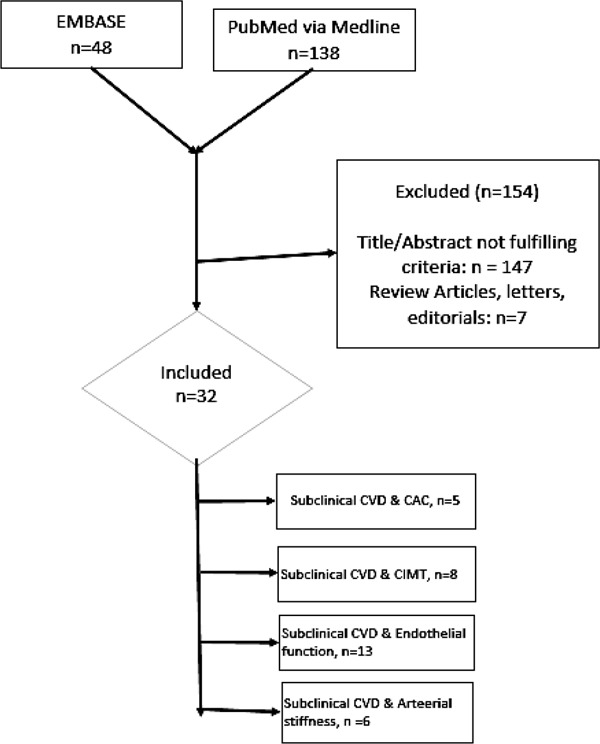
Methods: Literature search was done via MEDLINE, EMBASE, Web of Science until June 2016 and 32 studies met the inclusion criteria. Sleep duration and quality were measured either via subjective methods, as self-reported questionnaires or Pittsburg Sleep Quality Index (PSQI) or via objective methods, as actigraphy or polysomnography or by both. Among subclinical CVD measures, coronary artery calcium (CAC) was measured by electron beam computed tomography, Carotid intima-media thickness (CIMT) measured by high-resolution B-mode ultrasound on carotid arteries, endothelial/microvascular function measured by flow mediated dilation (FMD) or peripheral arterial tone (PAT) or iontophoresis or nailfold capillaroscopy, and arterial stiffness measured by pulse wave velocity (PWV) or ankle brachial index (ABI).
Results: Subjective short sleep duration was associated with CAC and CIMT, but variably associated with endothelial dysfunction (ED) and arterial stiffness; however, subjective long sleep duration was associated with CAC, CIMT and arterial stiffness, but variably associated with ED. Objective short sleep duration was positively associated with CIMT and variably with CAC but not associated with ED. Objective long sleep duration was variably associated with CAC and CIMT but not associated with ED. Poor subjective sleep quality was significantly associated with ED and arterial stiffness but variably associated with CAC and CIMT. Poor objective sleep quality was significantly associated with CIMT, and ED but variably associated with CAC.
Conclusions: Overall, our review provided mixed results, which is generally in line with published literature, with most of the studies showing a significant relationship with subclinical CVD, but only some studies failed to demonstrate such an association. Although such mechanistic relationship needs further evaluation in order to determine appropriate screening strategies in vulnerable populations, this review strongly suggested the existence of a relationship between abnormal sleep duration and quality with increased subclinical CVD burden.
Conflict of interest statement
M. Aziz, SS. Ali, S. Das, A. Younus, R. Malik, M. Latif, Choudhry H, D. Anugula, G. Abbas, Joseph S, JV Elizondo, E Veledar, and K. Nasir stated that no conflict of interest exists. No financial support was given and that no off-label or investigational use of a drug or device was performed as part of this research.
Figures
References
-
- Colten HR, Altevogt BM, Research IoMUCoSMa : Sleep Physiology. 2006;
-
- Nagai M, Hoshide S, Nishikawa M, Shimada K, Kario K: Sleep duration and insomnia in the elderly: associations with blood pressure variability and carotid artery remodeling. Am J Hypertens, 2013; 26: 981-989 - PubMed
-
- Westerlund A, Bellocco R, Sundstrom J, Adami HO, Akerstedt T, Trolle Lagerros Y: Sleep characteristics and cardiovascular events in a large Swedish cohort. Eur J Epidemiol, 2013; 28: 463-473 - PubMed
Publication types
MeSH terms
Substances
LinkOut - more resources
Full Text Sources
Other Literature Sources
Miscellaneous
