


Carotid and aortic stiffness in essential hypertension and their relation with target organ damage: the CATOD study
- PMID: 27841779
- PMCID: PMC5486968
- DOI: 10.1097/HJH.0000000000001167
Carotid and aortic stiffness in essential hypertension and their relation with target organ damage: the CATOD study
Abstract
Objective: The objective of the study is to investigate in the hypertensive population the possible differential association between increased aortic and/or carotid stiffness and organ damage in multiple districts, such as the kidney, the vessels, and the heart.
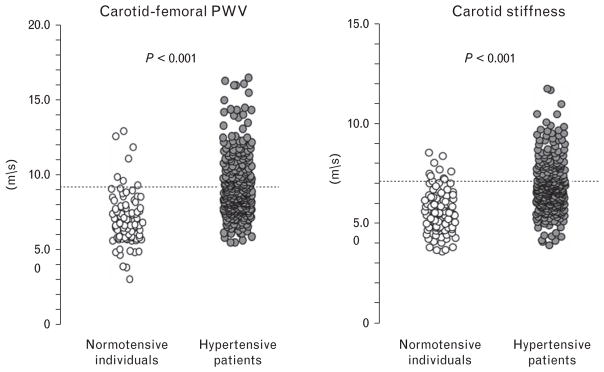
Methods: In 314 essential hypertensive patients, carotid-femoral pulse wave velocity (cfPWV, by applanation tonometry) and carotid stiffness (from ultrasound images analysis), together with left ventricular hypertrophy, carotid intima-media thickness, urinary albumin-creatinin ratio, and glomerular filtration rate were measured. Increased cfPWV and carotid stiffness were defined according to either international reference values or the 90th percentile of a local control group (110 age and sex-matched healthy individuals).
Results: When considering the 90th percentile of a local control group, increased cfPWV was associated with reduced glomerular filtration rate, either when carotid stiffness was increased [odds ratio (OR) 13.27 (confidence limits (CL) 95% 3.86-45.58)] or not [OR 7.39 (CL95% 2.25-24.28)], whereas increased carotid stiffness was associated with left ventricular hypertrophy, either when cfPWV was increased [OR 2.86 (CL95% 1.15-7.09)] or not [OR 2.81 (CL95% 1.13-6.97)]. No association between increased cfPWV or carotid stiffness and target organ damage was found when cutoffs obtained by international reference values were used. The concomitance of both increased cfPWV and carotid stiffness did not have an additive effect on organ damage.
Conclusion: Aortic and carotid stiffness are differentially associated with target organ damage in hypertensive patients. Regional arterial stiffness as assessed by cfPWV is associated with renal organ damage and local carotid stiffness with cardiac organ damage.
Figures
Comment in
-
Heart and kidneys: separate targets of carotid and aortic stiffness?J Hypertens. 2017 Feb;35(2):243-245. doi: 10.1097/HJH.0000000000001195. J Hypertens. 2017. PMID: 28002259 No abstract available.
References
-
- Lakatta EG. Arterial and cardiac aging: major shareholders in cardiovascular disease enterprises: Part III: cellular and molecular clues to heart and arterial aging. Circulation. 2003;107:490–497. - PubMed
-
- Laurent S, Cockcroft J, Van Bortel L, Boutouyrie P, Giannattasio C, Hayoz D, et al. Expert consensus document on arterial stiffness: methodological issues and clinical applications. Eur Heart J. 2006;27:2588–2605. - PubMed
-
- Blacher J, Pannier B, Guerin AP, Marchais SJ, Safar ME, London GM. Carotid arterial stiffness as a predictor of cardiovascular and all-cause mortality in end-stage renal disease. Hypertension. 1998;32:570–574. - PubMed
-
- van Sloten TT, Schram MT, van den Hurk K, Dekker JM, Nijpels G, Henry RM, et al. Local stiffness of the carotid and femoral artery is associated with incident cardiovascular events and all-cause mortality: the Hoorn study. J Am Coll Cardiol. 2014;63:1739–1747. - PubMed
MeSH terms
Substances
Grants and funding
LinkOut - more resources
Full Text Sources
Other Literature Sources
Medical
