. 2016 Oct 11;3(11):876-883.
doi: 10.1002/acn3.362. eCollection 2016 Nov.

Novel NALCN variant: altered respiratory and circadian rhythm, anesthetic sensitivity

Affiliations

Novel NALCN variant: altered respiratory and circadian rhythm, anesthetic sensitivity

Bernarda Lozic et al. Ann Clin Transl Neurol. .

Abstract

The sodium leak channel, a Na+-permeable, nonselective cation channel, is widely expressed in the nervous system, contributing a basal Na+-leak conductance and regulating neuronal excitability. A 3-year-old girl, heterozygous for a de novo missense mutation in NALCN (c.956C>T; p.Ala319Val) predicted to be deleterious, presented from birth with: stimulus-induced, episodic contractures of the limbs and face with associated respiratory distress; distal arthrogryposis; severe axial hypotonia; and severe global developmental delay (CLIFAHDD syndrome). In infancy, she manifested a reversed sleep-wake rhythm, nocturnal life-threatening respiratory rhythm disturbances with central apnea. Sevoflurane sensitivity caused respiratory depression and cardiac arrest.


Figures
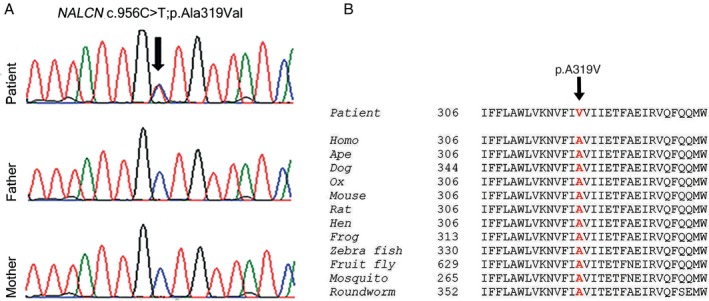
Figure 1
Figure 1
(A) The partial chromatograms from Sanger sequencing illustrate a heterozygous mutation (c.956C>T, p.Ala319Val) in exon 9 of NALCN, identified in the patient and normal sequences from healthy parents. The arrow indicates the mutation site. Computer programs, PolyPhen‐2, SIFT, and MutationTaster, show the mutation to be damaging. (B) Illustration of high evolutionary conservation of amino acid sequences in the region of the mutated residue (shown in red), supporting the concept that the mutation is functionally disruptive.
Figure 2
Figure 2
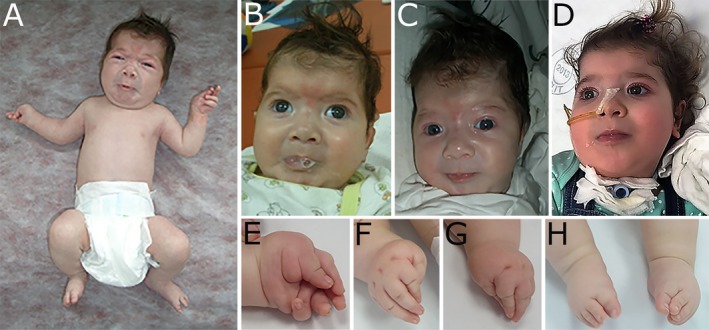
Typical facial characteristics of CLIFAHDD syndrome are shown in (A–C): broad nasal bridge, anteverted nasal tip and large nares, short columella, long philtrum, deep nasolabial folds, rounded cheeks, pursed lips, micrognathia, H‐shaped chin dimpling, low‐set ears, and short neck. (A) Illustrates the stimulus‐provoked facial and limb contractions, particularly frequent in the neonatal period; arms are flexed and abducted, legs flexed or cycling. Mild contractures were present at elbows, knees, and hips. (B) Copius foamy saliva extrudes from the pursed lips. (C) During the attack, the child sweats excessively in the face, head and upper trunk. (D) At age 33 months: the child is anxious, facial contractions are milder, drooling persists; she is dependent on nasogastric tube feeding and is treated with positive pressure ventilation via tracheostomy. (E–G) illustrate the distal arthrogryposis; with camptodactyly, adducted thumbs, and ulnar deviation. (H) Bilateral varus foot deformity.
Figure 3
Figure 3
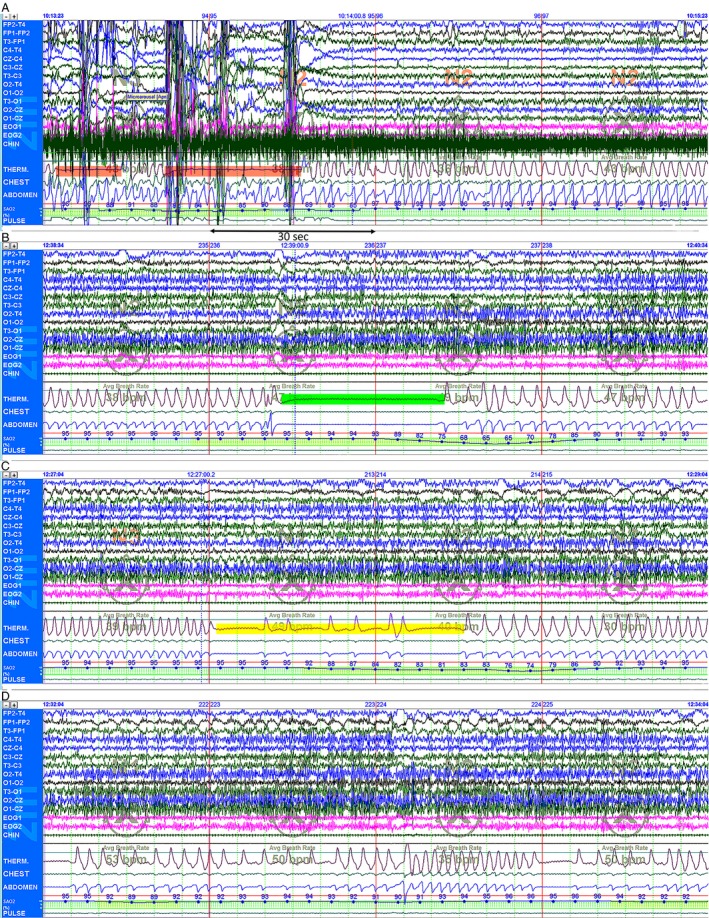
Representative polysomnography (PSG) recordings (each 120 sec) of changes in respiratory rhythm; baseline SpO2 saturation of 95%: (A) Two episodes of obstructive apnea (highlighted in red) lasting 12 and 25 sec, respectively, associated with paradoxical chest and abdominal wall motion, SpO2 desaturation of 84%, accompanied by increased chin EMG activity. Arousal response with change from stage 3 to stage 2 non‐rapid eye movement (NREM) NREM sleep. (B) The abrupt onset of central apnea lasting 35 sec (highlighted in green) accompanied by SpO2 desaturation of 65%. Note the lack of flow through the tracheostomy thermistor sensor, and complete absence of chest and abdominal wall movements; stage 2 NREM sleep. (C) Pathological periodic breathing and repeat brief central apneas (highlighted in yellow) and SpO2 desaturation of 74%. Arousal with change from stage 3 to stage 2 NREM sleep. (D) Variants of periodic breathing and altered respiratory rhythm. Recordings were performed with a tracheostomy in place, using standard digital PSG equipment: Polysmith Nihon Kohden America Inc., CA, USA. PSGs were scored as per the 2007 American Academy of Sleep Medicine (AASM) guidelines for the scoring of sleep and associated events.23

References

    1. Lu B, Su Y, Das S, et al. Peptide neurotransmitters activate a cation channel complex of NALCN and UNC‐80. Nature 2009;457:741–744. - PMC - PubMed
    1. Lu B, Zhang Q, Wang H, et al. Extracellular calcium controls background current and neuronal excitability via an UNC79‐UNC80‐NALCN cation channel complex. Neuron 2010;68:488–499. - PMC - PubMed
    1. Lu B, Su Y, Das S, et al. The neuronal channel NALCN contributes resting sodium permeability and is required for normal respiratory rhythm. Cell 2007;129:371–383. - PubMed
    1. Lu TZ, Feng Z‐P. A sodium leak current regulates pacemaker activity of adult central pattern generator neurons in Lymnaea stagnalis . PLoS One 2011;6:e18745. - PMC - PubMed
    1. Köroğlu Ç, Seven M, Tolun A. Recessive truncating NALCN mutation in infantile neuroaxonal dystrophy with facial dysmorphism. J Med Genet 2013;50:515–520. - PubMed

LinkOut - more resources