. 2016 Nov 1:7:1708.
doi: 10.3389/fmicb.2016.01708. eCollection 2016.

Chicken IgY Fc Linked to Bordetella avium ompA and Taishan Pinus massoniana Pollen Polysaccharide Adjuvant Enhances Macrophage Function and Specific Immune Responses

Affiliations

Chicken IgY Fc Linked to Bordetella avium ompA and Taishan Pinus massoniana Pollen Polysaccharide Adjuvant Enhances Macrophage Function and Specific Immune Responses

Wenwen Dong et al. Front Microbiol. .

Abstract

Fc-fusion technologies, in which immunoglobulin Fc is genetically fused to an antigenic protein, have been developed to confer antibody-like properties to proteins and peptides. Mammalian IgG Fc fusion exhibits improved antigen-induced immune responses by providing aggregates with high avidity for the IgG Fc receptor and salvaging the antigenic portion from endosomal degradation. However, whether the linked chicken IgY Fc fragment shares similar characteristics to mammalian IgG Fc remains unclear. In this study, we linked the chicken IgY Fc gene to the outer membrane protein A (ompA) of Bordetella avium through overlapping PCR. The fusion gene was cloned into the pPIC9 plasmid to construct the recombinant Pichia pastoris transformant expressing the ompA-Fc fusion protein. The effects of the linked Fc on macrophage vitality, activity, efficiency of antigen processing, and immune responses induced by the fused ompA were investigated. Furthermore, the effect of Taishan Pinus massoniana pollen polysaccharide (TPPPS), an immunomodulator, on chicken macrophage activation was evaluated. TPPPS was also used as an adjuvant to investigate its immunomodulatory effect on immunoresponses induced by the fused ompA-Fc in chickens. The pinocytosis, phagocytosis, secretion of nitric oxide and TNF-α, and MHC-II molecular expression of the macrophages treated with the fused ompA-Fc were significantly higher than those of the macrophages treated with ompA alone. The addition of TPPPS to the fused ompA-Fc further enhanced macrophage functions. The fused ompA-Fc elicited higher antigen-specific immune responses and protective efficacy compared with ompA alone. Moreover, the fused ompA-Fc conferred higher serum antibody titers, serum IL-2 and IL-4 concentrations, CD4+ and CD8+ T-lymphocyte counts, lymphocyte transformation rate, and protection rate compared with ompA alone. Notably, the prepared TPPPS adjuvant ompA-Fc vaccines induced high immune responses and protection rate. The linked Fc and TPPPS adjuvant can remarkably enhance macrophage functions and specific immune responses. This study provides new perspectives to improve the immune effects of subunit vaccines for prevention of poultry diseases.

Keywords: IgY Fc; Pichia pastoris expression; TPPPS; peritoneal macrophage; subunit vaccine.


Figures
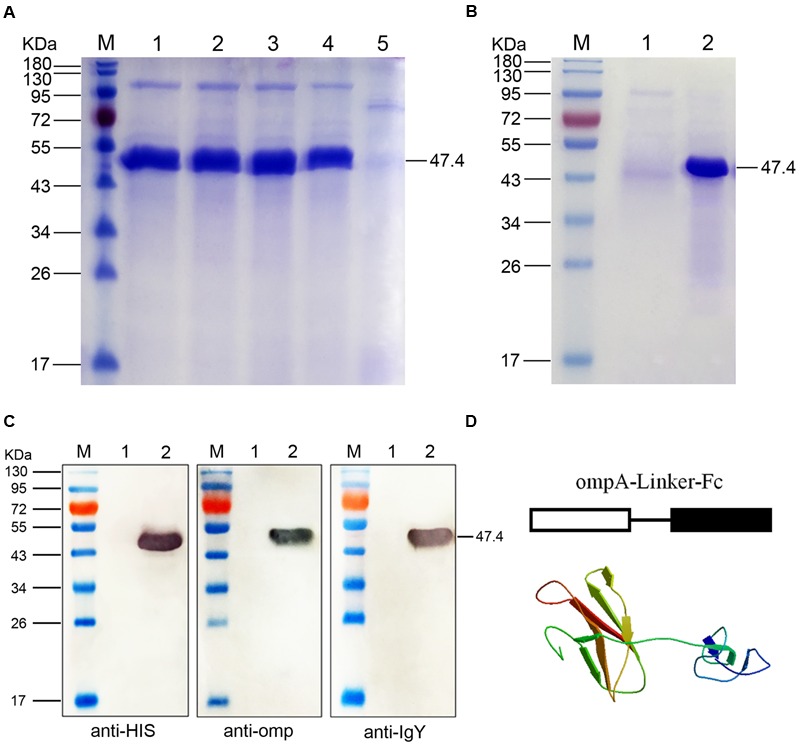
FIGURE 1
FIGURE 1
SDS-PAGE and Western blot analyses of the fused ompA–Fc expressed in Pichia pastoris. (A) SDS-PAGE identification of the fusion ompA–Fc at different induction times. M, Page ruler pre-stained protein ladder; lanes 1–4, culture supernatant of P. pastoris transformed with the recombinant pPIC9-ompA–Fc plasmid after 96, 72, 48, and 24 h of methanol induction; lane 5, culture supernatant of P. pastoris transformed with blank pPIC9 vector (negative control). (B) Purification of the fused ompA–Fc. M, Page ruler pre-stained protein ladder; lane 1, purified ompA–Fc; lane 2, culture supernatant after column chromatography. (C) Western blot analyses of the fused ompA–Fc with the anti-His tag antibody, mouse anti-omp polyclonal antibody, and the rabbit anti-chicken IgG (HRP). M, protein molecular size page ruler; lane 1, culture supernatant of P. pastoris transformed with blank pPIC9 vector (negative control); lane 2, culture supernatant of P. pastoris transformed with the recombinant pPIC9-ompA–Fc plasmid at 96 h post induction. (D) Schematic and 3D structure of the fused ompA–Fc.
FIGURE 2
FIGURE 2
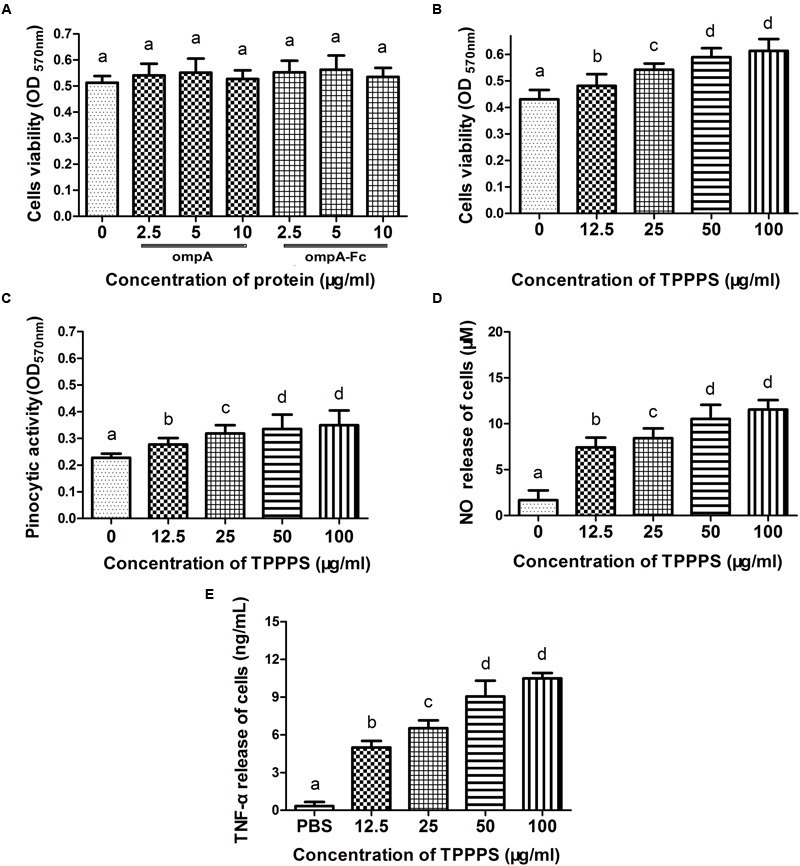
Influences of the linked Fc or Taishan Pinus massoniana pollen polysaccharide (TPPPS) on macrophage activity. Peritoneal macrophages were cultured with the various concentrations of ompA–Fc (2.5, 5, and 10 μg/mL), ompA (2.5, 5, and 10 μg/mL), TPPPS (12.5, 25, 50, and 100 μg/mL), and PBS for 24 h. The activity of peritoneal macrophages was determined by MTT assay (A,B). The neutral red uptake (C), NO (D), and TNF-α (E) production of peritoneal macrophages were detected as previously described. All values represent the means ± SD of triplicate experiments. Different lowercase letters above the columns indicate significant differences between the different groups (P < 0.05).
FIGURE 3
FIGURE 3
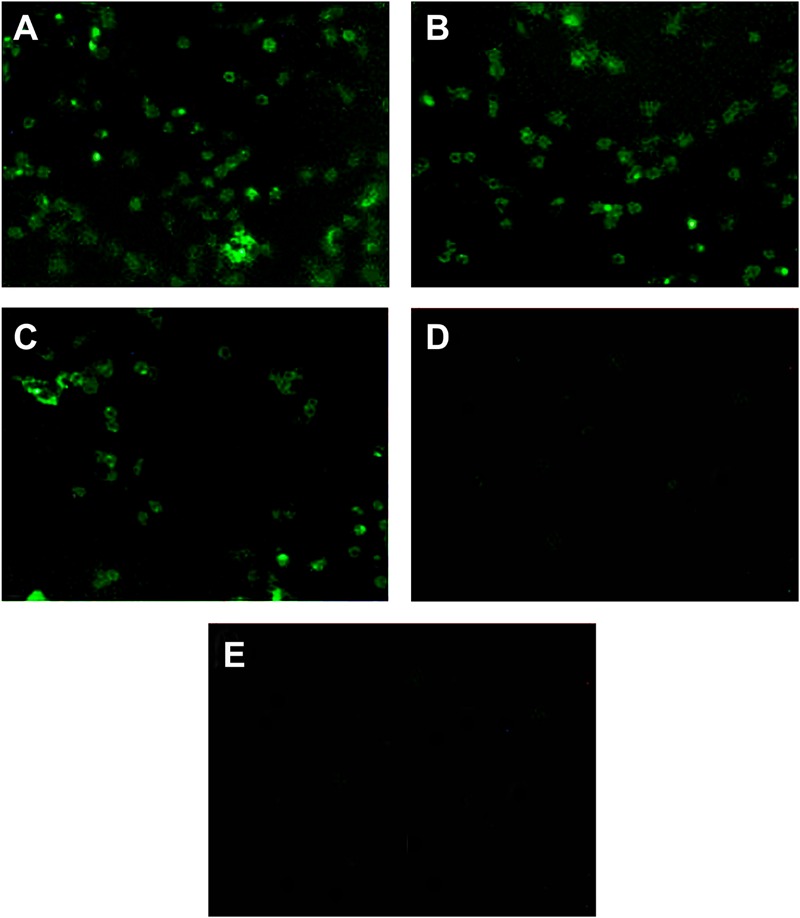
The linked Fc and TPPPS adjuvant enhance phagocytosis of peritoneal macrophages. Initially, 5 μg/mL ompA–Fc mixed with 50 μg/mL TPPPS (A), 5 μg/mL ompA–Fc (B), 5 μg/mL ompA (C), and 50 μg/mL TPPPS (D) and 100 μL PBS (E) were separately added into 96-well cell culture plates, where fresh peritoneal macrophages were cultured. After 6 h incubation, IFA was used to analyze the ompA phagocytosis, and the rat anti-omp polyclonal antibody as primary antibody and FITC-conjugated mouse anti-rat IgG as secondary antibody were incubated successively.
FIGURE 4
FIGURE 4
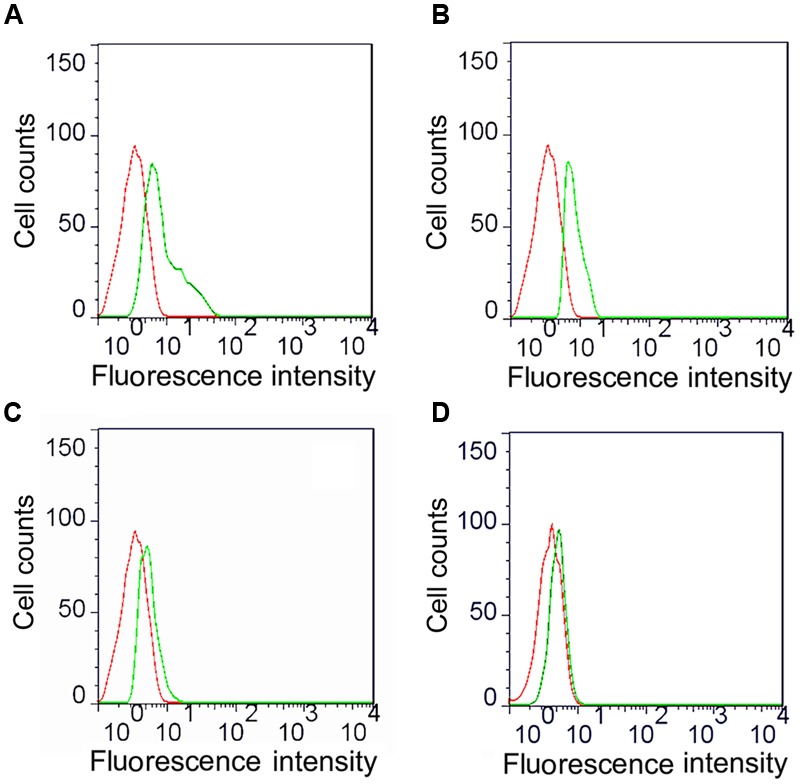
Flow cytometric analysis of MHC-II molecules expressed on macrophages. The macrophages were cultured into 24-well cell culture plates and 5 μg/mL ompA–Fc mixed with 50 μg/mL TPPPS (A), 5 μg/mL ompA–Fc (B), 5 μg/mL ompA (C), and 50 μg/mL TPPPS, (D) and 400 μL PBS were added into each well. After 6 h incubation, cells were incubated with 10 μL of mouse anti-chicken MHC-II antibody for 30 min and then stained with 1:500 FITC-conjugated goat anti-mouse antibody for 30 min. The expression of MHC-II molecules on the surface of macrophages was detected by flow cytometry. Red dotted line: PBS-treated macrophages (control group); green dotted line: recombinant protein and/or TPPPS-treated macrophages (experimental group). The images are representative of three independent experiments.
FIGURE 5
FIGURE 5
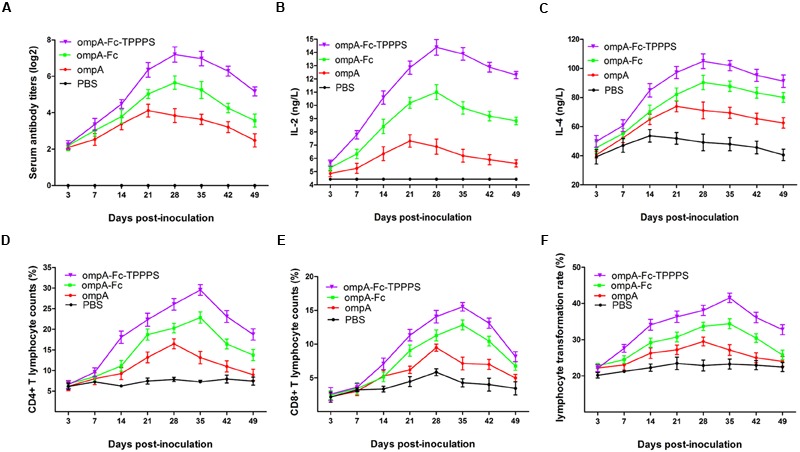
Linked Fc and TPPPS adjuvant enhance the humoral and cell-mediated immune responses. Chickens in the four groups were, respectively, inoculated with ompA subunit vaccine, ompA–Fc subunit vaccine, TPPPS adjuvant ompA–Fc subunit vaccine, and PBS at 0, 7, and 14 dpv. The specific anti-ompA antibody titers (A) were determined by indirect ELISA as previously described, and the concentrations of IL-2 (B) and IL-4 (C) were determined by commercial ELISA kits; the percentages of CD4+ (D) and CD8+ (E) T lymphocytes and LTRs (F) were detected by flow cytometry and MTT assay, respectively. All values represent the means ± SD of three independent experiments.
FIGURE 6
FIGURE 6
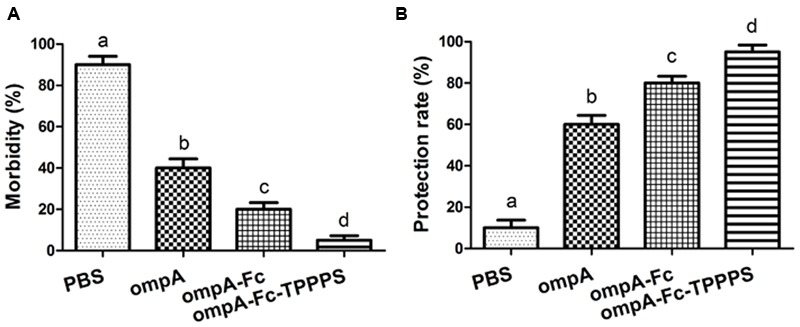
Protective rates of Bordetella avium-challenged chickens. Chickens in four groups were inoculated with ompA subunit vaccine, ompA–Fc subunit vaccine, TPPPS adjuvant ompA–Fc vaccine, and PBS at 1, 7, and 14 dpv. One week after the third vaccination, 20 chickens from each group were challenged intranasally with 10 LD50 of B. avium LL strain. Morbidity (A) and protective rate (B) were monitored for seven successive days after challenge. Morbidity (%) = No. of chickens with clinical symptoms/Total No. × 100. (B) Protective rate (%) = No. of chickens without clinical symptoms/Total No. × 100. Values shown represent the means ± SD for three independent experiments. Different lowercase letters above the columns indicate significant differences between the different groups (P ≤ 0.05).

References

    1. Amigorena S., Bonnerot C. (1999). Fc receptors for IgG and antigen presentation on MHC class I and class II molecules. Semin. Immunol. 11 385–390. 10.1006/smim.1999.0196 - DOI - PubMed
    1. Brumeanu T., Swiggard W., Steinman R., Bona C., Zaghouani H. (1993). Efficient loading of identical viral peptide onto class II molecules by antigenized immunoglobulin and influenza virus. J. Exp. Med. 178 1795–1799. 10.1084/jem.178.5.1795 - DOI - PMC - PubMed
    1. Cereghino J. L., Cregg J. M. (2000). Heterologous protein expression in the methylotrophic yeast Pichia pastoris. Fems. Microbiol. Rev. 24 45–66. 10.1111/j.1574-6976.2000.tb00532.x - DOI - PubMed
    1. Cook J., Barber B. H. (1995). Recombinant antibodies containing an engineered B-cell epitope capable of eliciting conformation-specific antibody responses. Vaccine 13 1770–1778. 10.1016/0264-410X(95)00140-V - DOI - PubMed
    1. Cui G., Zhong S., Yang S., Zuo X., Liang M., Sun J., et al. (2013). Effects of Taishan Pinus massoniana pollen polysaccharide on the subunit vaccine of Proteus mirabilis in birds. Int. J. Biol. Macromol. 56 94–98. 10.1016/j.ijbiomac.2013.02.006 - DOI - PubMed