. 2016 Nov 29;113(48):13917-13922.
doi: 10.1073/pnas.1612635113. Epub 2016 Nov 14.

Arabidopsis thaliana GH3.5 acyl acid amido synthetase mediates metabolic crosstalk in auxin and salicylic acid homeostasis

Affiliations

Arabidopsis thaliana GH3.5 acyl acid amido synthetase mediates metabolic crosstalk in auxin and salicylic acid homeostasis

Corey S Westfall et al. Proc Natl Acad Sci U S A. .

Abstract

In Arabidopsis thaliana, the acyl acid amido synthetase Gretchen Hagen 3.5 (AtGH3.5) conjugates both indole-3-acetic acid (IAA) and salicylic acid (SA) to modulate auxin and pathogen response pathways. To understand the molecular basis for the activity of AtGH3.5, we determined the X-ray crystal structure of the enzyme in complex with IAA and AMP. Biochemical analysis demonstrates that the substrate preference of AtGH3.5 is wider than originally described and includes the natural auxin phenylacetic acid (PAA) and the potential SA precursor benzoic acid (BA). Residues that determine IAA versus BA substrate preference were identified. The dual functionality of AtGH3.5 is unique to this enzyme although multiple IAA-conjugating GH3 proteins share nearly identical acyl acid binding sites. In planta analysis of IAA, PAA, SA, and BA and their respective aspartyl conjugates were determined in wild-type and overexpressing lines of A thaliana This study suggests that AtGH3.5 conjugates auxins (i.e., IAA and PAA) and benzoates (i.e., SA and BA) to mediate crosstalk between different metabolic pathways, broadening the potential roles for GH3 acyl acid amido synthetases in plants.

Keywords: Arabidopsis; auxin; plant biochemistry; plant hormone; protein structure.


Conflict of interest statement

The authors declare no conflict of interest.

Figures
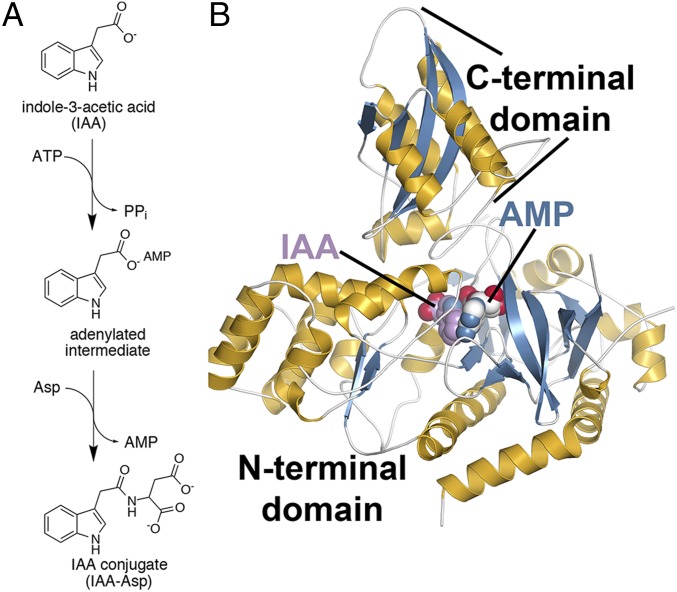
Fig. 1.
Fig. 1.
Reaction and 3D structure of AtGH3.5. (A) Overall reaction catalyzed by AtGH3.5 and other IAA-conjugating acyl acid amido synthetases. (B) 3D structure of AtGH3.5. The ribbon diagram shows the N- and C-terminal domains with α-helices (gold) and β-strands (blue). Ligands are shown as space-filling models.
Fig. 2.
Fig. 2.
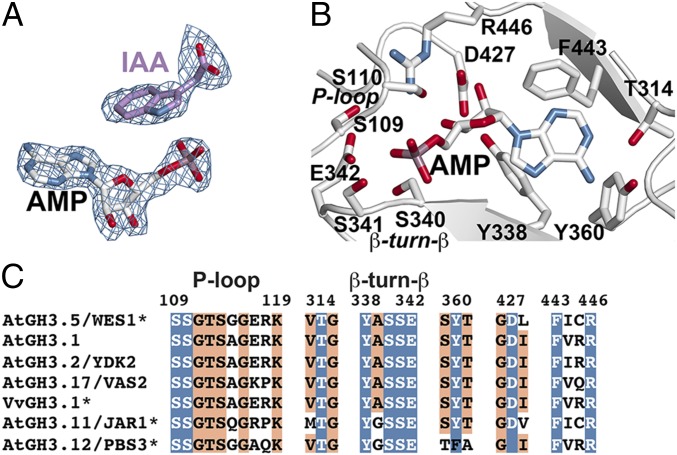
AtGH3.5 nucleotide binding site. (A) Electron density for IAA and AMP is shown as a 2Fo-Fc omit map (1.5 σ). (B) AMP and nucleotide binding site residues are shown as stick models. Regions corresponding to the P-loop and the β-turn-β motif are indicated. (C) Targeted sequence comparison of functionally characterized GH3 proteins from Arabidopsis and grape (VvGH3.1). Residues of the P-loop and the β-turn-β motif are noted. Numbering corresponds to AtGH3.5. Residues with side chains shown in B are colored in blue with white text. Other conserved positions are highlighted in orange. Asterisks indicate proteins with 3D structures (9, 13).
Fig. 3.
Fig. 3.
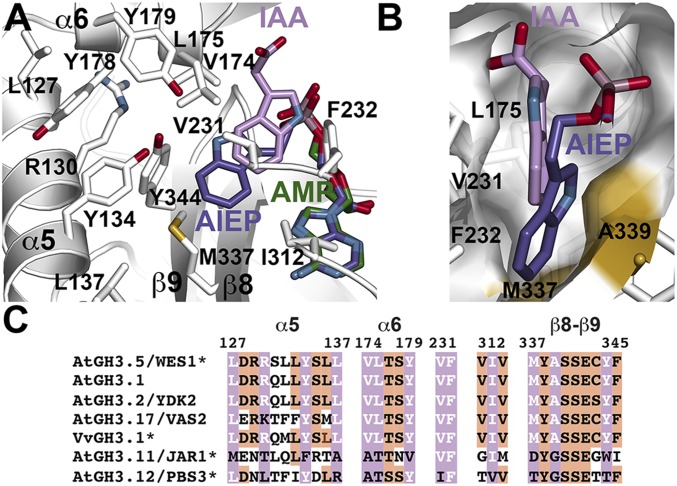
AtGH3.5 acyl acid binding site. (A) Residues in the acyl acid binding site of AtGH3.5 are shown as stick drawings. IAA (pink) and AMP (green) in the AtGH3.5 structure are indicated. For comparison, the position of the adenylated intermediate mimic AIEP (purple) from the VvGH3.1 crystal structure (13) is shown. (B) Comparison of IAA and AIEP from the AtGH3.5 and VvGH3.1 structures, respectively. The surface corresponds to AtGH3.5 with the positions of Met337 and Ala339, residues that alter IAA versus BA preference, colored in gold. (C) Targeted sequence comparison of functionally characterized GH3 proteins from Arabidopsis and grape. Residues of α5, α6, and β8-turn-β9 are noted. Numbering corresponds to AtGH3.5. Residues with side chains shown in A are colored in pink with white text. Other conserved positions are highlighted in orange. Asterisks indicate proteins with 3D structures (9, 13).
Fig. S1.
Fig. S1.
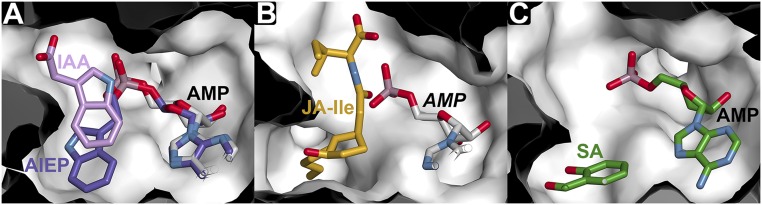
Comparison of GH3 protein acyl acid binding sites. Surface views of the acyl acid binding sites of AtGH3.5 (A), AtGH3.11 (B), and AtGH3.12 (C) highlight the structural difference in each enzyme. Each view is oriented to show the binding of acyl acids relative to the nucleotide site. (A) AtGH3.5 active site. The positions of IAA (pink) and AMP (white) were determined crystallographically (Figs. 2 and 3) with the position of AIEP (purple) from the VvGH3.1 structure (13) overlaid on the AtGH3.5•AMP•IAA complex structure. (B) AtGH3.11 active site. Binding of JA-Ile in the crystal structure reveals a larger active site to accommodate the oxylipin moiety of JA (9). The location of AMP is modeled based on the AtGH3.5 structure and is shown only for reference. (C) The AtGH3.12 active site. The crystallographically determined positions of SA, an inhibitor of AtGH3.12, and AMP (both ligands in green) are shown (9).
Fig. S2.
Fig. S2.
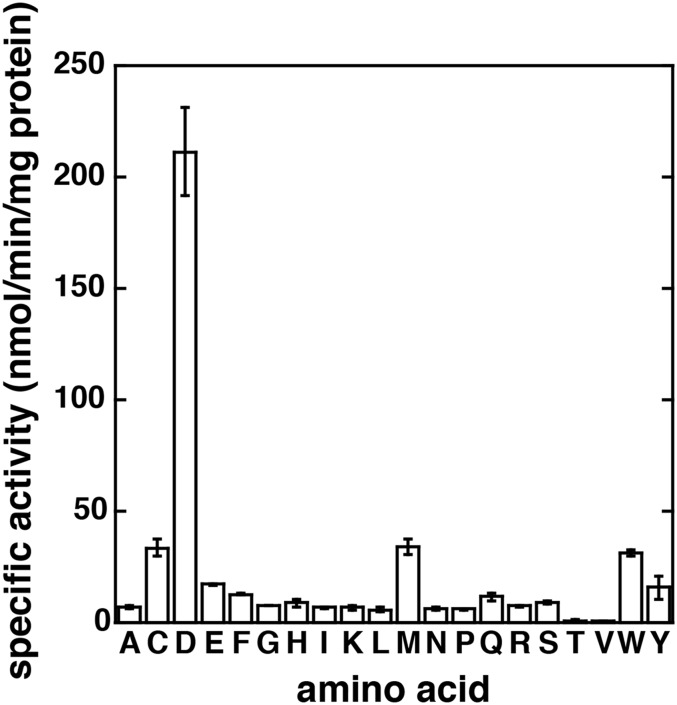
Amino acid screen of AtGH3.5. Activity assays of AtGH3.5 with 1 mM IAA, 1 mM ATP, and 5 mM amino acid. Each assay was performed in triplicate; data are shown as mean ± SD.
Fig. S3.
Fig. S3.
AtGH3.5-overexpressing plants. (A) Comparison of 1-mo-old A. thaliana wild-type Col-0 rosettes (Left) and 1-mo-old 35S:Atgh3.5 rosettes for overexpressing lines OE1–4 (Right). (B) Immunoblot analysis of AtGH3.5::FLAG (transgenic lines OE1–4) expression in transgenic A. thaliana plants. Wild-type A. thaliana Col-0 is included as a negative control. The molecular weight (MW) ladder is shown. Equal amounts (20 μg) of total soluble protein extracted from 1-mo-old leaf tissues were separated by SDS/PAGE, electrotransferred, and probed with anti-FLAG M2 antibody to detect FLAG-tagged proteins.
Fig. 4.
Fig. 4.
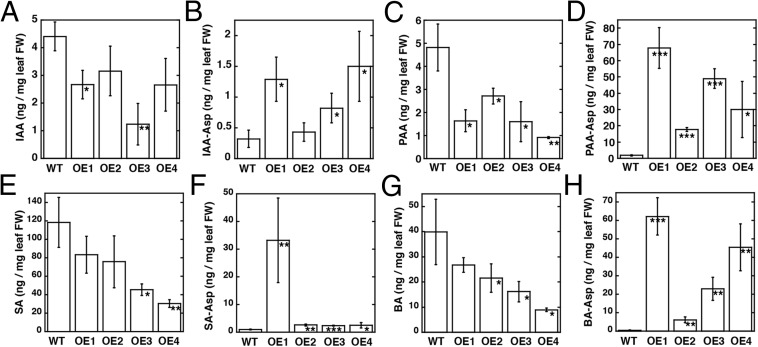
Levels of free acyl acids and acyl acid conjugates in wild-type and AtGH3.5-overexpressing lines of Arabidopsis thaliana. Levels of IAA (A), IAA-Asp (B), PAA (C), PAA-Asp (D), SA (E), SA-Asp (F), BA (G), and BA-Asp (H) from 1-mo-old leaf tissue of wild-type A. thaliana and four independently transformed AtGH3.5-overexpressing lines (OE1–4). Metabolite levels are in nanograms per mg fresh weight (FW) leaf tissue with mean ± SD (n = 12–18). *P < 0.01, **P < 0.001, ***P < 0.0001 versus wild type.
Fig. S4.
Fig. S4.
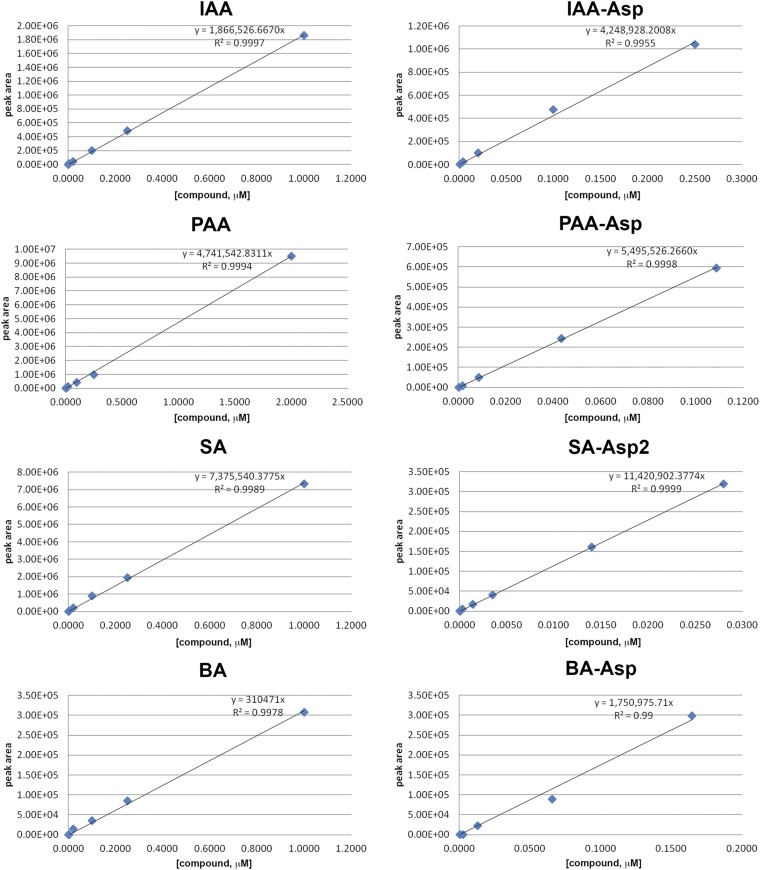
Standard curves for mass spectrometry of free and conjugated acyl acids. Using the first MRM transitions listed in Table S4 a standard curve was generated for all compounds but SA-Asp. All compounds showed a linear response. SA-Asp had a better standard curve with the second MRM transition.

References

    1. Korasick DA, Enders TA, Strader LC. Auxin biosynthesis and storage forms. J Exp Bot. 2013;64(9):2541–2555. - PMC - PubMed
    1. Westfall CS, Muehler AM, Jez JM. Enzyme action in the regulation of plant hormone responses. J Biol Chem. 2013;288(27):19304–19311. - PMC - PubMed
    1. Staswick PE, Tiryaki I, Rowe ML. Jasmonate response locus JAR1 and several related Arabidopsis genes encode enzymes of the firefly luciferase superfamily that show activity on jasmonic, salicylic, and indole-3-acetic acids in an assay for adenylation. Plant Cell. 2002;14(6):1405–1415. - PMC - PubMed
    1. Fonseca S, et al. (+)-7-iso-Jasmonoyl-L-isoleucine is the endogenous bioactive jasmonate. Nat Chem Biol. 2009;5(5):344–350. - PubMed
    1. Meesters C, et al. A chemical inhibitor of jasmonate signaling targets JAR1 in Arabidopsis thaliana. Nat Chem Biol. 2014;10(10):830–836. - PubMed

Publication types

Associated data

LinkOut - more resources