


Wrist Accelerometer Cut Points for Classifying Sedentary Behavior in Children
- PMID: 27851669
- PMCID: PMC5332065
- DOI: 10.1249/MSS.0000000000001158
Wrist Accelerometer Cut Points for Classifying Sedentary Behavior in Children
Abstract
Introduction: This study aimed to examine the validity and accuracy of wrist accelerometers for classifying sedentary behavior (SB) in children.
Methods: Fifty-seven children (5-8 and 9-12 yr) completed an ~170-min protocol, including 15 semistructured activities and transitions. Nine ActiGraph (GT3X+) and two GENEActiv wrist cut points were evaluated. Direct observation was the criterion measure. The accuracy of wrist cut points was compared with that achieved by the ActiGraph hip cut point (≤25 counts per 15 s) and the thigh-mounted activPAL3. Analyses included equivalence testing, Bland-Altman procedures, and area under the receiver operating curve (ROC-AUC).
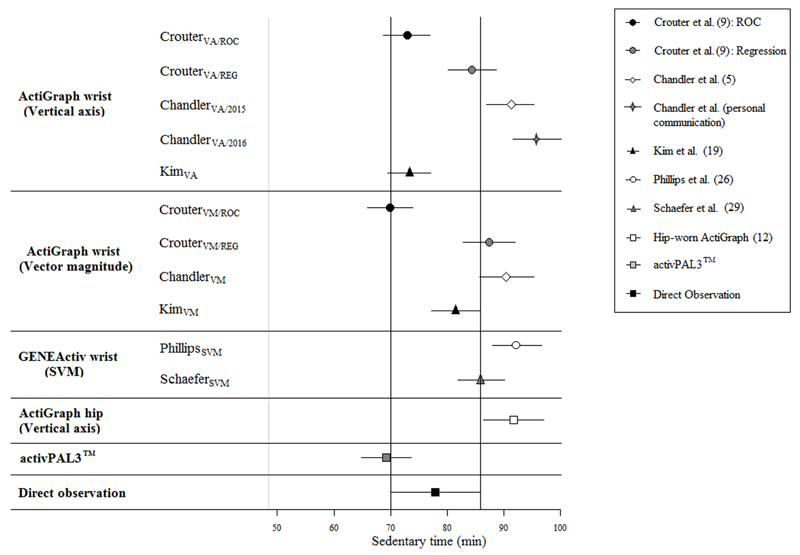
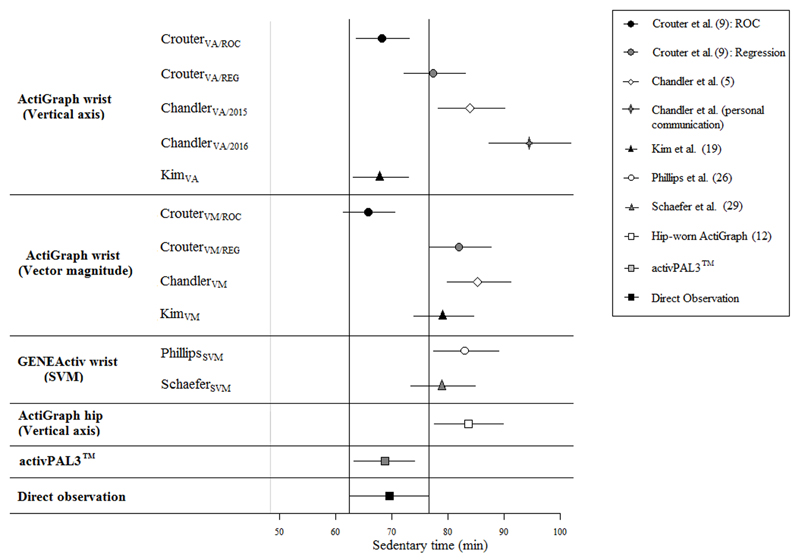
Results: The most accurate ActiGraph wrist cut points (Kim; vector magnitude, ≤3958 counts per 60 s; vertical axis, ≤1756 counts per 60 s) demonstrated good classification accuracy (ROC-AUC = 0.85-0.86) and accurately estimated SB time in 5-8 yr (equivalence P = 0.02; mean bias = 4.1%, limits of agreement = -20.1% to 28.4%) and 9-12 yr (equivalence P < 0.01; -2.5%, -27.9% to 22.9%). The mean bias of SB time estimates from Kim were smaller than ActiGraph hip (5-8 yr: 15.8%, -5.7% to 37.2%; 9-12 yr: 17.8%, -3.9% to 39.5%) and similar to or smaller than activPAL3 (5-8 yr: 12.6%, -39.8% to 14.7%; 9-12 yr: -1.4%, -13.9% to 11.0%), although classification accuracy was similar to ActiGraph hip (ROC-AUC = 0.85) but lower than activPAL3 (ROC-AUC = 0.92-0.97). Mean bias (5-8 yr: 6.5%, -16.1% to 29.1%; 9-12 yr: 10.5%, -13.6% to 34.6%) for the most accurate GENEActiv wrist cut point (Schaefer: ≤0.19 g) was smaller than ActiGraph hip, and activPAL3 in 5-8 yr, but larger than activPAL3 in 9-12 yr. However, SB time estimates from Schaefer were not equivalent to direct observation (equivalence P > 0.05) and classification accuracy (ROC-AUC = 0.79-0.80) was lower than for ActiGraph hip and activPAL3.
Conclusion: The most accurate SB ActiGraph (Kim) and GENEActiv (Schaefer) wrist cut points can be applied in children with similar confidence as the ActiGraph hip cut point (≤25 counts per 15 s), although activPAL3 was generally more accurate.
Conflict of interest statement
The authors have no conflict of interest to declare. The results of the present study do not constitute endorsement by the American College of Sports Medicine. The results are presented clearly, honestly, and without fabrication, falsification, or inappropriate data manipulation.
Figures
References
-
- Batterham M, Van Loo C, Charlton K, Cliff D, Okely A. Improved interpretation of studies comparing methods of dietary assessment: Combining equivalence testing with the limits of agreement. Br J Nutr. 2016;115(7):1273–1280. - PubMed
-
- Center for Disease Control and Prevention. Physical activity Monitor (PAM) Procedures Manual. [cited 2016 May 19]; [internet]. Available from: http://www.cdc.gov/nchs/data/nhanes/nhanes_11_12/Physical_Activity_Monit....
-
- Chandler J, Brazendale K, Beets M, Mealing B. Classification of physical activity intensities using a wrist-worn accelerometer in 8–12-year-old children. Pediatr Obes. 2015;11(2):120–127. - PubMed
MeSH terms
Grants and funding
LinkOut - more resources
Full Text Sources
Other Literature Sources
Medical
