


The Effect of Oliveria Decumbens and Pelargonium Graveolens on Healing of Infected Skin Wounds in Mice
- PMID: 27853689
- PMCID: PMC5109387
The Effect of Oliveria Decumbens and Pelargonium Graveolens on Healing of Infected Skin Wounds in Mice
Abstract
Background: Staphylococcus aureus is one of the most causative organisms in the skin wound infections. Development of resistant S. aureus to current treatments in individuals with low immunity is a global concern. The aim of this study was to evaluate the efficacy of herbal formulation against skin wound infection.
Methods: The efficacy of herbal formulation containing Oliveria decumbens and Pelargonium graveolens essential oils was evaluated in comparison to mupirocin against Methicillin Resistant S. aureus (MRSA) related skin wound infection in mice animal model.
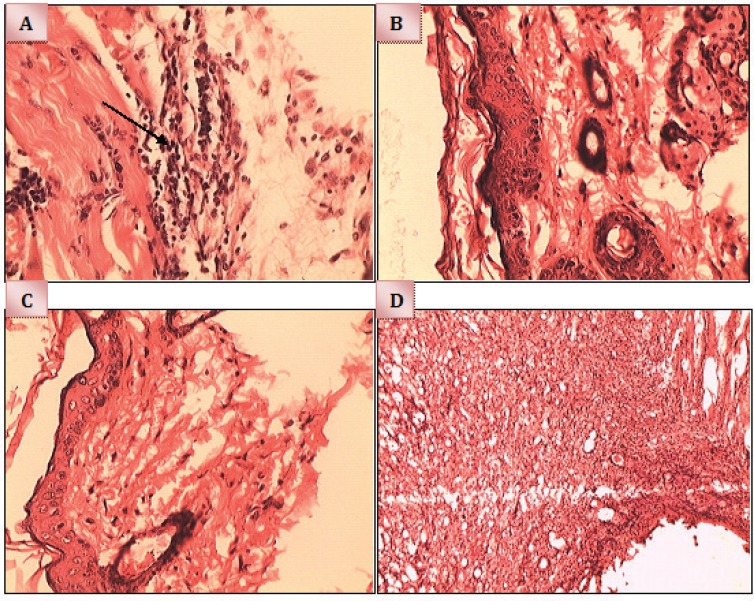
Results: The herbal cream and mupirocin decreased the log CFU by 2.5±0.26 and 2.46±0.32, respectively, while the log CFU of S. aureus from wound skin were 5.9±0.26 and 5.65±0.23 for placebo and control groups, respectively. Moreover, the histological examinations showed that this cream improved the wound healing and increased the collagen deposition and wound contraction.
Conclusion: This natural new formulation with O. decumbens and P. graveolens essential oils could be recommended as a new candidate for wound healing.
Keywords: Healing; Infected wound; Mouse; Oliveria decumbens; Pelargonium graveolens.
Figures
References
-
- Golding GR, Quinn B, Bergstrom K, Stockdale D, Woods S, Nsungu M, Brooke B, Levett PN, Horsman G, McDonald R, Szklarczuk B, Silcox S, Paton S, Carson M, Mulvey MR, Irvine J. Community-based educational intervention to limit the dissemination of community-associated methicillin-resistant Staphylococcus aureus in Northern Saskatchewan, Canada. BMC public Health. 2012;12:15. - PMC - PubMed
-
- Saderi H, Owlia P, Habibi M. Mupirocin resistance among Iranian isolates of Staphylococcus aureus. Med Sci Monit. 2008;14:210–3. - PubMed
-
- Amin G, Sourmaghi MHS, Zahedi M, Khanavi M, Samadi N. Essential oil composition and antimicrobial activity of Oliveria decumbens. Fitoterapia. 2005;76:704–7. - PubMed
-
- Mahboobi M, Shahcheraghi F, Feizabadi MM. Bactericidal Effects of Essential Oils from Clove, Lavender and Geranium on Multi-Drug Resistant Isolates of Pseudomonas aeruginosa. Iran J Biotech. 2006;4:137–40.
LinkOut - more resources
Full Text Sources