Review
. 2016 Nov 17;4(1):121.
doi: 10.1186/s40478-016-0392-6.

Review of RyR1 pathway and associated pathomechanisms

Affiliations
Review

Review of RyR1 pathway and associated pathomechanisms

Jessica W Witherspoon et al. Acta Neuropathol Commun. .

Abstract

Ryanodine receptor isoform-1 (RyR1) is a major calcium channel in skeletal muscle important for excitation-contraction coupling. Mutations in the RYR1 gene yield RyR1 protein dysfunction that manifests clinically as RYR1-related congenital myopathies (RYR1-RM) and/or malignant hyperthermia susceptibility (MHS). Individuals with RYR1-RM and/or MHS exhibit varying symptoms and severity. The symptoms impair quality of life and put patients at risk for early mortality, yet the cause of varying severity is not well understood. Currently, there is no Food and Drug Administration (FDA) approved treatment for RYR1-RM. Discovery of effective treatments is therefore critical, requiring knowledge of the RyR1 pathway. The purpose of this review is to compile work published to date on the RyR1 pathway and to implicate potential regions as targets for treatment. The RyR1 pathway is comprised of protein-protein interactions, protein-ligand interactions, and post-translational modifications, creating an activation/regulatory macromolecular complex. Given the complexity of this pathway, we divided these interactions and modifications into six regulatory groups. Three of several RyR1 interacting proteins, FK506-binding protein 12 (FKBP12), triadin, and calmodulin, were identified as playing important roles across all groups and may serve as promising target sites for treatment. Also, variability in disease severity may be influenced by prolongation or hyperactivity of post-translational modifications resulting from RyR1 dysfunction.

Keywords: Excitation-contraction; Mitochondria; Muscle; Myopathies; Oxidative; Pathomechanism; Post-translational modifications; RyR1; Skeletal; Stress; Treatment.


Figures
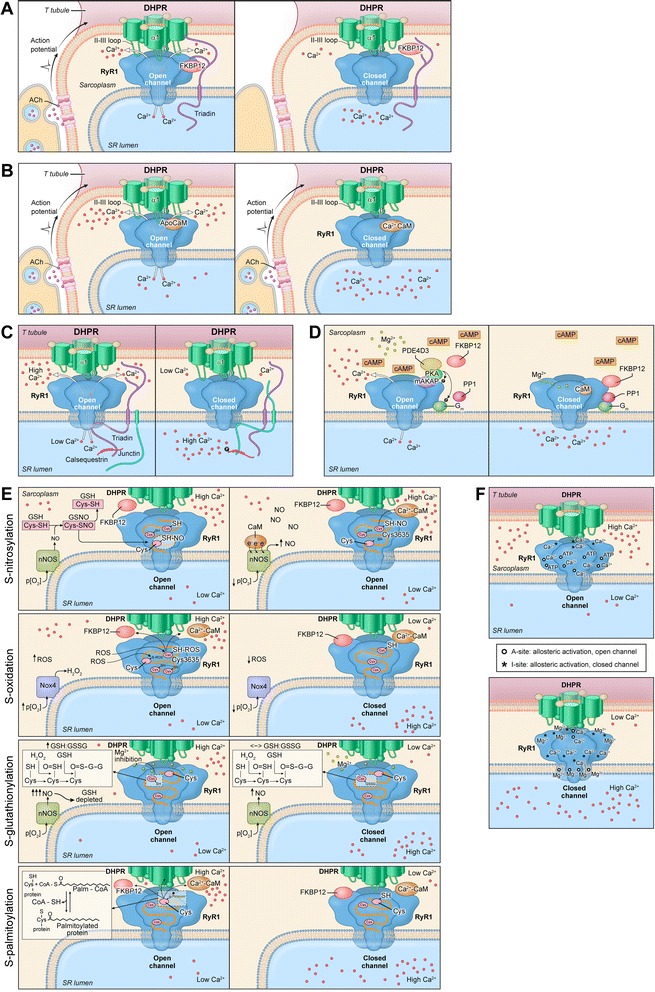
Fig. 1
Fig. 1
a Group 1. 1) RyR1 open (voltage-gated): RyR1 activation in response to DHPR activation by acetylcholine (ACh) release at the neuromuscular junction in skeletal muscle 2) RyR1 closed: no neuromuscular-stimulated ACh release. b Group 2. 1) RyR1 open: No interdomain interaction (unzipped) with bound ApoCaM in response to RyR1 activation preceded by DHPR activation resulting in high sarcoplasmic Ca2 + 2) RyR1 closed: bound Ca2+-Cam at high [Ca2+] resulting in interdomain interaction (zipped) and high sarcoplasmic reticulum (SR) Ca2+. c Group 3. 1) RyR1 open: RyR1-triadin interaction due to triadin-calsequestrin (CSQ) interaction at high Ca2+ bound CSQ resulting in high sarcoplasmic Ca2+ 2) RyR1 closed: RyR1-junctin interaction due to junctin-CSQ interaction at low Ca2+ bound CSQ in phosphorylated state  resulting in high SR Ca2+. d Group 4. 1) RyR1 open: RyR1 and Gm phosphorylation by PKA due to high [cAMP] resulting in high sarcoplasmic Ca2+ 2) RyR1 closed: RyR1 dephosphorylation by PP1 due to low [cAMP] resulting in high SR Ca2+. e Group 5. S-nitrosylation. 1) RyR1 open: nitrosylation of RyR1 cysteine residues by nitric oxide-glutathione reaction in response to physiologic p(O2)  resulting in high sarcoplasmic Ca2+2) RyR1 open: nitrosylation of RyR1 by nitric oxide overrides Ca-CaM inhibitory effect resulting in high sarcoplasmic Ca2+ S-oxidation. 1) RyR1 open: oxidation of RyR1 cysteine residues by reactive oxygen species reaction in response to increased physiologic p(O2) resulting in high sarcoplasmic Ca2+ 2) RyR1 closed: no RyR1 oxidation at low physiologic p(O2) with bound Ca2+-CaM resulting in high SR Ca2+ S-glutathionylation. 1) RyR1 open: initial increase in reduced glutathione (GSH) stimulating glutathionylation of RyR1 cysteine residues by GSH, in turn, decreasing the GSH:GSSG and reducing RyR1 sensitivity to Mg2+ inhibition resulting in high sarcoplasmic Ca2+ 2) RyR1 closed: no glutathionylation until GSH:GSSG ratio is restored resulting in high SR Ca2+ S-palmitoylation. 1) RyR1 open: palmitoylation of RyR1 cysteine residues by the fatty acid palmitoyl-CoA resulting in high sarcoplasmic Ca2+2) RyR1 closed: no palmitoylation resulting in high SR Ca2+. f Group 6. 1) RyR1 open: RyR1-ligand (Ca2+and ATP) binding activation resulting in high sarcoplasmic Ca2+ 2) RyR1 closed: RyR1-ligand (Ca2+ and Mg2+) binding deactivation resulting in high SR Ca2+

References

    1. Aghdasi B, Reid MB, Hamilton SL. Nitric oxide protects the skeletal muscle Ca2+ release channel from oxidation induced activation. J Biol Chem. 1997;272:25462–25467. doi: 10.1074/jbc.272.41.25462. - DOI - PubMed
    1. Amburgey K, McNamara N, Bennett LR, McCormick ME, Acsadi G, Dowling JJ. Prevalence of congenital myopathies in a representative pediatric united states population. Ann Neurol. 2011;70:662–665. doi: 10.1002/ana.22510. - DOI - PubMed
    1. Amburgey K, Bailey A, Hwang JH, Tarnopolsky MA, Bonnemann CG, Medne L, Mathews KD, Collins J, Daube JR, Wellman GP, et al. Genotype-phenotype correlations in recessive RYR1-related myopathies. Orphanet J Rare Dis. 2013;8:117. doi: 10.1186/1750-1172-8-117. - DOI - PMC - PubMed
    1. Andersson DC, Betzenhauser MJ, Reiken S, Meli AC, Umanskaya A, Xie W, Shiomi T, Zalk R, Lacampagne A, Marks AR. Ryanodine receptor oxidation causes intracellular calcium leak and muscle weakness in aging. Cell Metab. 2011;14:196–207. doi: 10.1016/j.cmet.2011.05.014. - DOI - PMC - PubMed
    1. Andersson DC, Meli AC, Reiken S, Betzenhauser MJ, Umanskaya A, Shiomi T, D’Armiento J, Marks AR. Leaky ryanodine receptors in beta-sarcoglycan deficient mice: a potential common defect in muscular dystrophy. Skelet Muscle. 2012;2:9. doi: 10.1186/2044-5040-2-9. - DOI - PMC - PubMed

Publication types

MeSH terms

Substances

LinkOut - more resources
