


Repositionable Versus Balloon-Expandable Devices for Transcatheter Aortic Valve Implantation in Patients With Aortic Stenosis
- PMID: 27856487
- PMCID: PMC5210340
- DOI: 10.1161/JAHA.116.004088
Repositionable Versus Balloon-Expandable Devices for Transcatheter Aortic Valve Implantation in Patients With Aortic Stenosis
Abstract
Background: The safety and effectiveness of the fully repositionable LOTUS valve system as compared with the balloon-expandable Edwards SAPIEN 3 prosthesis for the treatment of aortic stenosis has not been evaluated to date.
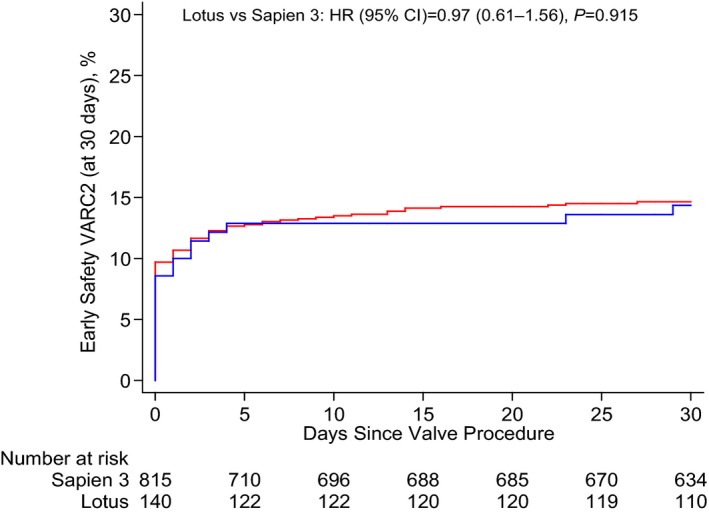
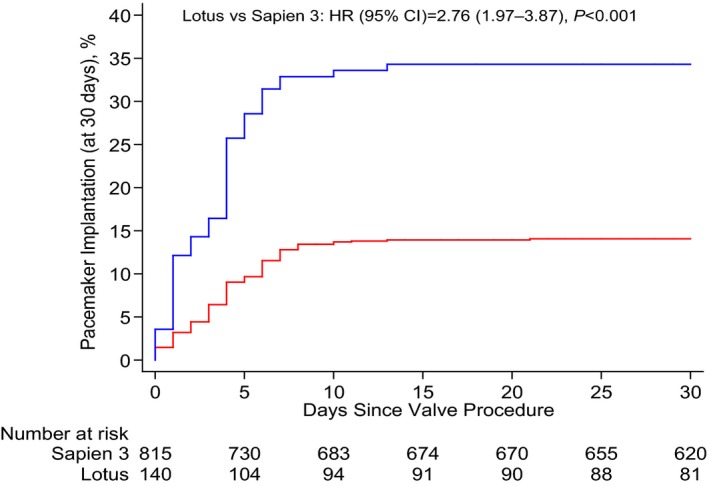
Methods and results: All patients undergoing transcatheter aortic valve implantation with the Edwards SAPIEN 3 or the LOTUS valve system were included into the Swiss Transcatheter Aortic Valve Implantation Registry. An adjusted analysis was performed to compare the early clinical safety outcome according to the Valve Academic Research Consortium-2 definition. Between February 2014 and September 2015, 140 and 815 patients were treated with the LOTUS and the Edwards SAPIEN 3 valve, respectively. There was no difference in crude and adjusted analyses of the early safety outcome between patients treated with LOTUS (14.3%) and those treated with Edwards SAPIEN 3 (14.6%) (crude hazard ratio, 0.97; 95% CI, 0.61-1.56 [P=0.915]; adjusted hazard ratio, 1.03; 95% CI, 0.64-1.67 [P=0.909]). More than mild aortic regurgitation was <2% for both devices. A total of 34.3% of patients treated with LOTUS and 14.1% of patients treated with Edwards SAPIEN 3 required a permanent pacemaker (HR, 2.76; 95% CI, 1.97-3.87 [P<0.001]).
Conclusions: The repositionable LOTUS valve system and the balloon-expandable Edwards SAPIEN 3 prosthesis appeared comparable in regard to the Valve Academic Research Consortium-2 early safety outcome, and the rates of more than mild aortic regurgitation were exceedingly low for both devices. The need for new permanent pacemaker implantation was more frequent among patients treated with the LOTUS valve.
Keywords: aortic valve regurgitation; newer‐generation devices; permanent pacemaker; transcatheter aortic valve replacement.
© 2016 The Authors. Published on behalf of the American Heart Association, Inc., by Wiley Blackwell.
Figures
References
-
- Pilgrim T, Windecker S. Newer‐generation devices for transcatheter aortic valve replacement. JACC Cardiovasc Interv. 2016;9:373–375. - PubMed
-
- Meredith Am IT, Walters DL, Dumonteil N, Worthley SG, Tchétché D, Manoharan G, Blackman DJ, Rioufol G, Hildick‐Smith D, Whitbourn RJ, Lefèvre T, Lange R, Müller R, Redwood S, Allocco DJ, Dawkins KD. Transcatheter aortic valve replacement for severe symptomatic aortic stenosis using a repositionable valve system: 30‐day primary endpoint results from the REPRISE II study. J Am Coll Cardiol. 2014;64:1339–1348. - PubMed
-
- Rampat R, Khawaja MZ, Byrne J, MacCarthy P, Blackman DJ, Krishnamurthy A, Gunarathne A, Kovac J, Banning A, Kharbanda R, Firoozi S, Brecker S, Redwood S, Bapat V, Mullen M, Aggarwal S, Manoharan G, Spence MS, Khogali S, Dooley M, Cockburn J, de Belder A, Trivedi U, Hildick‐Smith D. Transcatheter aortic valve replacement using the repositionable LOTUS valve. JACC Cardiovasc Interv. 2016;9:367–372. - PubMed
-
- Meredith IT, Walters DL, Dumonteil N, Worthley SG, Tchétché D, Manoharan G, Blackman DJ, Rioufol G, Hildick‐Smith D, Whitbourn RJ, Lefèvre T, Lange R, Müller R, Redwood S, Feldman TE, Allocco DJ, Dawkins KD. 1‐year outcomes with the fully repositionable and retrievable Lotus Transcatheter Aortic Replacement Valve in 120 high‐risk surgical patients with severe aortic stenosis. JACC Cardiovasc Interv. 2016;9:376–384. - PubMed
-
- Wenaweser P, Stortecky S, Heg D, Tueller D, Nietlispach F, Falk V, Pedrazzini G, Jeger R, Reuthebuch O, Carrel T, Räber L, Amann FW, Ferrari E, Toggweiler S, Noble S, Roffi M, Gruenenfelder J, Jüni P, Windecker S, Huber C. Short‐term clinical outcomes among patients undergoing transcatheter aortic valve implantation in Switzerland: the Swiss TAVI registry. EuroIntervention. 2014;10:982–989. - PubMed
Publication types
MeSH terms
LinkOut - more resources
Full Text Sources
Other Literature Sources
