


Spontaneous default network activity reflects behavioral variability independent of mind-wandering
- PMID: 27856733
- PMCID: PMC5137714
- DOI: 10.1073/pnas.1611743113
Spontaneous default network activity reflects behavioral variability independent of mind-wandering
Abstract
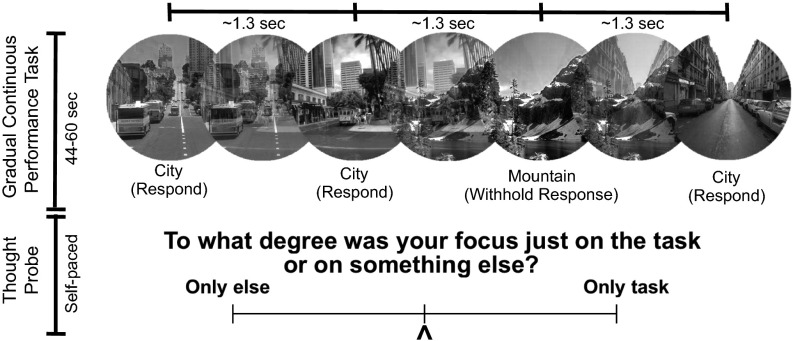
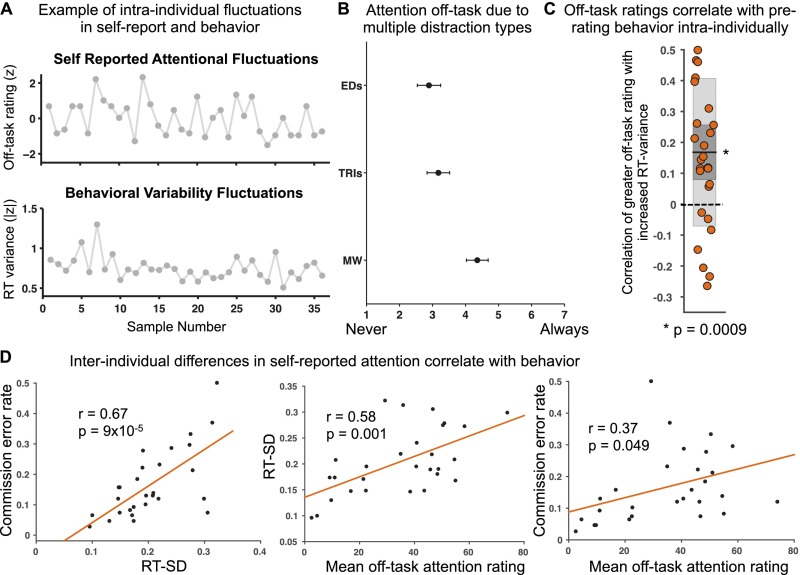
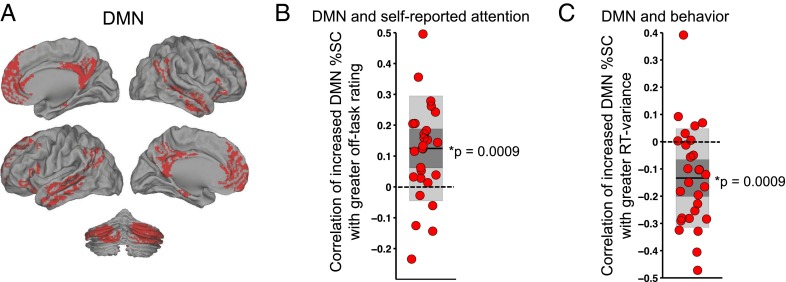
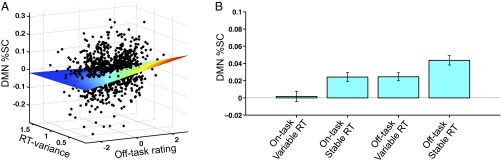
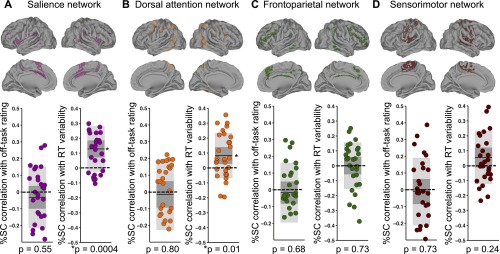
The brain's default mode network (DMN) is highly active during wakeful rest when people are not overtly engaged with a sensory stimulus or externally oriented task. In multiple contexts, increased spontaneous DMN activity has been associated with self-reported episodes of mind-wandering, or thoughts that are unrelated to the present sensory environment. Mind-wandering characterizes much of waking life and is often associated with error-prone, variable behavior. However, increased spontaneous DMN activity has also been reliably associated with stable, rather than variable, behavior. We aimed to address this seeming contradiction and to test the hypothesis that single measures of attentional states, either based on self-report or on behavior, are alone insufficient to account for DMN activity fluctuations. Thus, we simultaneously measured varying levels of self-reported mind-wandering, behavioral variability, and brain activity with fMRI during a unique continuous performance task optimized for detecting attentional fluctuations. We found that even though mind-wandering co-occurred with increased behavioral variability, highest DMN signal levels were best explained by intense mind-wandering combined with stable behavior simultaneously, compared with considering either single factor alone. These brain-behavior-experience relationships were highly consistent within known DMN subsystems and across DMN subregions. In contrast, such relationships were absent or in the opposite direction for other attention-relevant networks (salience, dorsal attention, and frontoparietal control networks). Our results suggest that the cognitive processes that spontaneous DMN activity specifically reflects are only partially related to mind-wandering and include also attentional state fluctuations that are not captured by self-report.
Keywords: daydreaming; default mode network; resting state; spontaneous thought; sustained attention.
Conflict of interest statement
The authors declare no conflict of interest.
Figures
Comment in
-
Reply to Csifcsák and Mittner: Fitting data to neural models of mind-wandering.Proc Natl Acad Sci U S A. 2017 Jul 25;114(30):E6033. doi: 10.1073/pnas.1707780114. Epub 2017 Jul 13. Proc Natl Acad Sci U S A. 2017. PMID: 28705871 Free PMC article. No abstract available.
-
Linking brain networks and behavioral variability to different types of mind-wandering.Proc Natl Acad Sci U S A. 2017 Jul 25;114(30):E6031-E6032. doi: 10.1073/pnas.1705108114. Epub 2017 Jul 13. Proc Natl Acad Sci U S A. 2017. PMID: 28705872 Free PMC article. No abstract available.
References
-
- Shulman GL, et al. Common blood flow changes across visual tasks: II. Decreases in cerebral cortex. J Cogn Neurosci. 1997;9(5):648–663. - PubMed
-
- Smallwood J, Schooler JW. The restless mind. Psychol Bull. 2006;132(6):946–958. - PubMed
-
- Buckner RL, Andrews-Hanna JR, Schacter DL. The brain’s default network: Anatomy, function, and relevance to disease. Ann N Y Acad Sci. 2008;1124:1–38. - PubMed
-
- Christoff K, Irving ZC, Fox KC, Spreng RN, Andrews-Hanna JR. Mind-wandering as spontaneous thought: A dynamic framework. Nat Rev Neurosci. 2016;17(11):718–731. - PubMed
Publication types
MeSH terms
Grants and funding
LinkOut - more resources
Full Text Sources
Other Literature Sources
