


Reducing nicotine exposure results in weight gain in smokers randomised to very low nicotine content cigarettes
- PMID: 27856940
- PMCID: PMC5428392
- DOI: 10.1136/tobaccocontrol-2016-053301
Reducing nicotine exposure results in weight gain in smokers randomised to very low nicotine content cigarettes
Abstract
Background: The Food and Drug Administration can reduce the nicotine content in cigarettes to very low levels. This potential regulatory action is hypothesised to improve public health by reducing smoking, but may have unintended consequences related to weight gain.
Methods: Weight gain was evaluated from a double-blind, parallel, randomised clinical trial of 839 participants assigned to smoke 1 of 6 investigational cigarettes with nicotine content ranging from 0.4 to 15.8 mg/g or their own usual brand for 6 weeks. Additional analyses evaluated weight gain in the lowest nicotine content cigarette groups (0.4 and 0.4 mg/g, high tar) to examine the effect of study product in compliant participants as assessed by urinary biomarkers. Differences in outcomes due to gender were also explored.
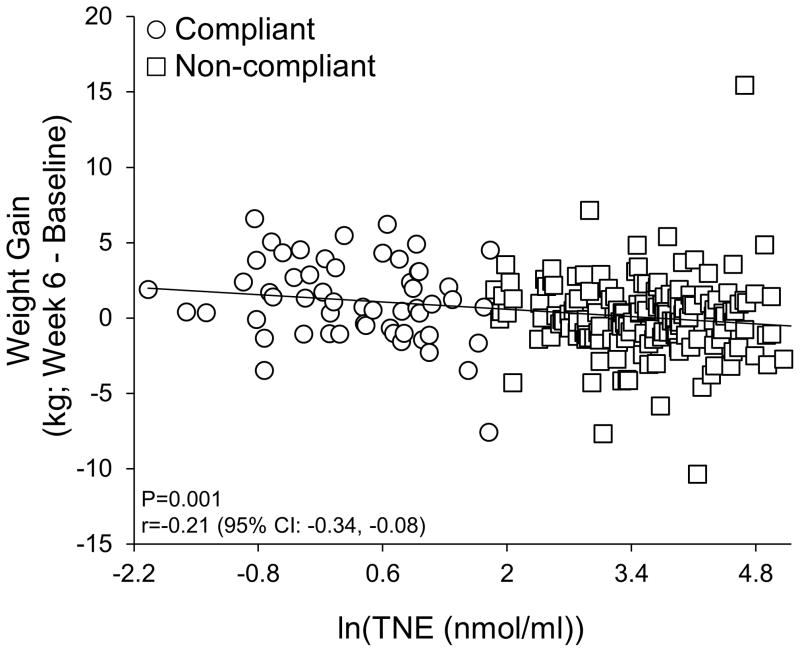
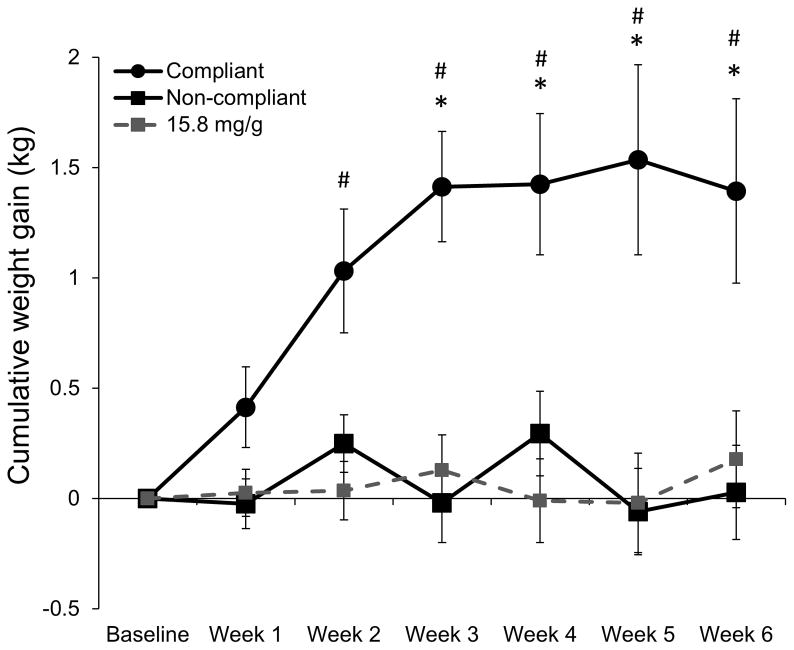
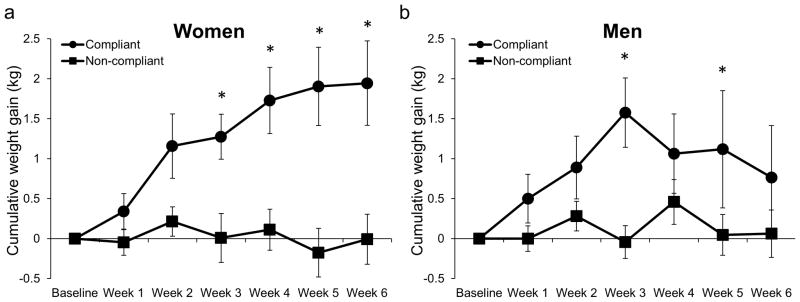
Findings: There were no significant differences in weight gain when comparing the reduced nicotine conditions with the 15.8 mg/g control group across all treatment groups and weeks. However, weight gain at week 6 was negatively correlated with nicotine exposure in the 2 lowest nicotine content cigarette conditions. Within the 2 lowest nicotine content cigarette conditions, male and female smokers biochemically verified to be compliant on study product gained significantly more weight than non-compliant smokers and control groups.
Conclusions: The effect of random assignment to investigational cigarettes with reduced nicotine on weight gain was likely obscured by non-compliance with study product. Men and women who were compliant in the lowest nicotine content cigarette conditions gained 1.2 kg over 6 weeks, indicating weight gain is a likely consequence of reduced exposure to nicotine.
Trial registration number: NCT01681875, Post-results.
Keywords: Harm Reduction; Nicotine; Public policy.
Published by the BMJ Publishing Group Limited. For permission to use (where not already granted under a licence) please go to http://www.bmj.com/company/products-services/rights-and-licensing/.
Figures
References
-
- Centers for Disease C, Prevention. Vital signs: current cigarette smoking among adults aged >/=18 years--United States, 2005–2010. MMWR Morb Mortal Wkly Rep. 2011;60:1207–12. - PubMed
-
- World Health Organization Study Group on Tobacco Product R. WHO Study Group on Tobacco Product Regulation. Report on the scientific basis of tobacco product regulation: fifth report of a WHO study group. World Health Organ Tech Rep Ser. 2015 - PubMed
-
-
Family Smoking Prevention and Tobacco Control Act, (2009).
-
-
- Benowitz NL, Henningfield JE. Establishing a nicotine threshold for addiction. The implications for tobacco regulation. N Engl J Med. 1994;331:123–5. - PubMed
Publication types
MeSH terms
Substances
Associated data
Grants and funding
LinkOut - more resources
Full Text Sources
Other Literature Sources
Medical
