Trends in Participation Rates for the National Cancer Screening Program in Korea, 2002-2012
- PMID: 27857022
- PMCID: PMC5512374
- DOI: 10.4143/crt.2016.186
Trends in Participation Rates for the National Cancer Screening Program in Korea, 2002-2012
Abstract
Purpose: The National Cancer Screening Program (NCSP) in Korea supports cancer screening for stomach, liver, colorectal, breast, and cervical cancer. This study was conducted to assess trends in participation rates among Korean men and women invited to undergo screening via the NCSP as part of an effort to guide future implementation of the program in Korea.
Materials and methods: Data from the NCSP for 2002 to 2012 were used to calculate annual participation rates with 95% confidence intervals (CI) by sex, insurance status, and age group for stomach, liver, colorectal, breast, and cervical cancer screening.
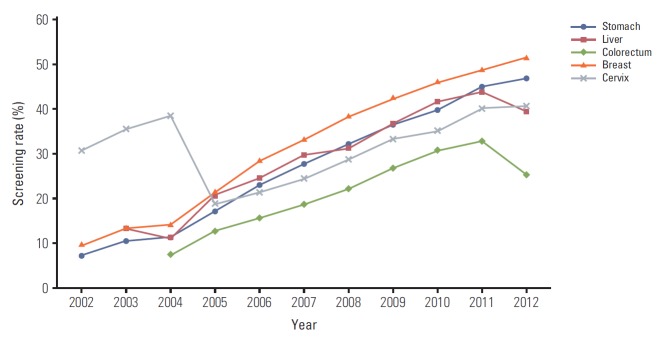
Results: In 2012, participation rates for stomach, liver, colorectal, breast, and cervical cancer screening were 47.3%, 25.0%, 39.5%, 51.9%, and 40.9%, respectively. The participation rates increased annually by 4.3% (95% CI, 4.0 to 4.6) for stomach cancer, 3.3% (95% CI, 2.5 to 4.1) for liver cancer, 4.1% (95% CI, 3.2 to 5.0) for colorectal cancer, 4.6% (95% CI, 4.1 to 5.0) for breast cancer, and 0.9% (95% CI, -0.7 to 2.5) for cervical cancer from 2002 to 2012.
Conclusion: Participant rates for the NCSP for the five above-mentioned cancers increased annually from 2002 to 2012.
Keywords: Early detection of cancer; Mass screening; Neoplasms.
Conflict of interest statement
Conflict of interest relevant to this article was not reported.
Figures
References
-
- Ferlay J, Soerjomataram I, Dikshit R, Eser S, Mathers C, Rebelo M, et al. Cancer incidence and mortality worldwide: sources, methods and major patterns in GLOBOCAN 2012. Int J Cancer. 2015;136:E359–86. - PubMed
-
- Statistics Korea [Internet] Daejeon: Statistics Korea; 2014. [cited 2015 Aug 6]. Available from: http://kostat.go.kr/
-
- Stewart BW, Wild CP. World cancer report 2014. Lyon: International Agency for Research on Cancer; 2014. - PubMed
-
- Yoo KY. Cancer control activities in the Republic of Korea. Jpn J Clin Oncol. 2008;38:327–33. - PubMed
Publication types
MeSH terms
LinkOut - more resources
Full Text Sources
Other Literature Sources