


Material Specificity Drives Medial Temporal Lobe Familiarity But Not Hippocampal Recollection
- PMID: 27859925
- PMCID: PMC5299537
- DOI: 10.1002/hipo.22683
Material Specificity Drives Medial Temporal Lobe Familiarity But Not Hippocampal Recollection
Abstract
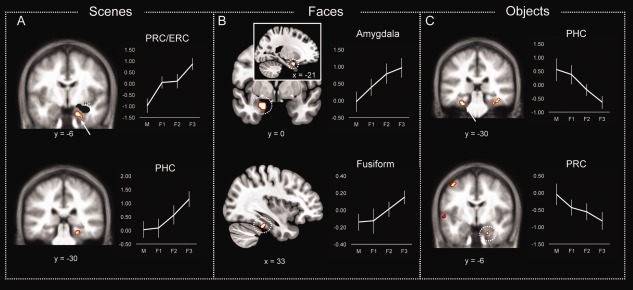
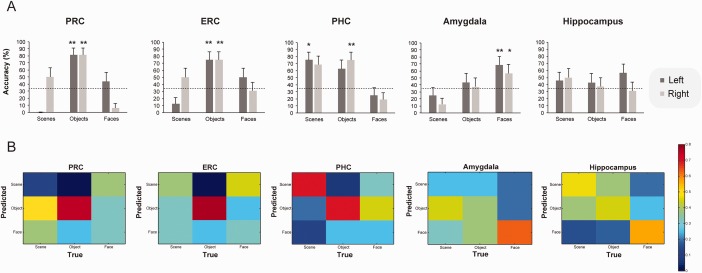
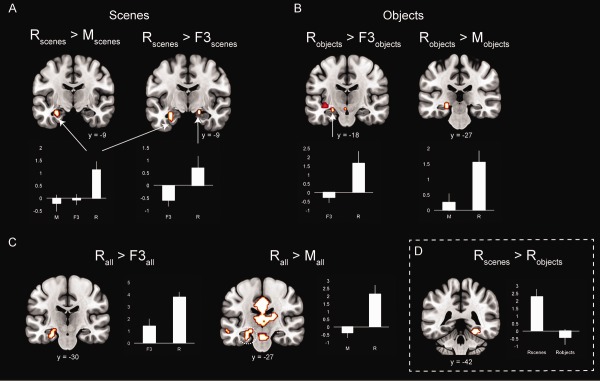
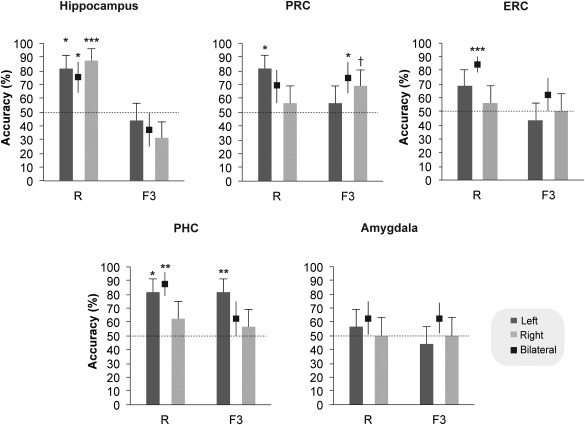
The specific role of the perirhinal (PRC), entorhinal (ERC) and parahippocampal cortices (PHC) in supporting familiarity-based recognition remains unknown. An fMRI study explored whether these medial temporal lobe (MTL) structures responded in the same way or differentially to familiarity as a function of stimulus type at recognition. A secondary aim was to explore whether the hippocampus responds in the same way to equally strong familiarity and recollection and whether this is influenced by the kind of stimulus involved. Univariate and multivariate analyses revealed that familiarity responses in the PRC, ERC, PHC and the amygdala are material-specific. Specifically, the PRC and ERC selectively responded to object familiarity, while the PHC responded to both object and scene familiarity. The amygdala only responded to familiarity memory for faces. The hippocampus did not respond to stimulus familiarity for any of the three types of stimuli, but it did respond to recollection for all three types of stimuli. This was true even when recollection was contrasted to equally accurate familiarity. Overall, the findings suggest that the role of the MTL neocortices and the amygdala in familiarity-based recognition depends on the kind of stimulus in memory, whereas the role of the hippocampus in recollection is independent of the type of cuing stimulus. © 2016 The Authors Hippocampus Published by Wiley Periodicals, Inc.
Keywords: amygdala; entorhinal cortex; parahippocampal cortex; perirhinal cortex; recognition memory.
© 2016 The Authors Hippocampus Published by Wiley Periodicals, Inc.
Figures
References
-
- Adolphs R, Tranel D, Hamann S, Young A, Calder A, Phelps E, Anderson A, Lee G, Damasio A. 1999. Recognition of facial emotion in nine individuals with bilateral amygdala damage. Neuropsychologia 37:1111–1117. - PubMed
-
- Aggleton JP, Brown MW. 1999. Episodic memory, amnesia, and the hippocampal, anterior thalamic axis. Behav Brain Sci 22:425–444. - PubMed
-
- Aminoff E, Gronau N, Bar M. 2007. The parahippocampal cortex mediates spatial and nonspatial associations. Cereb Cortex 17:1493–1503. - PubMed
-
- Ashburner J. 2007. A fast diffeomorphic image registration algorithm. Neuroimage 38:95–113. - PubMed
MeSH terms
Grants and funding
LinkOut - more resources
Full Text Sources
Other Literature Sources
