. 2017 Feb 1;102(2):689-697.
doi: 10.1210/jc.2016-3403.

Hepatitis C Virus E2 Protein Induces Upregulation of IL-8 Pathways and Production of Heat Shock Proteins in Human Thyroid Cells

Affiliations

Hepatitis C Virus E2 Protein Induces Upregulation of IL-8 Pathways and Production of Heat Shock Proteins in Human Thyroid Cells

Sara Salehi Hammerstad et al. J Clin Endocrinol Metab. .

Abstract

Context: Thyroiditis is one of the most common extrahepatic manifestations of hepatitis C virus (HCV) infection. By binding to surface cell receptor CD81, HCV envelope glycoprotein E2 mediates entry of HCV into cells. Studies have shown that different viral proteins may individually induce host responses to infection. We hypothesized that HCV E2 protein binding to CD81 expressed on thyroid cells activates a cascade of inflammatory responses that can trigger autoimmune thyroiditis in susceptible individuals.

Setting: Human thyroid cell lines ML-1 and human thyrocytes in primary cell culture were treated with HCV recombinant E2 protein. The expression of major proinflammatory cytokines was measured at the messenger RNA and protein levels. Next-generation transcriptome analysis was used to identify early changes in gene expression in thyroid cells induced by E2.

Results: HCV envelope protein E2 induced strong inflammatory responses in human thyrocytes, resulting in production of interleukin (IL)-8, IL-6, and tumor necrosis factor-α. Furthermore, the E2 protein induced production of several heat shock proteins including HSP60, HSP70p12A, and HSP10, in human primary thyrocytes. In thyroid cell line ML-1, RNA sequencing identified upregulation of molecules involved in innate immune pathways with high levels of proinflammatory cytokines and chemokines and increased expression of costimulatory molecules, specifically CD40, known to be a major thyroid autoimmunity gene.

Conclusion: Our data support a key role for HCV envelope protein E2 in triggering thyroid autoimmunity through activation of cytokine pathways by bystander mechanisms.


Figures

Figure 1.
Figure 1.
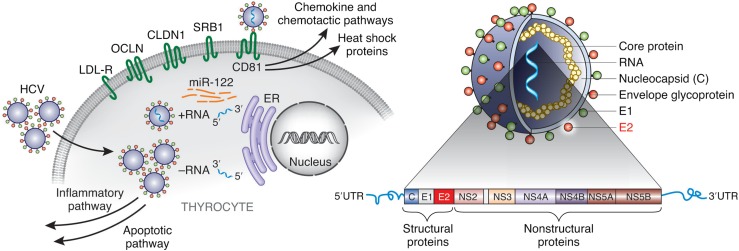
HCV entry is initiated by the interaction between E2 and CD81. By binding to the large extracellular loop of surface receptor CD81, HCV envelope protein E2 induces production of inflammatory signaling pathways and production of HSPs.
Figure 2.
Figure 2.
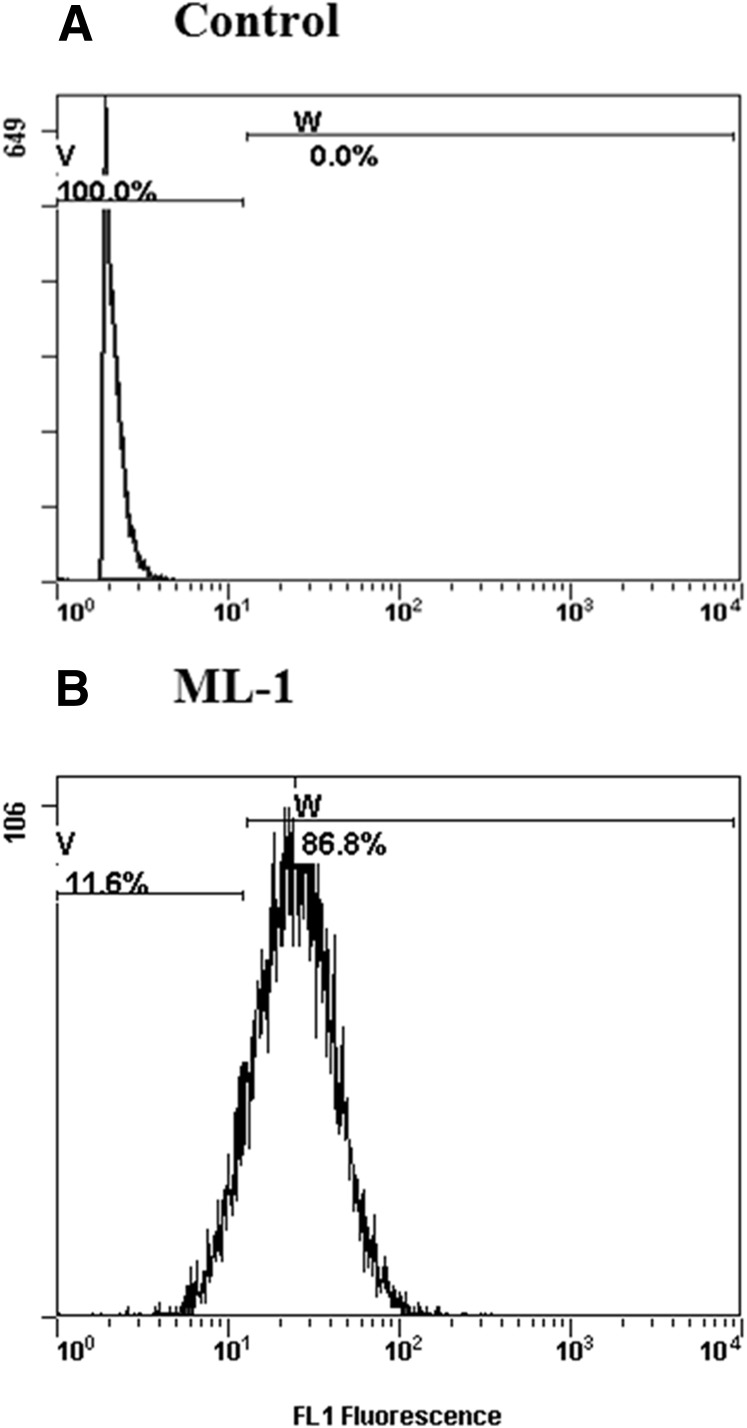
Expression of human CD81 receptor on ML-1 cells. ML-1 cells were incubated with (A) immunoglobulin G1 isotope control or (B) human anti-CD81 antibody. Flow cytometry shows a robust expression of HCV surface receptor CD81 on ML-1 cells in culture.
Figure 3.
Figure 3.
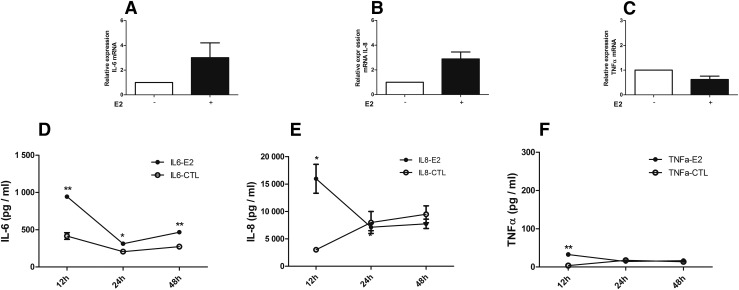
Expression of cytokines in ML-1 cells in culture incubated with HCV envelope protein E2. (A–C) Incubation of ML-1 cells with recombinant HCV E2 protein (5 μg/mL) induced increased expression of (A) IL-6 and (B) IL-8 mRNA levels, but (C) TNFα mRNA levels were unchanged. Relative expression of mRNA was determined by real-time qPCR (corrected to glyceraldehyde 3-phosphate dehydrogenase): (A) IL-6, (B) IL-8, and (C) TNFα. Similarly, protein levels of (D) IL-6 and (E) IL-8 were increased, whereas (F) TNFα was only slightly increased at 12 hours. Concentration of cytokines (pg/mL) in supernatants of cultured cells: (D) IL-6, (E) IL-8, and (F) TNFα. The results are presented as mean ± standard error of the mean. *P < 0.05; **P < 0.01. CTL, control (untreated cells).
Figure 4.
Figure 4.
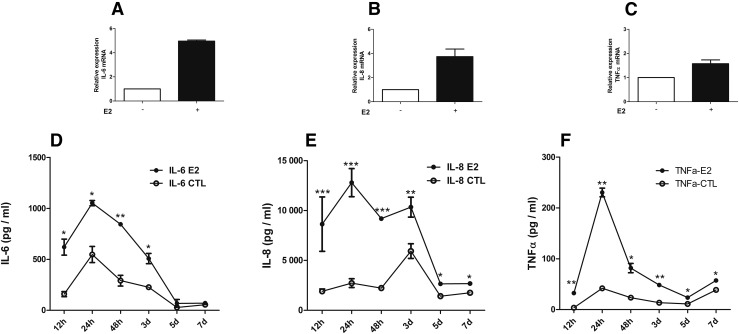
Expression of cytokines in human thyroid primary cells in culture incubated with recombinant HCV envelope protein E2. Recombinant HCV E2 protein at a concentration of 5 µg/mL induced an increased expression of IL-6, IL-8, and TNFα both at the mRNA and at the protein levels. Time course up to 1 week shows increased protein secretion in supernatants of human primary thyrocytes. (A–C) Relative expression of mRNA by real-time qPCR (corrected to glyceraldehyde 3-phosphate dehydrogenase): (A) IL-6, (B) IL-8, and (C) TNFα. (D–F) Concentration of cytokines (pg/mL) in supernatant: (D) IL-6, (E) IL-8, and (F) TNFα. Results are presented as mean ± standard error of the mean. *P < 0.05; **P < 0.01; ***P < 0.001.
Figure 5.
Figure 5.
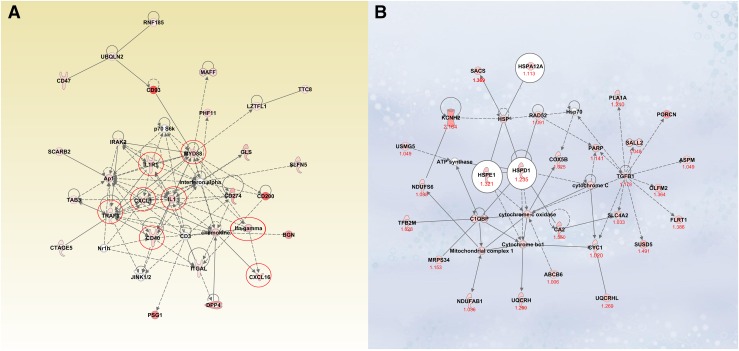
(A) An example of innate immune response induced by E2 in ML-1 cells. Recombinant HCV E2 protein increased the expression of costimulatory molecules such as CD40 and the activation of other molecules involved in the NF-κB signaling pathways in the human thyroid cell line ML-1. (B) HSP network induced by HCV E2 protein in human thyroid primary cells. In human thyroid primary cells, the expression of several HSPs was increased by HCV envelope glycoprotein E2: HSP60 (HSPD1), HSP10 (HSPE1), and HSP12A (heat shock 70kDa protein12a). Ingenuity pathway analysis detected several molecules involved in this network. The numbers indicate the log2 ratio for each gene.

References

    1. Menconi F, Hasham A, Tomer Y. Environmental triggers of thyroiditis: hepatitis C and interferon-α. J Endocrinol Invest. 2011;34(1):78–84. - PubMed
    1. World Health Organization. Hepatitis C. Available at: http://www.who.int/mediacentre/factsheets/fs164/en/. 2016.
    1. Antonelli A, Ferri C, Pampana A, Fallahi P, Nesti C, Pasquini M, Marchi S, Ferrannini E. Thyroid disorders in chronic hepatitis C. Am J Med. 2004;117(1):10–13. - PubMed
    1. Tomer Y. Hepatitis C and interferon induced thyroiditis. J Autoimmun. 2010;34(3):J322–J326. - PMC - PubMed
    1. Blackard JT, Kong L, Huber AK, Tomer Y. Hepatitis C virus infection of a thyroid cell line: implications for pathogenesis of hepatitis C virus and thyroiditis. Thyroid. 2013;23(7):863–870. - PMC - PubMed

MeSH terms