Review
. 2018 Sep;96(9):1467-1475.
doi: 10.1002/jnr.23978. Epub 2016 Nov 12.

Long distance projections of cortical pyramidal neurons

Affiliations
Review

Long distance projections of cortical pyramidal neurons

Charles R Gerfen et al. J Neurosci Res. 2018 Sep.

Abstract

The neuronal circuits defined by the axonal projections of pyramidal neurons in the cerebral cortex are responsible for processing sensory and other information to plan and execute behavior. Subtypes of cortical pyramidal neurons are organized across layers, with those in different layers distinguished by their patterns of axonal projections and connectivity. For example, those in layers 2 and 3 project between cortical areas to integrate sensory and other information with motor areas; while those in layers 5 and 6 also integrate information between cortical areas, but also project to subcortical structures involved in the generation of behavior. Recent advances in neuroanatomical techniques allow one to target specific subtypes of cortical pyramidal neurons and label both their inputs and projections. Combining these methods with neurophysiological recording techniques and newly introduced atlases of the mouse brain provide the opportunity to achieve a detailed view of the organization of cerebral cortical circuits. © 2016 Wiley Periodicals, Inc.

Keywords: axonal connections; cerebral cortex; cortical neurons.


Figures

Figure 1
Figure 1
The Major Circuits of the Cerebral Cortex and Basal Ganglia Are Diagrammed in a Sagittal Plane. Corticostriatal inputs arise from two major subtypes: intertelencephalic (IT) corticostriatal neurons, which provide bilateral inputs to the striatum, and pyramidal tract (PT) corticofugal neurons, which project an axon ipsilaterally with collaterals to the striatum, thalamus, subthalamic nucleus (STN), superior colliculus (SC), pons, and spinal cord. Two main subtypes of projection neurons in the striatum give rise to direct and indirect pathways. The direct pathway provides direct projections to the output nuclei of the basal ganglia, the internal segment of the globus pallidus (GPi), and the substantia nigra pars reticulata (SNr). The indirect pathway projects to the external segment of the globus pallidus (GPe), which connects indirectly through the STN to the GPi and SNr. The major output of the basal ganglia originates from GABAergic neurons in the GPi and SNr, which provide inhibitory input to the thalamus, SC, and pedunculopontine nucleus (PPN) From Gerfen et al., 2013.
Figure 2
Figure 2
BAC-Cre driver lines from the GENSAT project with selective expression in layer and subtype specific cortical pyramidal neurons. Selective Cre-expression is demonstrated by crossing to a Rosa26_EGFP reporter that labels pyramidal neurons in specific cortical layers. Injections of AAV-Cre-dependent EGP vectors into the cortex label the axonal projections of the specific cortical neuron subtype. The Cre line, Sim1_KJ18 expresses in layer 5b pyramidal tract (PT) neurons, which have axonal projections to the ipsilateral striatum (caudate-putamen, CP), the thalamus, subthalamic nucleus (STN), superior colliculus (SC) and pontine nuclei (pons). The Cre line, Tlx3_PL56 expresses in layer 5a inter-telencephalic (IT) pyramidal neurons, which have axonal projections bilaterally within the cortex and the striatum (CP), but do not project to other subcortical structures. The Cre line, Sepw1_NP39, expresses in layer 2/3 pyramidal neuron, which also project bilaterally within the cortex and to the striatum (CP), but not to other subcortical structures. The Cre line Grp_KH288 expresses in layers 2/3 and 5a of secondary motor cortex (MOs) pyramidal neurons, which express bilaterally to the cortex and striatum (CP), but not to other subcortical structures. (From Gerfen et al.,2013)
Figure 3
Figure 3
Injection cases into 5 sites in the primary somatosensory cortex from the Allen Institute Mouse Connectivity Database and their axonal projections are mapped in the Common Coordinate Framework mouse reference atlas. A) Injections of 5 sites in the primary somatosensory cortex are color coded with sites in the mouth region (blue), upper limb (red), lower limb (gree) and two sites in the barrel field (yellow and purple). B) In a horizontal plane the projections within the cortex are shown to project to frontal motor areas. C and D) In the sagittal plane the projections from the cortex are shown to project through the striatum to the thalamus and superior colliculus. In the coronal plane (E to J) the topographic relationship of the somatotopically organized primary sensory cortex is shown to be maintained in the axonal projections to the striatum (in sections E and F and at higher magnification in F”), to the thalamus ( G and H and at higher magnification in H”) and to the pontine nucleus (I and at higher magnification in I”).
Figure 4
Figure 4
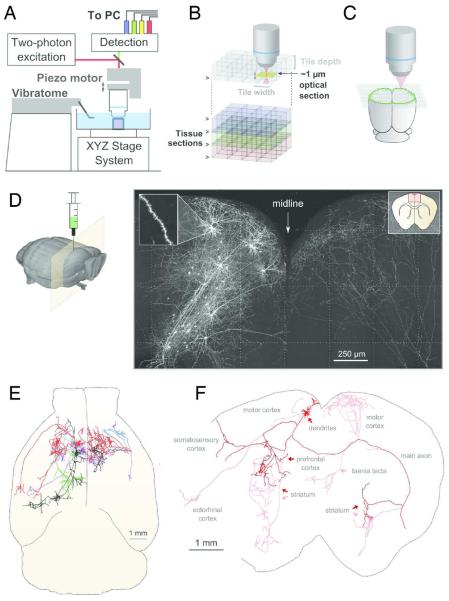
The Janelia Research Mouse Light Project to trace axonal projections of individual neurons. A) Schematic of the apparatus used for automated volumetric two-photon tomography. B) To image the whole mouse brain volume a collection of three-dimensional image staces covering the full volume of the mouse brain are acquired serially. Tiles are overlapped in all three dimensions aid in image registration. C) The area of the brain for each section is imaged by first tracing the outline of the section and then imaging all tiles internal to the traced region. D) Diagram of the injection of AAV-GFP vector into the cortex and resulting sparse labeling of neurons imaged. E) Top down view of axonal tracing of neurons, including pyramidal neurons in layer 2 (blue,purple), layer 5 ( red, black) and layer 6 (green). F) Illustration of axonal and dendritic reconstruction of one layer 5 IT neuron (red) shown in the coronal plane collapsed in the z-axis. Adapted from Economo et al., 2016.

References

    1. Constantinople CM, Bruno RM. Deep cortical layers are activated directly by thalamus. Science. 2013 (1) 341-1591-4. - PMC - PubMed
    1. Denardo LA, Berns BS, DeLoach K, Luo L. Connectivity of mouse somatosensory and prefrontal cortex examined with trans-snyaptic tracing. Nature Neuroscience. 2015;18:1687–1697. - PMC - PubMed
    1. Dong H-W. The Allen Reference Atlas: A Digital Color Brain Atlas Of The C57BL/6J Male Mouse. John Wiley and Sons, Inc.; Hoboken: 2007.
    1. Douglas RJ, Martin KAC. Neuronal circuits of the neocortex. Annu. Rev. Neurosci. 2004;27:419–451. - PubMed
    1. Economo MN, Clack NG, Lavis LD, Gerfen CR, Svoboda K, Myers EW, Chandrashekar J. A (2016)platform for brain-wide imaging and reconstruction of individual neurons. Elife. 2016 Jan 20;5:e10566. pii. - PMC - PubMed

Publication types

LinkOut - more resources