


Detection of Mismatch Repair Deficiency and Microsatellite Instability in Colorectal Adenocarcinoma by Targeted Next-Generation Sequencing
- PMID: 27863258
- PMCID: PMC5225299
- DOI: 10.1016/j.jmoldx.2016.07.010
Detection of Mismatch Repair Deficiency and Microsatellite Instability in Colorectal Adenocarcinoma by Targeted Next-Generation Sequencing
Abstract
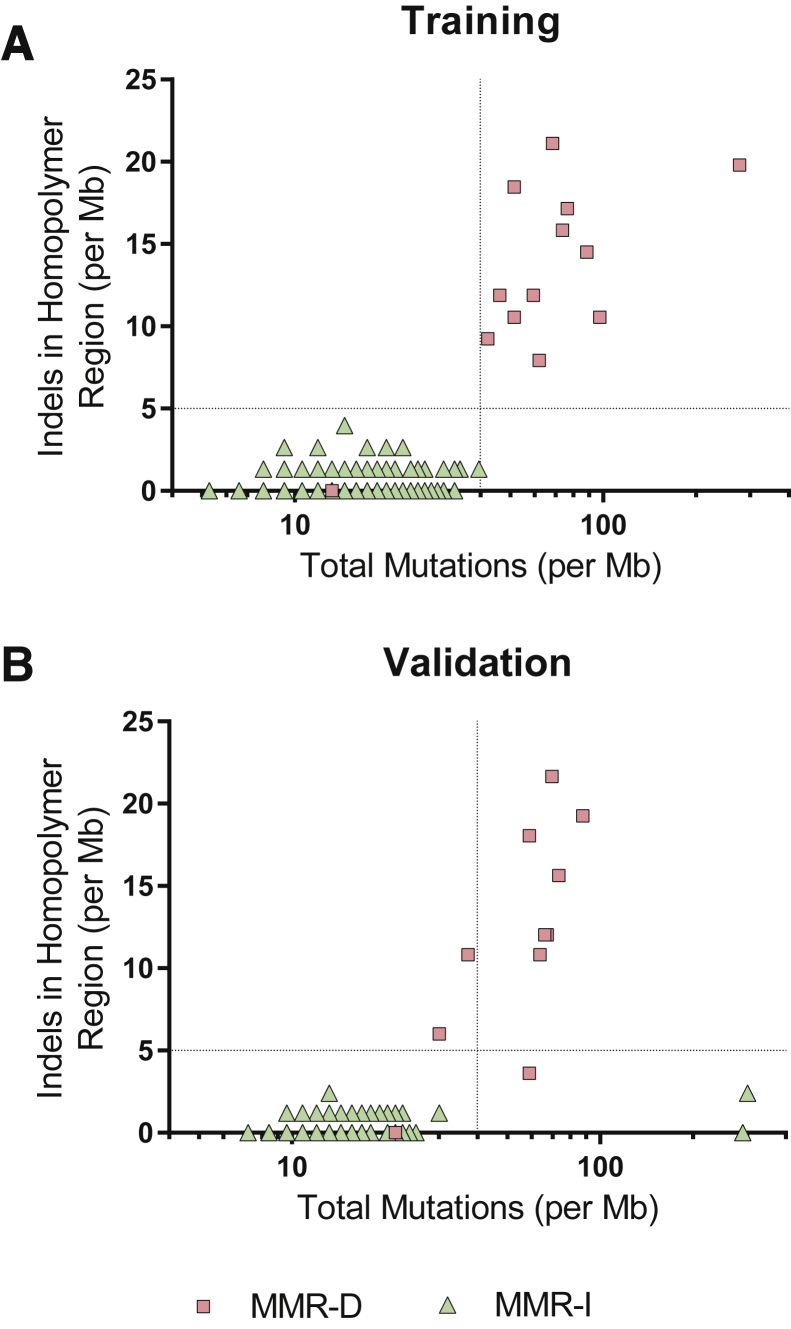
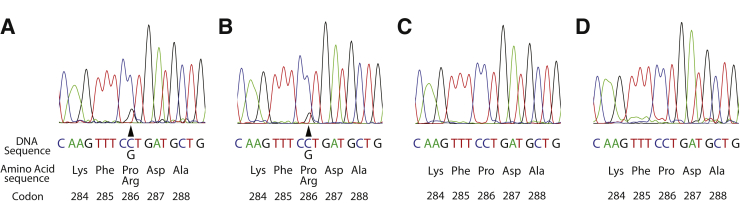
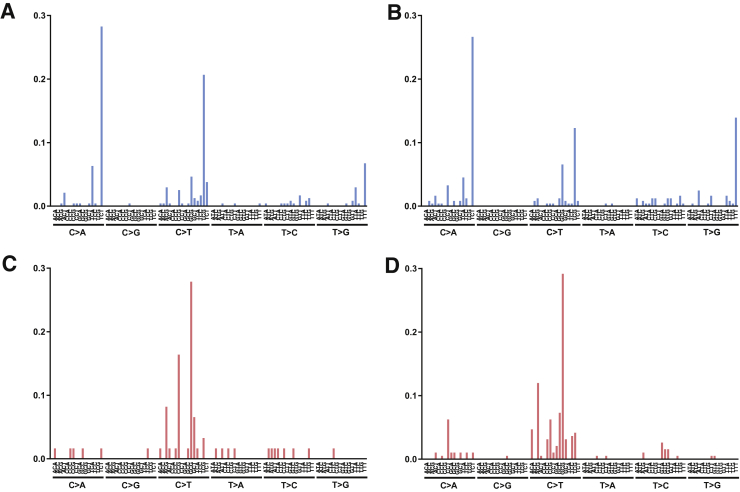
Mismatch repair protein deficiency (MMR-D) and high microsatellite instability (MSI-H) are features of Lynch syndrome-associated colorectal carcinomas and have implications in clinical management. We evaluate the ability of a targeted next-generation sequencing panel to detect MMR-D and MSI-H based on mutational phenotype. Using a criterion of >40 total mutations per megabase or >5 single-base insertion or deletion mutations in repeats per megabase, sequencing achieves 92% sensitivity and 100% specificity for MMR-D by immunohistochemistry in a training cohort of 149 colorectal carcinomas and 91% sensitivity and 98% specificity for MMR-D in a validation cohort of 94 additional colorectal carcinomas. False-negative samples are attributable to tumor heterogeneity, and next-generation sequencing results are concordant with analysis of microsatellite loci by PCR. In a subset of 95 carcinomas with microsatellite analysis, sequencing achieves 100% sensitivity and 99% specificity for MSI-H in the combined training and validation set. False-positive results for MMR-D and MSI-H are attributable to ultramutated cancers with POLE mutations, which are confirmed by direct sequencing of the POLE gene and are detected by mutational signature analysis. These findings provide a framework for a targeted tumor sequencing panel to accurately detect MMR-D and MSI-H in colorectal carcinomas.
Copyright © 2017 American Society for Investigative Pathology and the Association for Molecular Pathology. Published by Elsevier Inc. All rights reserved.
Figures
References
-
- Lynch H.T., Snyder C.L., Shaw T.G., Heinen C.D., Hitchins M.P. Milestones of Lynch syndrome: 1895–2015. Nat Rev Cancer. 2015;15:181–194. - PubMed
-
- Ribic C.M., Sargent D.J., Moore M.J., Thibodeau S.N., French A.J., Goldberg R.M., Hamilton S.R., Laurent-Puig P., Gryfe R., Shepherd L.E., Tu D., Redston M., Gallinger S. Tumor microsatellite-instability status as a predictor of benefit from fluorouracil-based adjuvant chemotherapy for colon cancer. N Engl J Med. 2003;349:247–257. - PMC - PubMed
-
- Giardiello F.M., Allen J.I., Axilbund J.E., Boland C.R., Burke C.A., Burt R.W., Church J.M., Dominitz J.A., Johnson D.A., Kaltenbach T., Levin T.R., Lieberman D.A., Robertson D.J., Syngal S., Rex D.K. Guidelines on genetic evaluation and management of lynch syndrome: a consensus statement by the US Multi-Society Task Force on Colorectal Cancer. Gastroenterology. 2014;147:502–526. - PubMed
-
- MacConaill L.E., Garcia E., Shivdasani P., Ducar M., Adusumilli R., Breneiser M., Byrne M., Chung L., Conneely J., Crosby L., Garraway L., Gong X., Hahn W., Hatton C., Kantoff P., Kluk M., Kuo F., Jia Y., Joshi R., Longtine J., Manning A., Palescandolo E., Sharaf N., Sholl L., van Hummelen P., Wade J., Wollinson B.M., Zepf D., Rollins B.J., Lindeman N.I. Prospective enterprise-level molecular genotyping of a cohort of cancer patients. J Mol Diagn. 2014;16:660–672. - PMC - PubMed
Publication types
MeSH terms
Grants and funding
LinkOut - more resources
Full Text Sources
Other Literature Sources
