


Feasibility trial of a scalable psychological intervention for women affected by urban adversity and gender-based violence in Nairobi
- PMID: 27863515
- PMCID: PMC5116169
- DOI: 10.1186/s12888-016-1117-x
Feasibility trial of a scalable psychological intervention for women affected by urban adversity and gender-based violence in Nairobi
Abstract
Background: Living in conditions of chronic adversity renders many women more vulnerable to experiencing gender-based violence (GBV). In addition to GBV's physical and social consequences, the psychological effects can be pervasive. Access to evidence-based psychological interventions that seek to support the mental health of women affected by such adversity is rare in low- and middle-income countries.
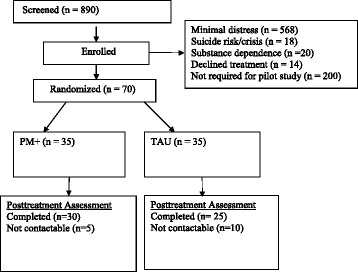
Methods: The current study evaluates a brief evidence-informed psychological intervention developed by the World Health Organization for adults impacted by adversity (Problem Management Plus; PM+). A feasibility randomised control trial (RCT) was conducted to inform a fully powered trial. Community health workers delivered the intervention to 70 women residing in three peri-urban settings in Nairobi, Kenya. Women, among whom 80% were survivors of GBV (N = 56), were randomised to receive five sessions of either PM+ (n = 35) by community health workers or enhanced treatment as usual (ETAU; n = 35).
Results: PM+ was not associated with any adverse events. Although the study was not powered to identify effects and accordingly did not identify effects on the primary outcome measure of general psychological distress, women survivors of adversity, including GBV, who received PM+ displayed greater reductions in posttraumatic stress disorder symptoms following treatment than those receiving ETAU.
Conclusions: This feasibility study suggests that PM+ delivered by lay health workers is an acceptable and safe intervention to reach women experiencing common mental disorders and be inclusive for those affected by GBV and can be studied in a RCT in this setting. The study sets the stage for a fully powered, definitive controlled trial to assess this potentially effective intervention.
Trial registration: ACTRN12614001291673 , 10/12/2014, retrospectively registered during the recruitment phase.
Keywords: Gender based violence; Mental health; Psychological intervention; Trauma; Trial.
References
-
- WHO . Global and regional estimates of violence against women: Prevalence and health effects of intimate partner violence and non-partner sexual violence. Geneva: WHO; 2013.
-
- Kenya National Bureau of Statistics . Kenya demographic and health survey, 2014. Maryland: KNBS and ICF International; 2015.
Publication types
MeSH terms
Grants and funding
LinkOut - more resources
Full Text Sources
Other Literature Sources
Medical
