Review
. 2017 Feb 1;9(2):a022129.
doi: 10.1101/cshperspect.a022129.

Non-Smad Signaling Pathways of the TGF-β Family

Affiliations
Review

Non-Smad Signaling Pathways of the TGF-β Family

Ying E Zhang. Cold Spring Harb Perspect Biol. .

Abstract

Transforming growth factor β (TGF-β) and structurally related factors use several intracellular signaling pathways in addition to Smad signaling to regulate a wide array of cellular functions. These non-Smad signaling pathways are activated directly by ligand-occupied receptors to reinforce, attenuate, or otherwise modulate downstream cellular responses. This review summarizes the current knowledge of the mechanisms by which non-Smad signaling pathways are directly activated in response to ligand binding, how activation of these pathways impinges on Smads and non-Smad targets, and how final cellular responses are affected in response to these noncanonical signaling modes.


Figures

Figure 1.
Figure 1.
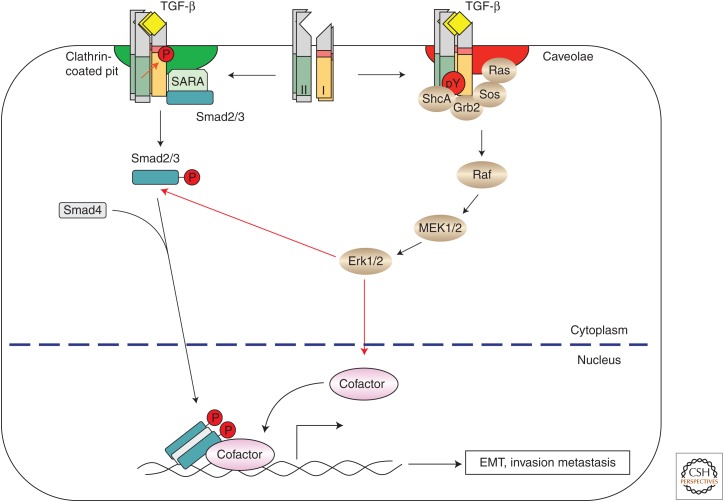
Transforming growth factor β (TGF-β)-induced activation of the extracellular signal-regulated kinase (Erk) mitogen-activated protein kinase (MAPK) pathway. On binding of TGF-β to its receptor complex, the constitutively active type II receptors phosphorylate the type I receptors at Ser/Thr residues, and induce tyrosine phosphorylation of both the type I and II receptors and ShcA. The phosphorylated tyrosines then recruit Grb2/Sos to activate Erk1/2 MAPK through activation of Ras, Raf, and MEK1/2 in a Smad-independent manner. ShcA directs the TGF-β receptors to caveolin-1-containing lipid raft for Erk MAPK activation. Clathrin-dependent internalization of TGF-β receptors into the Smad anchor for receptor activation (SARA)-containing early endosome is required for Smad activation. Activated Erk MAPK contributes to epithelial-to-mesenchymal transition (EMT) by phosphorylating targeted transcription factors, which in turn control transcription of EMT-related genes without or in cooperation with activated Smad complexes. Erk MAPK also directly phosphorylates R-Smads, thus controlling their activity.
Figure 2.
Figure 2.
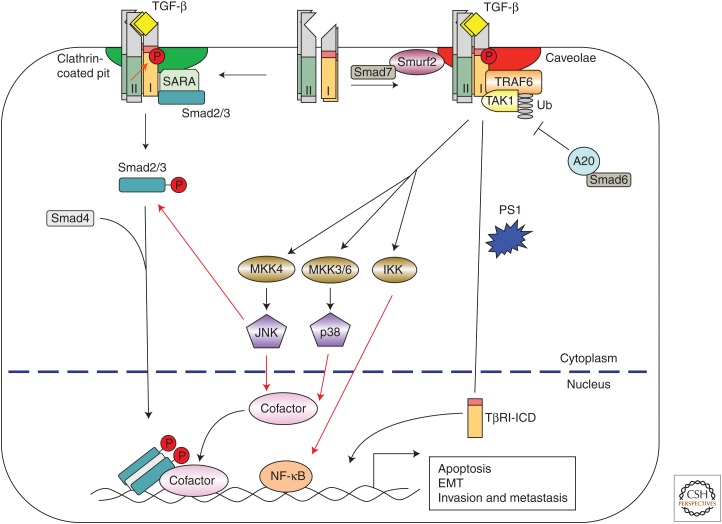
Transforming growth factor β (TGF-β)-induced activation of c-Jun amino terminal kinase (JNK) and p38 mitogen-activated protein kinase (MAPK) signaling, and the IκB kinase (IKK) pathway. Ligand-bound TGF-β receptors interact with TRAF6 and TGF-β-activated kinase 1 (TAK1), and induce Lys63-linked polyubiquitylation of TRAF6, which then activates TAK1 and downstream kinases, such as JNK, p38 MAPK, and IKK. Smad6 inhibits the TGF-β-induced JNK and p38 MAPK activation by recruiting a deubiquitylase A20 to deubiquitylate TRAF6, whereas Smad7 promotes TGF-β-induced JNK and p38 MAPK activation by directing the TGF-β receptors to caveolin-1-containing lipid rafts through interaction with Smurf2. Activated JNK and p38 MAPK then phosphorylate their targeted transcription factors, and IKK phosphorylates nuclear factor-κB (NF-κB), and these transcription factors cooperate with activated Smads to regulate apoptosis and epithelial-to-mesenchymal transition (EMT). In addition, JNK directly phosphorylates receptor-activated Smad (R-Smad) to regulate Smad activity. TRAF6 can also stimulate proteolytic cleavage of TβRI dependent on presenillin 1 and Lys63 ubiquitylation of TRAF6 to generate the intracellular domain (ICD) of TβRI, which then translocates into the nucleus to regulate cell invasion. SARA, Smad anchor for receptor activation; MKK, MAP kinase kinase; TRAF6, tumor necrosis factor receptor–associated factor 6.
Figure 3.
Figure 3.
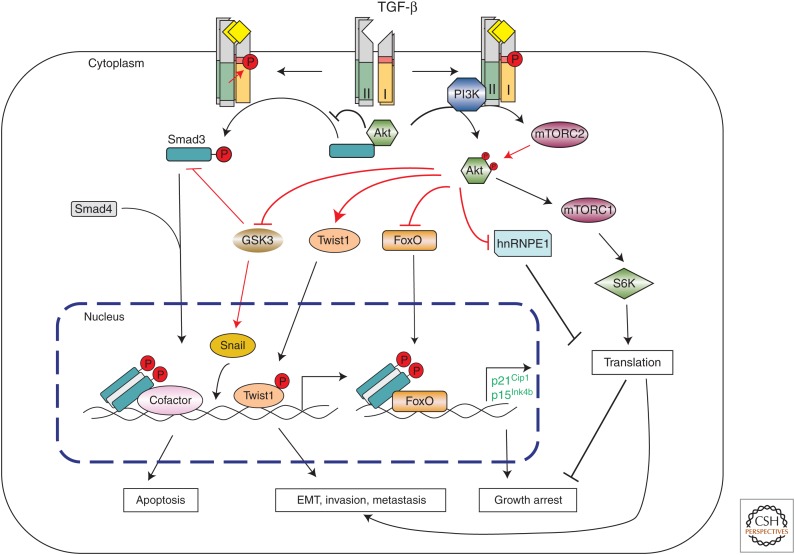
Transforming growth factor β (TGF-β)-induced activation of the PI3K-Akt pathway. TGF-β can induce PI3K and Akt activation, possibly through interaction of the p85 subunit of PI3K with the TGF-β receptors. Activated Akt then controls translational responses through mTOR1 and S6K, or directly acts on the translational responses by inducing phosphorylation of hnRNPE. TGF-β also induces activation of mTORC2, which contributes to enhanced Akt activation and forms a reinforcing feedback loop in PI3K-Akt activation. These non-Smad-mediated translational responses collaborate with Smad-mediated transcriptional responses during epithelial-to-mesenchymal transition (EMT), but can antagonize Smad-mediated transcription responses during growth arrest or apoptosis. Akt can regulate Smad3 activity by sequestering Smad3 in the cytoplasm or inhibiting GSK3β-mediated Smad3 phosphorylation and degradation. Akt can also regulate apoptosis or EMT by directly phosphorylating FoxO or Twist1 or inducing Snail phosphorylation by GSK3β.
Figure 4.
Figure 4.
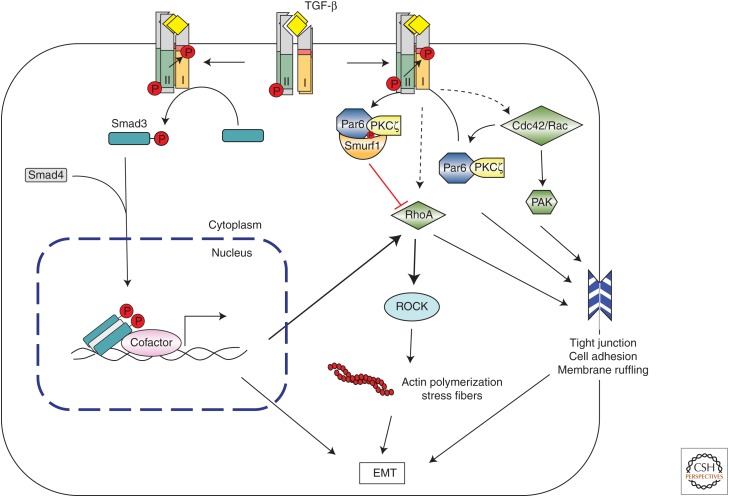
Transforming growth factor β (TGF-β)-induced regulation of the Rho family of small GTPases. RhoA and Rho-associated protein kinase (ROCK) can be activated by TGF-β by either Smad-dependent or -independent mechanisms to induce actin polymerization and stress fiber formation during epithelial-to-mesenchymal transition (EMT). Additionally, the TβRII receptor can directly phosphorylate Par6 by recruiting Smurf1, thus targeting RhoA for degradation, which leads to tight junction dissociation. TGF-β can also induce tight junction dissociation and cell migration during EMT by recruiting Cdc42 and/or Rac1 to the receptor complex, and activate p21-activated kinase (PAK) signaling. PKC, Protein kinase C.

References

    1. Afrakhte M, Moren A, Jossan S, Itoh S, Sampath K, Westermark B, Heldin CH, Heldin NE, ten Dijke P. 1998. Induction of inhibitory Smad6 and Smad7 mRNA by TGF-β family members. Biochem Biophys Res Commun 249: 505–511. - PubMed
    1. Arsura M, Panta GR, Bilyeu JD, Cavin LG, Sovak MA, Oliver AA, Factor V, Heuchel R, Mercurio F, Thorgeirsson SS, et al. 2003. Transient activation of NF-κB through a TAK1/IKK kinase pathway by TGF-β1 inhibits AP-1/SMAD signaling and apoptosis: Implications in liver tumor formation. Oncogene 22: 412–425. - PubMed
    1. Atfi A, Djelloul S, Chastre E, Davis R, Gespach C. 1997. Evidence for a role of Rho-like GTPases and stress-activated protein kinase/c-Jun N-terminal kinase (SAPK/JNK) in transforming growth factor β-mediated signaling. J Biol Chem 272: 1429–1432. - PubMed
    1. Bakin AV, Tomlinson AK, Bhowmick NA, Moses HL, Arteaga CL. 2000. Phosphatidylinositol 3-kinase function is required for transforming growth factor β-mediated epithelial to mesenchymal transition and cell migration. J Biol Chem 275: 36803–36810. - PubMed
    1. Bakin AV, Rinehart C, Tomlinson AK, Arteaga CL. 2002. p38 mitogen-activated protein kinase is required for TGFβ-mediated fibroblastic transdifferentiation and cell migration. J Cell Sci 115: 3193–3206. - PubMed

MeSH terms

Substances