


Pairing Animal Cartoon Characters With Produce Stimulates Selection Among Child Zoo Visitors
- PMID: 27866159
- PMCID: PMC5646221
- DOI: 10.1177/1090198116679359
Pairing Animal Cartoon Characters With Produce Stimulates Selection Among Child Zoo Visitors
Abstract
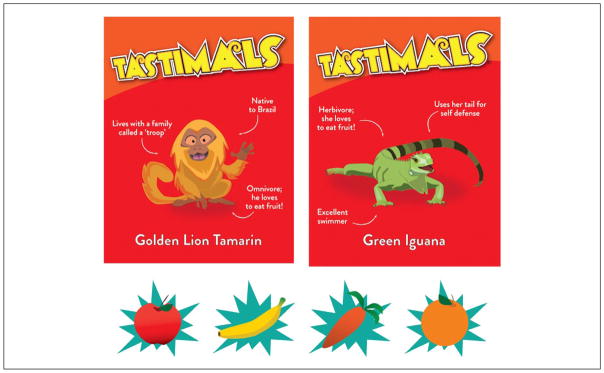
In order to address the pervasive trend of underconsumption of fruits and vegetables among children, we examined the hypothesis that children would be more likely to select fruits (apple slices, bananas, and oranges) and vegetables (baby carrots) when paired with animal cartoon image than when available without the character image. Tested in a randomized experiment using counterbalancing, products were arranged on two tables at two separate family fun nights held at a local zoo. Animal character produce parings were manipulated by placing one of two animals (tamarin or iguana) next to two of the four fruit or vegetable selections at each table, and by changing when available without the image. In total, 755 produce selections were made. Significantly more products paired with a character were selected (62.38%) than the same products, not paired (37.62%), χ2 = 46.32, df = 1, p < .001. The odds ratio of the treatment versus control was 1.66 (i.e., 471/284), indicating that children were 66% more likely to select a snack when paired with an animal cartoon. Study findings highlight the positive impact of animal cartoons on children's fruit and vegetable snack selections, and results suggest the potential for using animal cartoons to encourage fruit and vegetable selection for children.
Keywords: community health; diet; food retail; health communications; health promotion; interdisciplinary; new media and social media interventions; obesity; social marketing.
Conflict of interest statement
The authors declared no potential conflicts of interest with respect to the research, authorship, and/or publication of this article.
Figures

References
-
- Allen CT, Madden TJ. A closer look at classical conditioning. Journal of Consumer Research. 1985;12:301–315.
-
- Baranowski T, Davis M, Resnicow K, Baranowski J, Doyle C, Lin LS, … Wang DT. Gimme 5 fruit, juice, and vegetables for fun and health: Outcome evaluation. Health Education & Behavior. 2000;27:96–111. - PubMed
-
- Campbell-Arvai V, Arvai J, Kalof L. Motivating sustainable food choices: The role of nudges, value orientation, and information provision. Environment and Behavior. 2014;46:453–475.
-
- Foster GD, Karpyn A, Wojtanowski AC, Davis E, Weiss S, Brensinger C, … Glanz K. Placement and promotion strategies to increase sales of healthier products in supermarkets in low-income, ethnically diverse neighborhoods: A randomized controlled trial. American Journal of Clinical Nutrition. 2014;99:1359–1368. - PubMed
-
- Frazier M. Should the polar bear still sell Coca-Cola? The New Yorker. 2014 Nov 6; Retrieved from http://www.newyorker.com/business/currency/polar-bear-still-sell-coca-cola.
Publication types
MeSH terms
Grants and funding
LinkOut - more resources
Full Text Sources
Other Literature Sources
Miscellaneous
