Editorial
doi: 10.21037/atm.2016.10.62.
Towards a cure for Fibrodysplasia ossificans progressiva
Affiliations
- PMID: 27867996
- PMCID: PMC5104602
- DOI: 10.21037/atm.2016.10.62
Item in Clipboard
Editorial
Towards a cure for Fibrodysplasia ossificans progressiva
Ann Transl Med.
2016 Oct.
No abstract available
Conflict of interest statement
The authors have no conflicts of interest to declare.
Figures
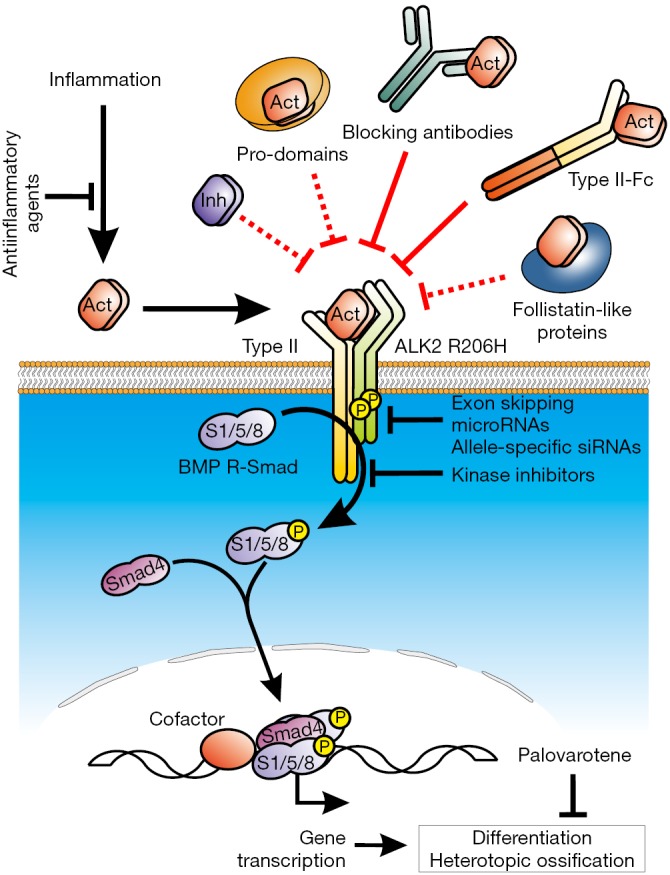
Inflammation-induced activin A is able to interact with receptor complexes incorporating the mutant ALK2 in order to induce downstream phosphorylation and activation of intracellular Smads 1/5/8, also called Receptor Smads (or R-Smads). They regulate the expression of genes involved in osteoblast differentiation and HO, as part of transcriptional complexes with other cellular factors. Normalization of the over-active mutant receptor has been intended by downregulating the expression of the receptor (using micro RNAs, exon-skipping or allele specific siRNA-mediated knock-down) or blocking its kinase activity using small molecule kinase inhibitors, which interfere with both the wild type and mutant allele. Hatsell et al. demonstrate the efficacy of type II-Fc constructs (sequestering several BMP and activin ligands) and an anti-activin A specific antibody to prevent ALK2-FOP induced Smad 1/5/8 signaling. These new extracellular strategies (depicted in red) may be complemented with inhibins and activin pro-domains (not tested thus far), or follistatins. Finally, a RAR-γ agonist that inhibits osteoblast differentiation (Palovarotene, Clementia Inc.) is currently being evaluated in Phase II clinical trials (NCT02279095, NCT02521792). Altogether, it remains to be determined whether activin-based therapies are effective in humans, which may benefit of combined treatments with anti-inflammatory drugs.
Comment on
-
ACVR1R206H receptor mutation causes fibrodysplasia ossificans progressiva by imparting responsiveness to activin A.Sci Transl Med. 2015 Sep 2;7(303):303ra137. doi: 10.1126/scitranslmed.aac4358. Sci Transl Med. 2015. PMID: 26333933 Free PMC article.
References
-
- Glaser DL, Kaplan FS. Treatment considerations for the management of fibrodysplasia ossificans progressiva. Clinical Reviews in Bone and Mineral Metabolism 2005;3:243-50. 10.1385/BMM:3:3-4:243 - DOI
Publication types
LinkOut - more resources
Full Text Sources
Other Literature Sources