


Growth and prevalence of feeding difficulties in children with Robin sequence: a retrospective cohort study
- PMID: 27868158
- PMCID: PMC5487830
- DOI: 10.1007/s00784-016-1996-8
Growth and prevalence of feeding difficulties in children with Robin sequence: a retrospective cohort study
Abstract
Objectives: In addition to breathing problems, patients with Robin sequence (RS) often encounter feeding difficulties (FD). Data regarding the occurrence of FD and possible influencing factors are scarce. The study aim was to elucidate these factors to improve treatment strategies.
Material and methods: A retrospective comparative cohort study was conducted, consisting of 69 infants diagnosed with both RS and a cleft palate and 64 isolated cleft palate only (iCPO) infants. Data regarding FD, growth, and airway intervention were collected during the first 2 years of life. A systematic review of the literature was conducted to identify reported FD in RS patients.
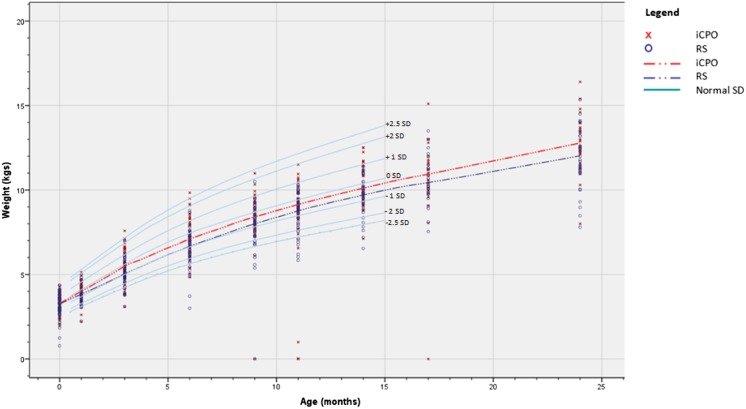
Results: RS patients had more FD (91 %) than iCPO patients (72 %; p = 0.004). Also, nasogastric (NG)-tube feeding was necessary more frequently and for a longer period (both p < 0.001). Growth was lower in RS than iCPO infants (p = 0.008) and was not affected by the kind of airway management (conservative/surgical; p = 0.178), cleft palate grade (p = 0.308), or associated disorders (p = 0.785). By contrast, surgical intervention subtype did significantly affect growth. Mean reported FD for RS in the literature is 80 % (range = 47-100 %), and 55 % (range = 11-100 %) of infants need NG-tube feeding.
Conclusions: FD is present in a large proportion of infants with RS, which indicates the need for early recognition and proper treatment to ensure optimal growth. Growth during the first 2 years of life is significantly lower in RS patients than iCPO patients, which indicates the need for careful attention and long-term follow-up.
Clinical relevance: This study indicates the need for early recognition and proper treatment of FD in RS to ensure optimal growth. In addition, growth needs careful attention and long-term follow-up.
Keywords: (Pierre) Robin sequence; Cleft palate; Feeding difficulties; Growth; Systematic review; Treatment; Weight.
Conflict of interest statement
Conflict of interest
All authors declare that they have no conflict of interest.
Funding
Miss Iris A.C. de Vries is PhD student and is partly funded by NutsOhra.
Ethical approval
All procedures performed were in accordance with the ethical standards of the institutional and/or national research committee and with the 1964 Helsinki Declaration and its later amendments or comparable ethical standards.
Informed consent
Informed consent was obtained from all individual participants included in the study.
Financial disclosure statement
All authors state they have no financial relationships relevant to this article to disclose.
Figures

References
-
- Fairburn P. Suffocation in an infant from retraction of the base of the tongue, connected with a defect in the frenum. Month J Med Sci. 1846;6:280–281.
-
- Shukowsky W. Zur aetiologie des stridor inspiratorius congenitus. Jahrb Kinderheilk. 1911;73:459–474.
-
- Robin P. Glossoptosis due to atresia and hypotrophy of the mandible. Am J Dis Child. 1934;48:541–547.
-
- Robin P. La chute de la base de la langue considérée comme une nouvelle cause de gans la respiration naso-pharyngienne. Bull Acad Natl Med. 1923;89:37–41.
Publication types
MeSH terms
LinkOut - more resources
Full Text Sources
Other Literature Sources
Medical
