


Addressing multilevel barriers to cervical cancer screening in Korean American women: A randomized trial of a community-based intervention
- PMID: 27869293
- PMCID: PMC5339039
- DOI: 10.1002/cncr.30391
Addressing multilevel barriers to cervical cancer screening in Korean American women: A randomized trial of a community-based intervention
Abstract
Background: Korean American women have among the lowest rates of cervical cancer screening in the United States. The authors evaluated a multicomponent intervention combining community education with navigation services to reduce access barriers and increase screening rates in this underserved population. It was hypothesized that cervical cancer screening rates would be higher among women who received the intervention program compared with those in the control program.
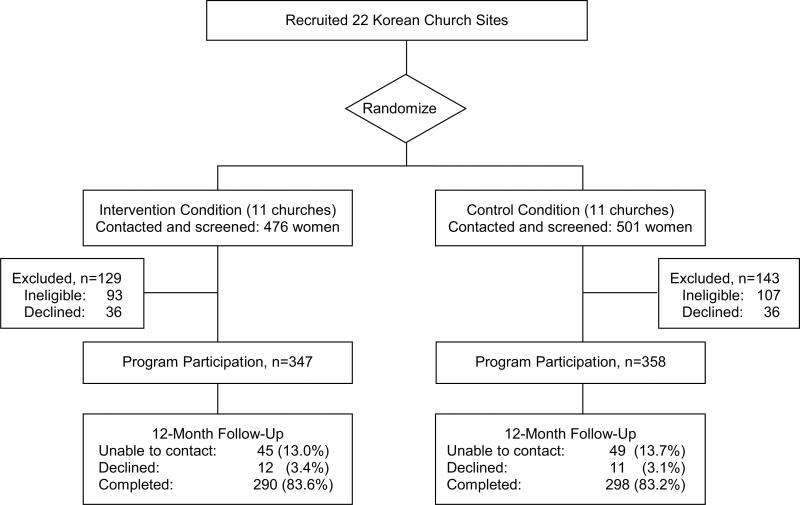
Methods: Korean American women (N = 705) were recruited from 22 churches. In this matched-pair, group-randomized design, 347 women received the intervention, which consisted of a culturally relevant cancer education program combined with provision of navigation services. The control group (N = 358) received general health education, including information about cervical cancer risk and screening and where to obtain low-cost or no-cost screening. Screening behavior was assessed 12 months after the program.
Results: Screening behavior data were obtained from 588 women 12 months after the program. In both site-level and participant-level analyses, the intervention program contributed to significantly higher screening rates compared with the control program (odds ratio [OR], 25.9; 95% confidence interval [CI], 10.1-66.1; P < .001). In sensitivity analysis, the treatment effect remained highly significant (OR, 16.7; 95% CI, 8.1-34.4; P < .001).
Conclusions: A multicomponent intervention combining community cancer education with navigation services yielded significant increases in cervical cancer screening rates among underscreened Korean American women. Community-accessible programs that incorporate cancer education with the delivery of key navigation services can be highly effective in increasing cervical cancer screening rates in this underserved population. Cancer 2017;123:1018-26. © 2016 American Cancer Society.
Keywords: Korean American; cervical cancer screening; community-based participatory research; intervention; navigation.
© 2016 American Cancer Society.
References
-
- ACS. Cancer Facts & Figures, 2016: Special Section on Cancer in Asian Americans, Native Hawaiians, and Pacific Islanders. American Cancer Society; Atlanta: 2016.
-
- Kagawa-Singer M, Pourat N, Breen N, et al. Breast and cervical cancer screening rates of subgroups of Asian American women in California. Med Care Res Rev. 2007;64:706–730. - PubMed
-
- Juon HS, Choi Y, Kim MT. Cancer screening behaviors among Korean-American women. Cancer Detect Prev. 2000;24:589–601. - PubMed
Publication types
MeSH terms
Grants and funding
LinkOut - more resources
Full Text Sources
Other Literature Sources
Medical
