. 2017 Feb;23(2):220-231.
doi: 10.3201/eid2302.161072. Epub 2017 Feb 15.

Highly Pathogenic Influenza A(H5Nx) Viruses with Altered H5 Receptor-Binding Specificity

Highly Pathogenic Influenza A(H5Nx) Viruses with Altered H5 Receptor-Binding Specificity

Hongbo Guo et al. Emerg Infect Dis. 2017 Feb.

Abstract

Emergence and intercontinental spread of highly pathogenic avian influenza A(H5Nx) virus clade 2.3.4.4 is unprecedented. H5N8 and H5N2 viruses have caused major economic losses in the poultry industry in Europe and North America, and lethal human infections with H5N6 virus have occurred in Asia. Knowledge of the evolution of receptor-binding specificity of these viruses, which might affect host range, is urgently needed. We report that emergence of these viruses is accompanied by a change in receptor-binding specificity. In contrast to ancestral clade 2.3.4 H5 proteins, novel clade 2.3.4.4 H5 proteins bind to fucosylated sialosides because of substitutions K222Q and S227R, which are unique for highly pathogenic influenza virus H5 proteins. North American clade 2.3.4.4 virus isolates have retained only the K222Q substitution but still bind fucosylated sialosides. Altered receptor-binding specificity of virus clade 2.3.4.4 H5 proteins might have contributed to emergence and spread of H5Nx viruses.

Keywords: H5 protein; H5Nx virus; emergence; fucosylated sialosides; hemagglutinin; highly pathogenic; influenza; influenza A virus; phylogeny; receptor binding; virus clade 2.3.4.4; viruses.


Figures
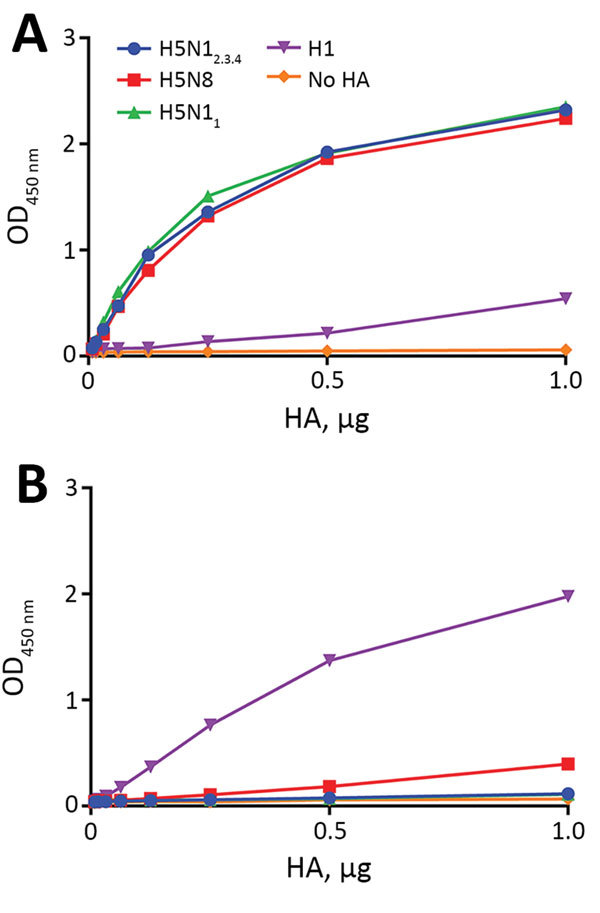
Figure 1
Figure 1
Binding of influenza A virus hemagglutinins to A) fetuin and B) transferrin. Limiting dilutions of soluble H5 trimers complexed with horseradish peroxidase−conjugated antibodies were used in a fetuin- or transferrin-binding assay. Optical density at 450 nm (OD450) corresponds to binding of HA to glycoproteins. HA, hemagglutinin; H5N12.3.4, novel H5N1 virus clade 2.3.4; H5N11, H5N1 virus clade 1.
Figure 2
Figure 2
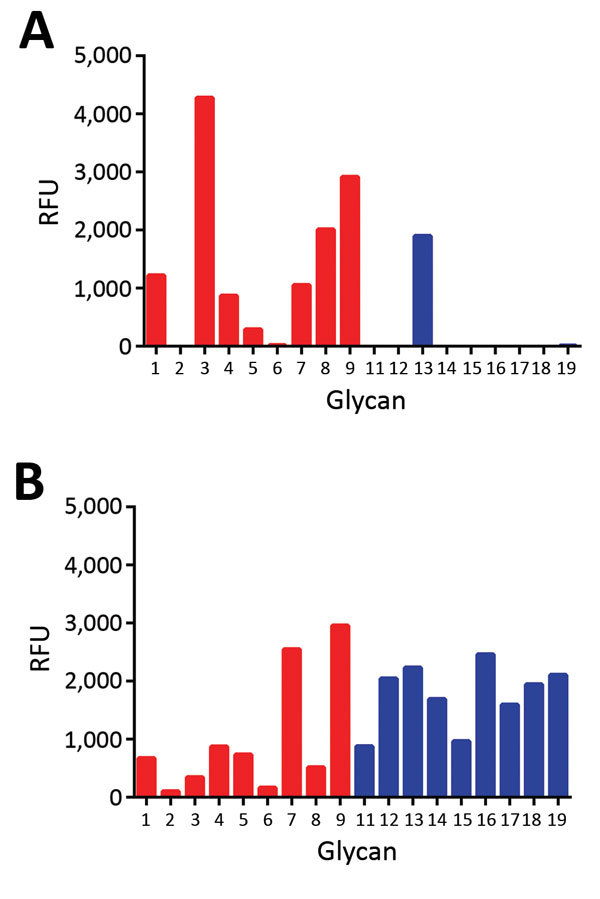
Glycan array analysis of recombinant H5 proteins of influenza A viruses. A) Wild-type H5N12.3.4 (KS) and B) H5N8 (QR) H5 proteins were applied to the glycan array precomplexed with StrepMAB-classic (IBA GmbH, Göttingen, Germany) and fluorescent secondary antibodies. Letters in parentheses indicate amino acids at positions 222 and 227. Binding of hemagglutinins is indicated in relative fluorescence units (RFU). Binding is shown to sialylated glycans present in the array for nonfucosylated (glycans 1–9; red bars) and fucosylated (glycans 11–19; blue bars) forms. Glycan numbers indicated on the x-axes correspond to glycan structures shown in Figure 3. H5N12.3.4, novel H5N1 virus clade 2.3.4.
Figure 3
Figure 3
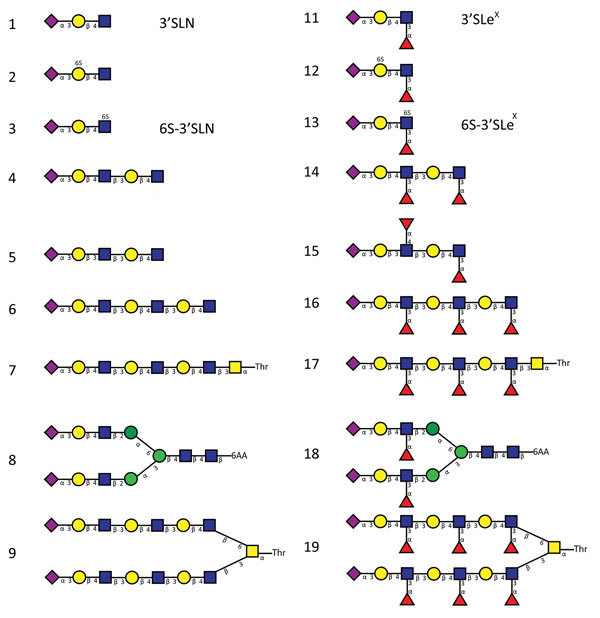
Glycan structures of influenza A viruses. Structures are shown for sialylated glycans present in the array in nonfucosylated (glycans 1–9) and fucosylated (glycans 11–19) forms and binding by hemagglutinins is shown in Figures 2 and 7. Glycans 1 and 11 correspond to 3′SLN (nonfucosylated glycan) and 3′SLeX (fucosylated form of 3′SLN), respectively. Similarly, glycans 3 and 13 correspond to 6-O-sulfo 3′SLN (6S-3′SLN) and 6-O-sulfo 3′SLeX (6S-3′SLeX), respectively. Blue squares, N-acetylglucosamine; yellow circles, galactose; green circles, mannose; purple diamonds, sialic acid; red triangles, fucose. H5N12.3.4, novel H5N1 virus clade 2.3.4.
Figure 4
Figure 4
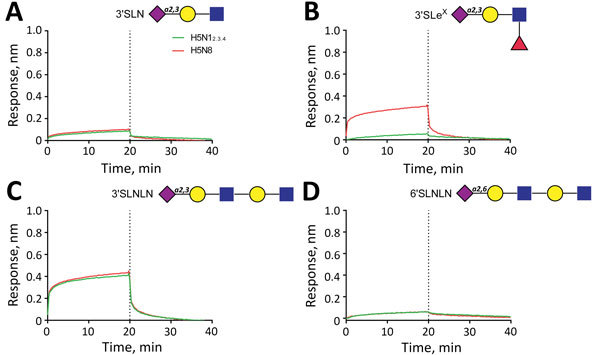
Analysis of binding of influenza A virus H5N12.3.4 and H5N8 hemagglutinins to sialylated glycans by using biolayer interferometry. A) 3′SLN, B) 3′SLeX, C) 3′SLNLN, D) 6′SLNLN. After complexing biotinylated glycans with streptavidin sensors, association and subsequent dissociation of H5 proteins complexed with StrepMAB-classic (IBA GmbH, Göttingen, Germany) was determined. Blue squares, N-acetylglucosamine; yellow circles, galactose; purple diamonds, sialic acid; red triangles, fucose. The dotted lines at the 20-min time points distinguish the association and dissociation phases. H5N12.3.4, novel H5N1 virus clade 2.3.4.
Figure 5
Figure 5
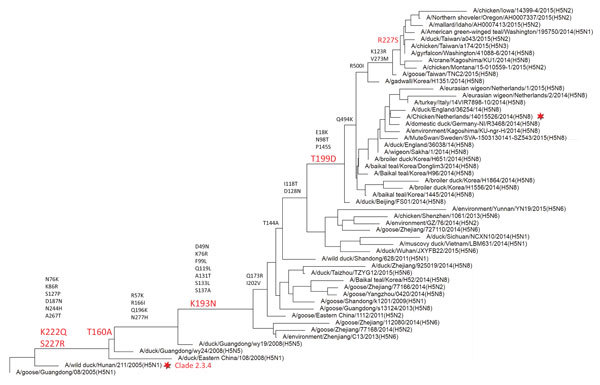
Phylogenetic analysis of influenza A virus clade 2.3.4.4 H5 proteins. A 362-aa full-length hemagglutinin (HA) sequence for H5 clade 2.3.4.4 was obtained from GenBank and the GISAID database (http://platform.gisaid.org). An HA protein tree was constructed by using the PHYLIP neighbor-joining algorithm (https://ugene.net/wiki/display/UUOUM/PHYLIP+Neighbor-Joining) and the F84 distance matrix. This tree was used to construct a guide tree with 52 HA sequences representing all branches of the tree. These sequences were used to construct a summary tree of similar topology as the guide tree. Items above the branches indicate key residues that differ between different branches. Items in red above the branches indicate mutations introduced in this study. The HA protein tree is rooted by an early clade 2.3.4 isolate (A/goose/Guangdong/08). H5N12.3.4 and H5N8 HA proteins used in this study are indicated by red stars. H5N12.3.4, novel H5N1 virus clade 2.3.4.
Figure 6
Figure 6
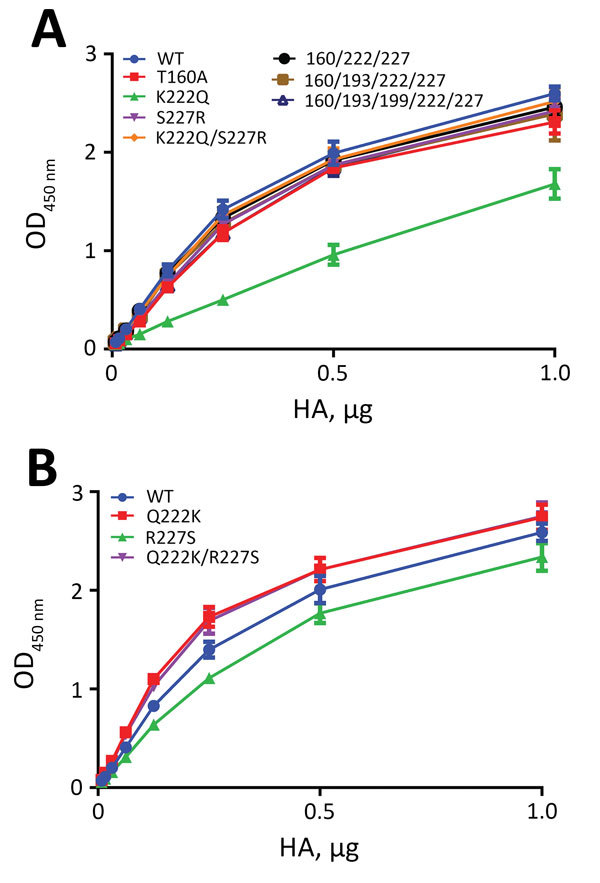
Binding of influenza A virus mutant H5N12.3.4 HA (A) and H5N8 HA (B) to fetuin. Binding was assayed as described in the legend to Figure 1. Mutated residues are indicated. 160/222/227, 160/193/222/227, and 160/193/199/222/227 refer to T160A/K222Q/S227R, T160A/K193N/K222Q/S227R and T160A/K193N/T199D/K222Q/S227R substitutions in H5N12.3.4 HA, respectively. Optical density at 450 nm (OD450) corresponds to binding of HA to glycoproteins. WT, wild-type; HA, hemagglutinin. H5N12.3.4, novel H5N1 virus clade 2.3.4.
Figure 7
Figure 7
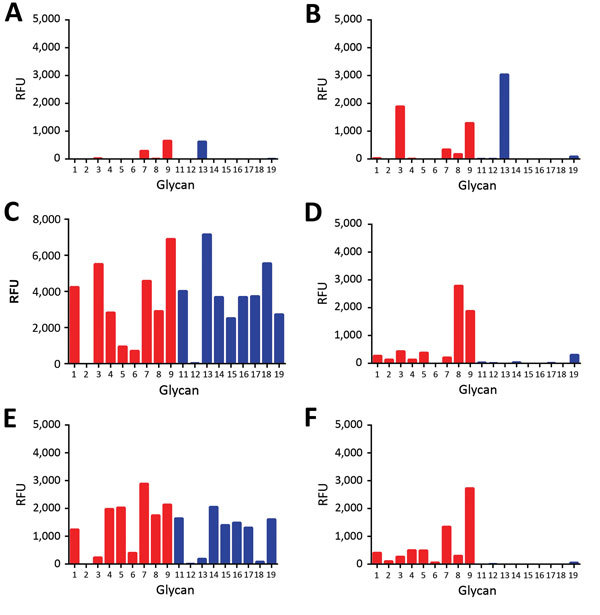
Glycan array analysis of influenza A virus mutant H5 proteins. A) mutant H5N12.3.4 K222Q (QS); B) mutant H5N12.3.4 S227R (KR); C) mutant H5N12.3.4 K222Q/S227R (QR); D) H5N8 Q222K (KR); E) R227S (QS); F) Q227R/R227S (KS). Proteins were applied to the glycan array as detailed in the legend to Figure 2. Letters in parentheses indicate amino acids at positions 222 and 227. Binding of hemagglutinins is indicated in relative fluorescence units (RFU). Binding is shown to sialylated glycans present in the array in nonfucosylated (glycans 1–9; red bars) and fucosylated (glycans 11–19; blue bars) forms. Glycan numbers indicated on the x-axes correspond to glycan structures shown in Figure 3. H5N12.3.4, novel H5N1 virus clade 2.3.4.
Figure 8
Figure 8
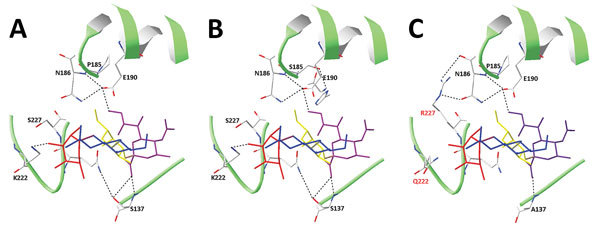
Structural models of influenza A virus H5 proteins complexed with 3′SLeX. A) Clade 1 H5 (H5N11 of A/Vietnam/1194/2004) complexed with 3′SLeX (PDB 3ZNM0 (29). B) H5N12.3.4 and C) H5N8 hemagglutinins were modeled into the structure shown in panel A as detailed in Materials and Methods. Key amino acids are indicated and shown in a stick representation. C (gray), O (red), and N (blue) in the side chains are colored. SIA, Gal, GlcNAc, and Fuc moieties of 3′SLeX are shown in purple, yellow, blue, and red, respectively. Hydrogen bonds are indicated by dotted lines. H5N12.3.4, novel H5N1 virus clade 2.3.4; H5N11, H5N1 virus clade 1.
Figure 9
Figure 9
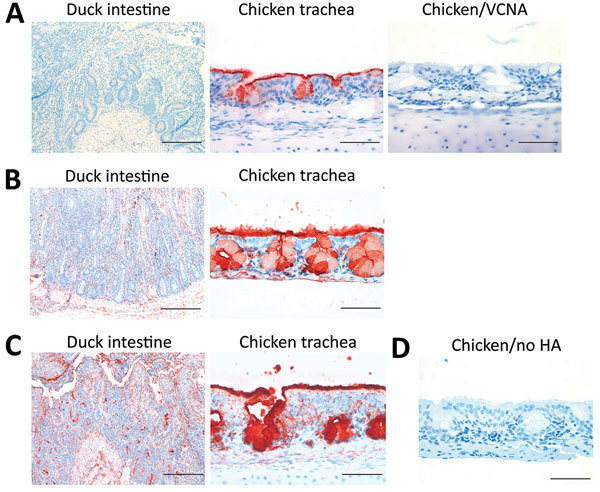
Histochemical analysis of binding of influenza A virus H5 proteins to avian tissues. A) Duck intestine and chicken trachea tissues stained with an antibody specific for 3′SLeX (anti-3′SLeX). Tissue sections treated with Vibrio cholerae neuraminidase (VCNA) before immunostaining were used as controls. Scale bars indicate 200 μm in left panel and 50 μm in center and right panels. B, C) Duck intestine and chicken trachea tissues incubated with H5 proteins H5N12.3.4 and H5N8 after precomplexing with horseradish peroxidase (HRP)−conjugated antibodies. Scale bars indicate 200 μm in left panel and 50 μm in right panel. D) Chicken trachea tissues incubated with HRP-conjugated antibodies against H5N12.3.4 (no hemagglutinin [HA]) were used as a negative control. H5N12.3.4, novel H5N1 virus clade 2.3.4. Scale bar indicates 50 μm.

References

    1. de Vries E, Guo H, Dai M, Rottier PJ, van Kuppeveld FJ, de Haan CA. Rapid emergence of highly pathogenic avian influenza subtypes from a subtype H5N1 hemagglutinin variant. Emerg Infect Dis. 2015;21:842–6. 10.3201/eid2105.141927 - DOI - PMC - PubMed
    1. Saito T, Tanikawa T, Uchida Y, Takemae N, Kanehira K, Tsunekuni R. Intracontinental and intercontinental dissemination of Asian H5 highly pathogenic avian influenza virus (clade 2.3.4.4) in the winter of 2014-2015. Rev Med Virol. 2015;25:388–405. 10.1002/rmv.1857 - DOI - PubMed
    1. Ip HS, Torchetti MK, Crespo R, Kohrs P, DeBruyn P, Mansfield KG, et al. Novel Eurasian highly pathogenic avian influenza A H5 viruses in wild birds, Washington, USA, 2014. Emerg Infect Dis. 2015;21:886–90. 10.3201/eid2105.142020 - DOI - PMC - PubMed
    1. Pasick J, Berhane Y, Joseph T, Bowes V, Hisanaga T, Handel K, et al. Reassortant highly pathogenic influenza A H5N2 virus containing gene segments related to Eurasian H5N8 in British Columbia, Canada, 2014. Sci Rep. 2015;5:9484. 10.1038/srep09484 - DOI - PMC - PubMed
    1. Swayne DE. High pathogenicity avian influenza in the Americas. In: Swayne DE, editor. Avian influenza. Oxford (UK): Blackwell; 2009. p. 191–216.

MeSH terms

Substances

LinkOut - more resources