Review
. 2017 Jan 2;95(1-2):527-538.
doi: 10.1002/jnr.23912.

Sexual modulation of sex-shared neurons and circuits in Caenorhabditis elegans

Affiliations
Review

Sexual modulation of sex-shared neurons and circuits in Caenorhabditis elegans

Douglas S Portman. J Neurosci Res. .

Abstract

Studies using the nematode C. elegans have provided unique insights into the development and function of sex differences in the nervous system. Enabled by the relative simplicity of this species, comprehensive studies have solved the complete cellular neuroanatomy of both sexes as well as the complete neural connectomes of the entire adult hermaphrodite and the adult male tail. This work, together with detailed behavioral studies, has revealed three aspects of sex differences in the nervous system: sex-specific neurons and circuits; circuits with sexually dimorphic synaptic connectivity; and sex differences in the physiology and functions of shared neurons and circuits. At all of these levels, biological sex influences neural development and function through the activity of a well-defined genetic hierarchy that acts throughout the body to translate chromosomal sex into the state of a master autosomal regulator of sexual differentiation, the transcription factor TRA-1A. This Review focuses on the role of genetic sex in implementing sex differences in shared neurons and circuits, with an emphasis on linking the sexual modulation of specific neural properties to the specification and optimization of sexually divergent and dimorphic behaviors. An important and unexpected finding from these studies is that chemosensory neurons are a primary focus of sexual modulation, with genetic sex adaptively shaping chemosensory repertoire to guide behavioral choice. Importantly, hormone-independent functions of genetic sex are the principal drivers of all of these sex differences, making nematodes an excellent model for understanding similar but poorly understood mechanisms that likely act throughout the animal kingdom. © 2016 Wiley Periodicals, Inc.

Keywords: Caenorhabditis elegans; genetic sex; neural circuits and behavior; sex differences; sexual behavior; sexual dimorphism.


Conflict of interest statement

STATEMENT The author declares no conflicts of interest.

Figures
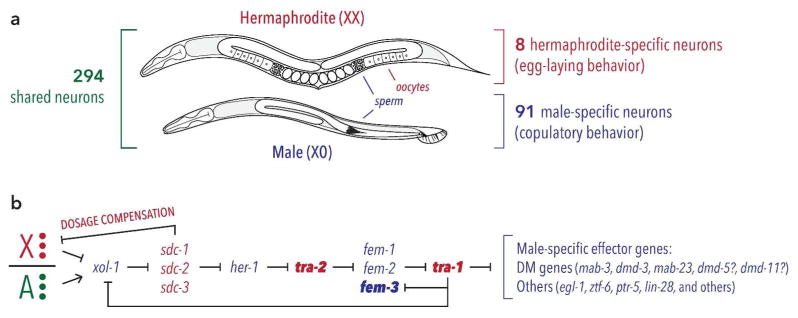
Figure 1
Figure 1. Sexual dimorphism and sex determination in the nematode C. elegans
(A) Adult males and hermaphrodites share an overall body plan but differ in germline, gonad, genitalia, and many other features. Adults of both sexes possess exactly 294 shared neurons, while adult hermaphrodites and adult males possess 8 and 91 sex-specific neurons, respectively. (B) The genetic hierarchy controlling C. elegans sex determination in the soma is triggered by the ratio of sex chromosomes to autosomes (X/A ratio). Genes active in XX animals are shown in red, while those active in XO animals are shown in blue. The X/A ratio is “calculated” through the molecular activities of dosage-sensitive X- and A-linked genes (red and green circles, respectively), which converge on the regulation of the autosomal gene xol-1. As a result of this regulation, xol-1 is expressed only in XO embryos, where it regulates both sexual differentiation and well as dosage compensation by repressing the sdc genes. Downstream of the sdc genes, dosage compensation and sexual differentiation are implemented through independent pathways. At the terminus of the sex determination pathway lies the “master regulator” tra-1, shown in bold. Acting via its product TRA-1A, this gene is both necessary and sufficient for essentially all sex differences in the soma, including the nervous system. Several known direct targets of TRA-1A are shown, with question marks indicating targets that have been suggested to be direct. TRA-1A also regulates xol-1 and fem-3, providing feedback that likely stabilizes the state of the pathway once dosage compensation equalizes the X-to-A ratio. tra-2 and fem-3, both shown in bold, are normally active in only in hermaphrodites or males, respectively. Forced expression of these genes in specific tissues of the opposite sex is largely sufficient to reverse their sexual state by activating or inhibiting TRA-1A.
Figure 2
Figure 2. Sensory repertoires are tuned cell-autonomously by genetic sex
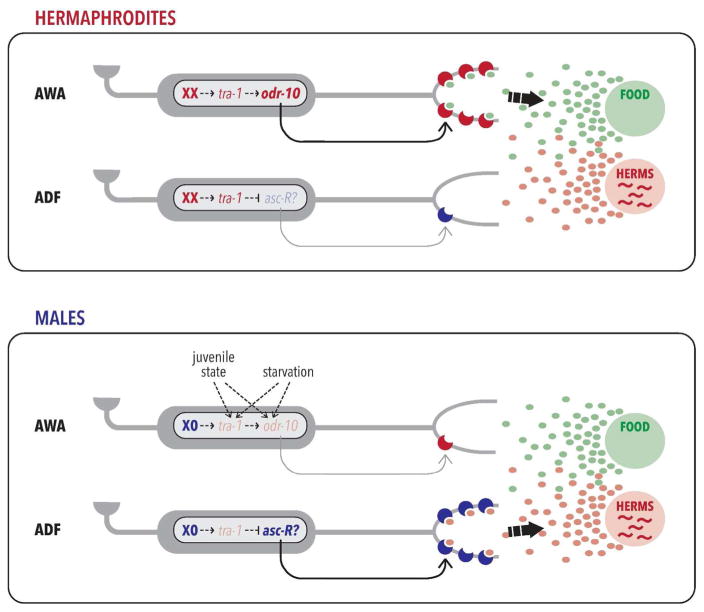
In hermaphrodites, the genetic sex of the AWA neuron triggers high levels of expression of odr-10, the receptor for the food odorant diacetyl (Ryan et al. 2014). In the ADF neuron and perhaps others, genetic sex acts cell-autonomously to inhibit sensitivity to sex pheromones (Fagan et al., in preparation), potentially also by regulating ascaroside receptor (“asc-R”) expression. The net effect of this is that food cues become more salient for hermaphrodites, promoting the prioritization of feeding behavior. In males, the state of the sex determination pathway is reversed; this inhibits odr-10 expression in AWA and increases the sensitivity of ADF and perhaps other neurons to ascaroside sex pheromones. (Dashed arrows inside the nucleus indicate indirect regulation; for simplicity, the entire pathway is not shown.) Thus, differential perception of chemosensory cues causes males to leave food and search for mates. In starved and larval males, odr-10 expression is upregulated. How these signals converge with genetic sex to regulate odr-10 remains unknown, but the effect of this regulation is to increase male attraction to food.
Figure 3
Figure 3. Genetic sex reconfigures the wiring of a shared sensory circuit
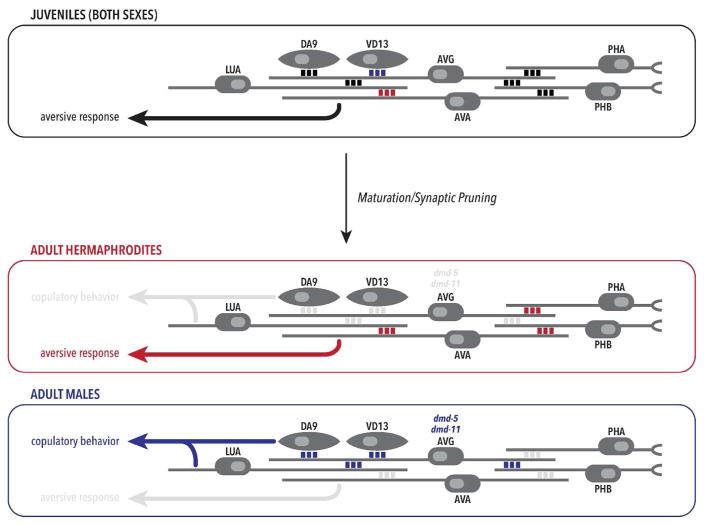
The phasmid sensory neurons PHA and PHB, present in the tail of both sexes, receive chemical and perhaps mechanical input. Postsynaptically, sex differences in connectivity among shared neurons (indicated by triplets of red and blue boxes) act to channel this sensory input into alternative synaptic pathways (Oren-Suissa et al. 2016). In the adult hermaphrodite, signaling by PHB modulates aversive behavior. In adult male, PHB promotes copulatory behavior. Interestingly, this differential connectivity (red and blue boxes in the lower boxes) arises mostly through sex-specific pruning of synapses that initially form in embryos/larvae of both sexes (black boxes in juvenile diagram). The action of the DM genes dmd-5 and dmd-11 in the male AVG helps determine the sex-specificity of the pruning process. In contrast, other synapses (red and blue boxes in upper box) already appear to be sexually dimorphic in larvae. In all diagrams, anterior is to the right and posterior to the left.

References

    1. Ankeny R. The natural history of Caenorhabditis elegans research. Nature reviews Genetics. 2001;2(6):474–479. - PubMed
    1. Bargmann CI, Horvitz HR. Control of larval development by chemosensory neurons in Caenorhabditis elegans. Science. 1991;251(4998):1243–1246. - PubMed
    1. Barr MM, Garcia LR. Male mating behavior. WormBook: the online review of C elegans biology. 2006:1–11. - PMC - PubMed
    1. Barrios A, Ghosh R, Fang C, Emmons SW, Barr MM. PDF-1 neuropeptide signaling modulates a neural circuit for mate-searching behavior in C. elegans. Nature neuroscience. 2012;15(12):1675–1682. - PMC - PubMed
    1. Barrios A, Nurrish S, Emmons SW. Sensory regulation of C. elegans male mate-searching behavior. Current biology: CB. 2008;18(23):1865–1871. - PMC - PubMed

Publication types

MeSH terms

Substances

LinkOut - more resources