Review
. 2017 Jan 2;95(1-2):136-147.
doi: 10.1002/jnr.23963.

Sex differences, gender and addiction

Affiliations
Review

Sex differences, gender and addiction

Jill B Becker et al. J Neurosci Res. .

Abstract

This review discusses alcohol and other forms of drug addiction as both a sociocultural and biological phenomenon. Sex differences and gender are not solely determined by biology, nor are they entirely sociocultural. The interactions among biological, environmental, sociocultural, and developmental influences result in phenotypes that may be more masculine or more feminine. These gender-related sex differences in the brain can influence the responses to drugs of abuse, progressive changes in the brain after exposure to drugs of abuse and whether addiction results from drug-taking experiences. In addition, the basic laboratory evidence for sex differences is discussed within the context of four types of sex/gender differences. © 2016 Wiley Periodicals, Inc.

Keywords: addiction; animal models; gender; sex differences; sociocultural influences.


Conflict of interest statement

The authors confirm they have no conflict of interest.

Figures
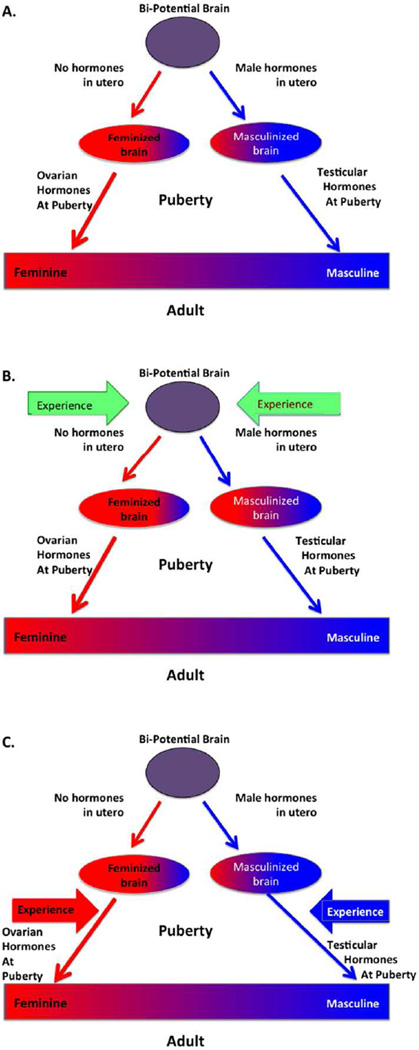
Figure 1
Figure 1
The sexual differentiation of the bi-potential brain is not bimodal – ending up either all male or all female. Instead the adult brain exists on a continuum that can be influenced by events during embryonic development and postnatal life. Events prior to puberty will tend to have a greater effect on the adult brain than events after puberty. A. Sexual differentiation of the brain is a result of testosterone produced by the developing testes in the male acting on the bi-potential brain to induce sexual differentiation of target brain regions. At puberty hormones from the testes and ovaries induce additional developmental events throughout the brain that further enhance or diminish sex differences in the brain. In the figure the bipotential brain is depicted in lavender that becomes more blue (masculine) or red (feminine) during development. The red arrows depict the female typical path and the blue arrows the male-typical path. Prior to puberty the brains are not fully formed and the hormones at puberty influence development further to result in the final phenotype. The bar at the bottom indicated that the sexual differentiation of the brain exists along a continuum from feminine to masculine. B. Experiences during prenatal development Influence sex differences in the brain (large green ‘Experience’ arrows). Events and experience during development can have the same or different effects on males and females. The direction of the effect depends on what type of event it is and when it happens during development. In the example here, prenatal experience, such as maternal stress can make both male and female fetuses less masculinized. Resulting in offspring that are both shifted in the same direction along the continuum. Other developmental events could have different effects. C. Experiences during post-natal development prior to puberty, such as playing with trucks by boys (blue ‘Experience’ arrow) vs. dolls by the girls (red ‘Experience’ arrow), can lead to greater sex differences in the brains of adults than would be there without these variations in experience. If boys and girls have the same experiences, both would potentially be affected by the experience, but the direction of the effect would depend on the brain at the time the experience occurs.

References

    1. Allen AM, Lunos S, Heishman SJ, al’Absi M, Hatsukami D, Allen SS. Subjective response to nicotine by menstrual phase. Addict Behav. 2015;43:50–53. - PMC - PubMed
    1. Andersen ML, Sawyer EK, Howell LL. Contributions of neuroimaging to understanding sex differences in cocaine abuse. Experimental and Clinical Psychopharmacology. 2012;20(1):2–15. - PMC - PubMed
    1. Anglin MD, Hser YI, McGlothlin WH. Sex differences in addict careers. 2. Becoming addicted. The American Journal of Drug and Alcohol Abuse. 1987;13(1–2):59–71. - PubMed
    1. Anker JJ, Carroll ME. Females are more vulnerable to drug abuse than males: evidence from preclinical studies and the role of ovarian hormones. Current topics in behavioral neurosciences. 2011;8:73–96. - PubMed
    1. Anker JJ, Carroll ME. Reinstatement of cocaine seeking induced by drugs, cues, and stress in adolescent and adult rats. Psychopharmacology. 2010;208(2):211–222. - PMC - PubMed
