


Hepatocellular Carcinoma Surveillance Among Patients With Cirrhosis in a Population-based Integrated Health Care Delivery System
- PMID: 27870642
- PMCID: PMC5436954
- DOI: 10.1097/MCG.0000000000000708
Hepatocellular Carcinoma Surveillance Among Patients With Cirrhosis in a Population-based Integrated Health Care Delivery System
Abstract
Purpose: Fewer than 1 in 5 patients with cirrhosis receive hepatocellular carcinoma (HCC) surveillance; however, most studies were performed in select patient populations, which may not be informative of practice patterns in population-based community practices. Further, few reported guideline-concordant consistent surveillance rates.
Goals: Characterize guideline-concordant HCC surveillance rates and patient-level factors associated with surveillance among a population-based cohort of patients with cirrhosis.
Study: We retrospectively characterized HCC surveillance among cirrhosis patients followed between January 2010 and December 2012 at an integrated health care delivery system in Washington state. Consistent surveillance was defined as an ultrasound every 6 months, and inconsistent surveillance was defined as ≥1 ultrasound during the 2-year follow-up period. Univariate and multivariate analyses were conducted to identify correlates of HCC surveillance receipt.
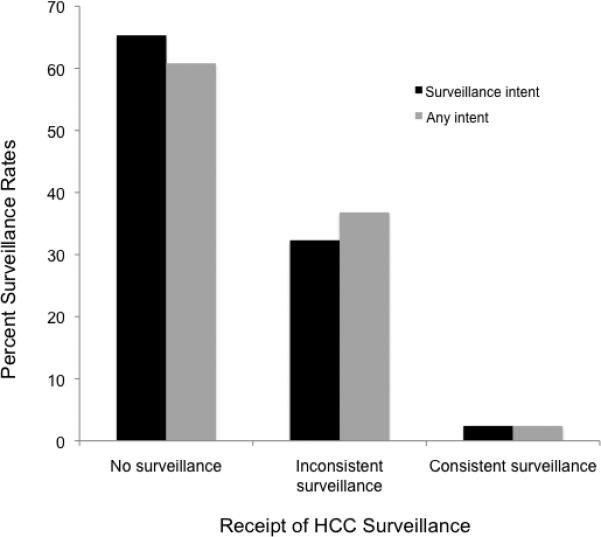
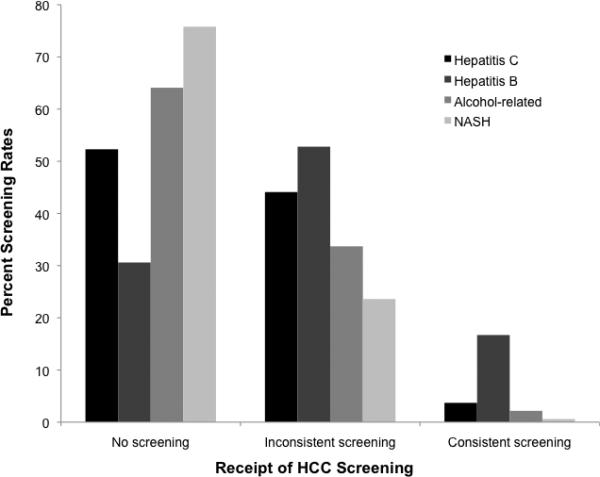
Results: Of 1137 patients with cirrhosis, 22 (2%) underwent consistent surveillance, 371 (33%) had inconsistent surveillance, and 744 (65%) received no surveillance during follow-up. Correlates of HCC surveillance receipt in multivariate analysis included Gastroenterology/Hepatology subspecialty care [odds ratio (OR), 1.88; 95% confidence interval (CI), 1.44-2.46], Child Pugh B/C cirrhosis (OR, 1.61; 95% CI, 1.07-2.43), elevated aspartate aminotransferase (OR, 1.63; 95% CI, 1.13-2.35), and etiology of liver disease. Compared with hepatitis C-infected patients, patients with hepatitis B infection were more likely to undergo surveillance (OR, 2.72; 95% CI, 1.28-5.81), whereas patients with alcohol-related cirrhosis (OR, 0.63; 95% CI, 0.42-0.93) and nonalcoholic steatohepatitis (OR, 0.39; 95% CI, 0.28-0.56) were less likely to undergo surveillance.
Conclusions: Although one third of patients undergo inconsistent HCC surveillance, <2% of patients receive guideline-concordant biannual HCC surveillance.
Figures
References
-
- El-Serag HB, Rudolph KL. Hepatocellular carcinoma: epidemiology and molecular carcinogenesis. Gastroenterology. 2007;132:2557–76. - PubMed
-
- Rahib L, Smith BD, Aizenberg R, Rosenzweig AB, Fleshman JM, Matrisian LM. Projecting cancer incidence and deaths to 2030: the unexpected burden of thyroid, liver, and pancreas cancers in the United States. Cancer Res. 2014;74:2913–21. - PubMed
-
- Llovet JM, Bustamante J, Castells A, et al. Natural history of untreated nonsurgical hepatocellular carcinoma: rationale for the design and evaluation of therapeutic trials. Hepatology. 1999;29:62–7. - PubMed
MeSH terms
Grants and funding
LinkOut - more resources
Full Text Sources
Other Literature Sources
Medical
