. 2017 Feb;31(2):751-760.
doi: 10.1096/fj.201600891R. Epub 2016 Nov 8.

Benzopyrimido-pyrrolo-oxazine-dione CFTR inhibitor (R)-BPO-27 for antisecretory therapy of diarrheas caused by bacterial enterotoxins

Affiliations

Benzopyrimido-pyrrolo-oxazine-dione CFTR inhibitor (R)-BPO-27 for antisecretory therapy of diarrheas caused by bacterial enterotoxins

Onur Cil et al. FASEB J. 2017 Feb.

Abstract

Secretory diarrheas caused by bacterial enterotoxins, including cholera and traveler's diarrhea, remain a major global health problem. Inappropriate activation of the cystic fibrosis transmembrane conductance regulator (CFTR) chloride channel occurs in these diarrheas. We previously reported that the benzopyrimido-pyrrolo-oxazinedione (R)-BPO-27 inhibits CFTR chloride conductance with low-nanomolar potency. Here, we demonstrate using experimental mouse models and human enterocyte cultures the potential utility of (R)-BPO-27 for treatment of secretory diarrheas caused by cholera and Escherichia coli enterotoxins. (R)-BPO-27 fully blocked CFTR chloride conductance in epithelial cell cultures and intestine after cAMP agonists, cholera toxin, or heat-stable enterotoxin of E. coli (STa toxin), with IC50 down to ∼5 nM. (R)-BPO-27 prevented cholera toxin and STa toxin-induced fluid accumulation in small intestinal loops, with IC50 down to 0.1 mg/kg. (R)-BPO-27 did not impair intestinal fluid absorption or inhibit other major intestinal transporters. Pharmacokinetics in mice showed >90% oral bioavailability with sustained therapeutic serum levels for >4 h without the significant toxicity seen with 7-d administration at 5 mg/kg/d. As evidence to support efficacy in human diarrheas, (R)-BPO-27 blocked fluid secretion in primary cultures of enteroids from human small intestine and anion current in enteroid monolayers. These studies support the potential utility of (R)-BPO-27 for therapy of CFTR-mediated secretory diarrheas.-Cil, O., Phuan, P.-W., Gillespie, A. M., Lee, S., Tradtrantip, L., Yin, J., Tse, M., Zachos, N. C., Lin, R., Donowitz, M., Verkman, A. S. Benzopyrimido-pyrrolo-oxazine-dione CFTR inhibitor (R)-BPO-27 for antisecretory therapy of diarrheas caused by bacterial enterotoxins.

Keywords: cholera; intestinal secretion; secretory diarrhea; traveler’s diarrhea.


Figures

Figure 1.
Figure 1.
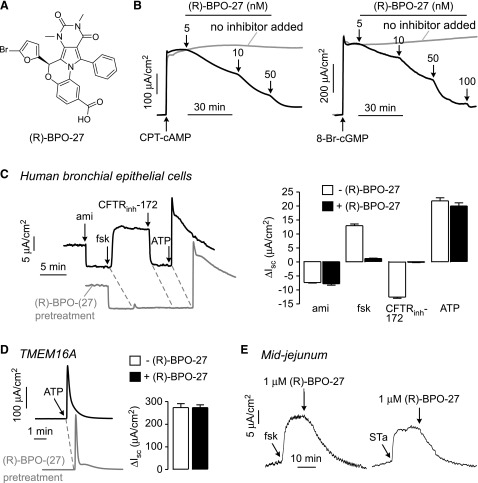
CFTR inhibition by (R)-BPO-27. A) Chemical structure of (R)-BPO-27. B) Short-circuit current in FRT cells expressing human wild-type CFTR showing responses to 100 μM CPT-cAMP (left) and 200 μM 8-Br-cGMP (right), with indicated concentrations of (R)-BPO-27 (representative of 3 experiments). C) Left: short-circuit in HBE cells in response to agonists and inhibitors that target key ion transport processes: 20 μM amiloride (ami), 20 μM forskolin (fsk), 10 μM CFTRinh-172, and 100 µM ATP. Experiments were done in the absence and presence of (R)-BPO-27 (10 μM, 10 min pretreatment). Right: data summary (means ± se; n = 3). D) Left: short-circuit current in TMEM16A-expressing FRT cells in response to 100 µM ATP. Experiments were done in the absence and presence of (R)-BPO-27 (10 μM, 5 min pretreatment). Right: data summary (means ± se; n = 3). E) Short-circuit current in mouse midjejunal strips showing responses to 20 µM forskolin (left), 10 μg/ml STa toxin (right), and 1 μM (R)-BPO-27 (representative of 3 experiments).
Figure 2.
Figure 2.
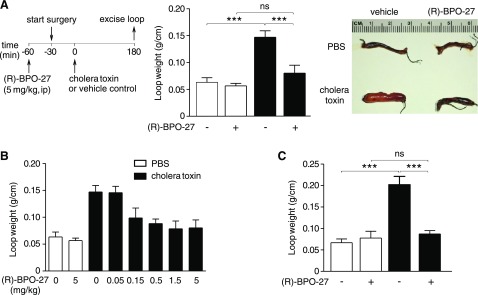
(R)-BPO-27 prevents fluid accumulation in cholera toxin-treated intestinal closed loops. A) Experimental protocol (left), loop weight/length ratio (middle), and representative photos (right) of loops treated with PBS or cholera toxin without or with (R)-BPO-27 (means ± se; n = 5–8 loops per group). B) (R)-BPO-27 dose-response study for experiments as in A (means ± se; n = 4–8 loops per group). C) Efficacy of orally administered (R)-BPO-27 (5 mg/kg) administered 60 min before surgery (means ± se; n = 3–7 loops per group). One-way ANOVA with post hoc Newman-Keuls multiple comparisons test. ***P < 0.001. ns, not significant.
Figure 3.
Figure 3.
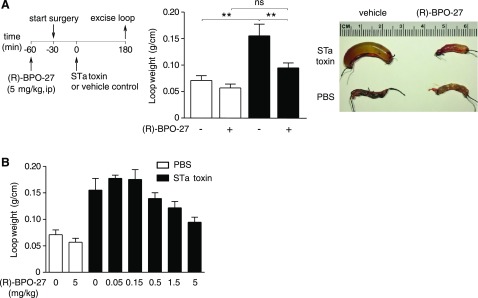
(R)-BPO-27 prevents fluid accumulation in STa toxin-treated intestinal closed loops. A) Experimental protocol (left), loop weight/length ratio (middle), and representative photos (right) of loops treated with PBS or STa toxin without or with (R)-BPO-27 (means ± se; n = 4 or 5 loops per group). B) (R)-BPO-27 dose-response study for experiments as in A (means ± se; n = 4 or 5 loops per group). One-way ANOVA with post hoc Newman-Keuls multiple comparisons test. **P < 0.01. ns, not significant.
Figure 4.
Figure 4.
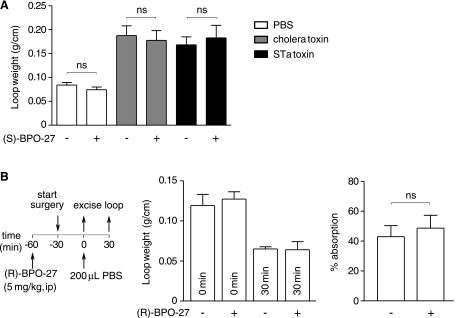
(S)-BPO-27 does not inhibit intestinal secretion, and (R)-BPO-27 does not inhibit intestinal absorption. A) Cholera toxin and STa toxin-induced intestinal secretion study done as in Figs. 2A and 3A but with (S)-BPO-27 (inactive enantiomer, 5 mg/kg, i.p.) (means ± se; n = 4–7 loops per group). One-way ANOVA with post hoc Newman-Keuls multiple comparisons test. B) Intestinal absorption study protocol (left), loop weight/length ratios at 0 and 30 min (middle), and percent intestinal absorption (right) in PBS-injected loops (means ± se; n = 4 loops per group); Student’s t test. ns, not significant.
Figure 5.
Figure 5.
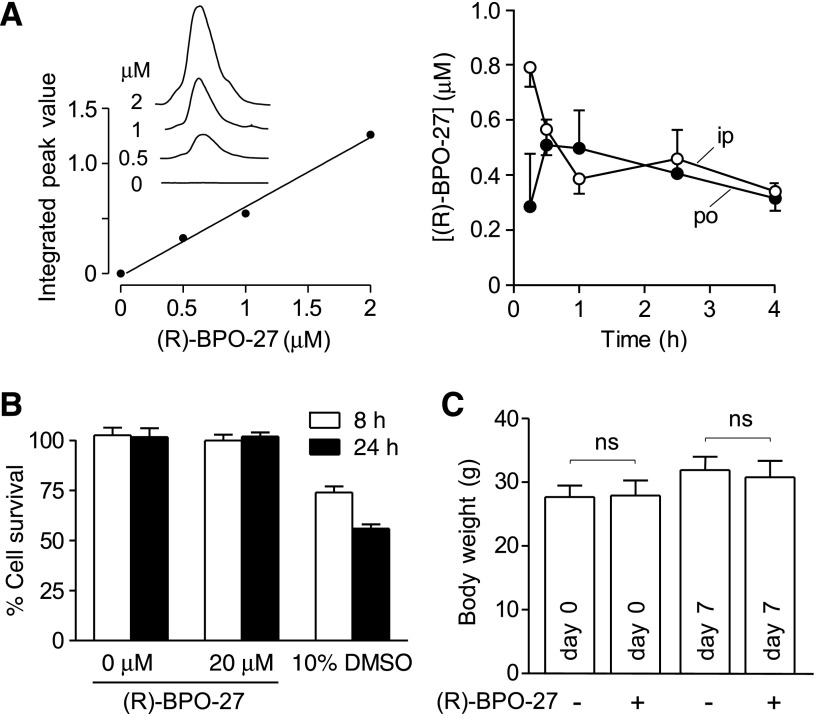
(R)-BPO-27 pharmacokinetics and toxicity. A) Standard serum concentration curve determined by LC-MS (left). Time course of serum (R)-BPO-27 concentration after bolus intraperitoneal or oral administration of 5 mg/kg (R)-BPO-27 at zero time (right) (means ± se; 3 mice per group). B) Cytotoxicity measured by Alamar Blue assay in FRT cells incubated with (R)-BPO-27 for 8 or 24 h (10% DMSO as positive control) (means ± se; n = 4 cultures). C) Body weight in mice receiving 5 mg/kg (R)-BPO-27 orally for 7 d (means ± se; n = 5 mice per group); Student’s t test. ns, not significant.
Figure 6.
Figure 6.
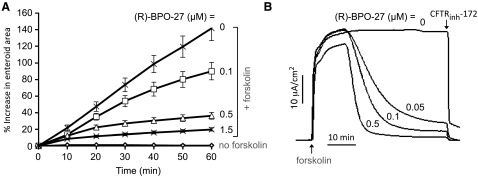
(R)-BPO-27 inhibits CFTR-dependent swelling of enteroids generated from human jejunum and CFTR Cl current in planar enteroid cultures. A) Inhibition of forskolin-induced swelling of enteroids by (R)-BPO-27. Enteroids were incubated with (R)-BPO-27 for 10 min before addition of 5 µM forskolin. Enteroid swelling was quantified as areas of fluorescently stained enteroids as determined by confocal microscopy (means ± se; n = 8). B) Short-circuit current in planar cultures generated from the human enteroids. Cultures were treated with 10 µM forskolin, and then indicated concentrations of (R)-BPO-27 were added to both apical and basolateral solutions, followed by 25 µM CFTRinh-172 added to the apical solution. Representative of 2 sets of studies.

References

    1. Verkman A. S., Galietta L. J. (2009) Chloride channels as drug targets. Nat. Rev. Drug Discov. 8, 153–171 - PMC - PubMed
    1. Solomon G. M., Marshall S. G., Ramsey B. W., Rowe S. M. (2015) Breakthrough therapies: cystic fibrosis (CF) potentiators and correctors. Pediatr. Pulmonol. 50(Suppl 40), S3–S13 - PMC - PubMed
    1. Cil O., Phuan P. W., Lee S., Tan J., Haggie P. M., Levin M. H., Sun L., Thiagarajah J. R., Ma T., Verkman A. S. (2016) CFTR activator increases intestinal fluid secretion and normalizes stool output in a mouse model of constipation. Cell Mol. Gastroenterol. Hepatol. 2, 317–327 - PMC - PubMed
    1. Flores A. M., Casey S. D., Felix C. M., Phuan P. W., Verkman A. S., Levin M. H. (2016) Small-molecule CFTR activators increase tear secretion and prevent experimental dry eye disease. FASEB J. 30, 1789–1797 - PMC - PubMed
    1. Solomon G. M., Raju S. V., Dransfield M. T., Rowe S. M. (2016) Therapeutic approaches to acquired cystic fibrosis transmembrane conductance regulator dysfunction in chronic bronchitis. Ann. Am. Thorac. Soc. 13(Suppl 2), S169–S176 - PMC - PubMed

Publication types