. 2016 Nov 21;47(1):116.
doi: 10.1186/s13567-016-0401-6.

Age is not a determinant factor in susceptibility of broilers to H5N2 clade 2.3.4.4 high pathogenicity avian influenza virus

Affiliations

Age is not a determinant factor in susceptibility of broilers to H5N2 clade 2.3.4.4 high pathogenicity avian influenza virus

Kateri Bertran et al. Vet Res. .

Abstract

In 2014-2015, the US experienced an unprecedented outbreak of H5 clade 2.3.4.4 highly pathogenic avian influenza (HPAI) virus. The H5N2 HPAI virus outbreak in the Midwest in 2015 affected commercial turkey and layer farms, but not broiler farms. To assess any potential genetic resistance of broilers and/or age-related effects, we investigated the pathogenesis and transmission of A/turkey/Minnesota/12582/2015 (H5N2) (Tk/MN/15) virus in commercial 5-week-old broilers, 8-week-old broilers, and >30-week-old broiler breeders. The mean bird lethal dose (BLD50) was 5.0 log10 mean egg infectious dose (EID50) for all age groups. The mean death time (MDT) was statistically not different among the three age groups, ranging between 3.2 and 4.8 days. All broilers that became infected shed high levels of virus with transmission to contacts and demonstrated severe pathology. Mortality and virus shedding results indicated that age is not a determinant factor in susceptibility of broilers to H5N2 clade 2.3.4.4 HPAI virus. Previously, the Tk/MN/15 virus had a BLD50 of 3.6 log10 EID50 and MDT of 2 days in White Leghorn chickens and a BLD50 of 5.0 log10 EID50 and MDT of 5.9 days in turkeys, suggesting that the broiler breed is less susceptible to Midwestern H5N2 virus than the layer breed but similarly susceptible to turkeys. Therefore, genetic resistance of broilers to infection may have accounted only partially for the lack of affected broiler farms in the Midwestern outbreaks, with other contributing factors such as fewer outside to on farm exposure to contacts, type of production management system or enhanced biosecurity.


Figures
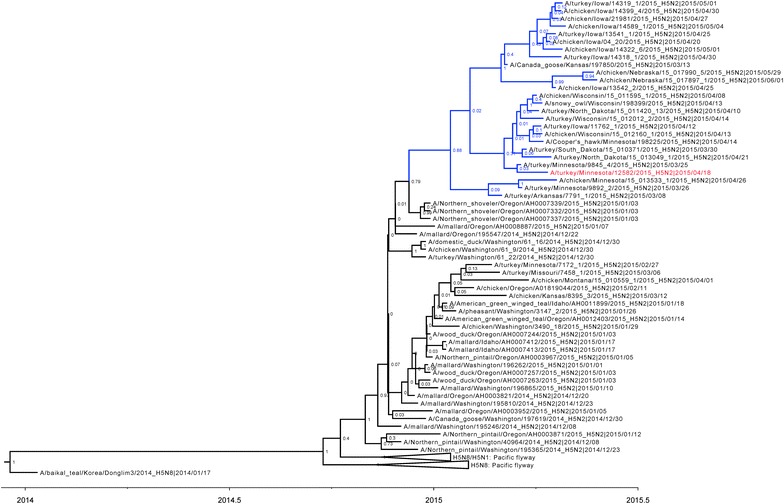
Figure 1
Figure 1
Relaxed clock molecular phylogenetic tree for H5 clade 2.3.4.4 HPAI viruses in the US. At each node, the number indicates a posterior probability. Blue branches represent the Midwest H5N2 cluster. The virus used in this study, A/turkey/Minnesota/12582/2015 (H5N2), is colored in red.
Figure 2
Figure 2
Mean viral oral shed from broilers directly inoculated or contact exposed with A/turkey/Minnesota/12582/2015 (H5N2) virus. Virus detection by qRRT-PCR at 2 and 4 dpc (or 1 and 3 dpe). The limit of detection for Tk/MN/15 virus was 2.0 log10 EID50/mL; therefore, qRRT-PCR negative samples were given a numeric value of 1.9 log10 EID50/mL. Intranasally inoculated 5-week old broilers (5w), 8-week old broilers (8w), and >30-week-old broiler breeders (>30w); contact exposed 5-week old broilers (5w-c), 8-week old broilers (8w-c), and >30-week-old broiler breeders (>30w-c).
Figure 3
Figure 3
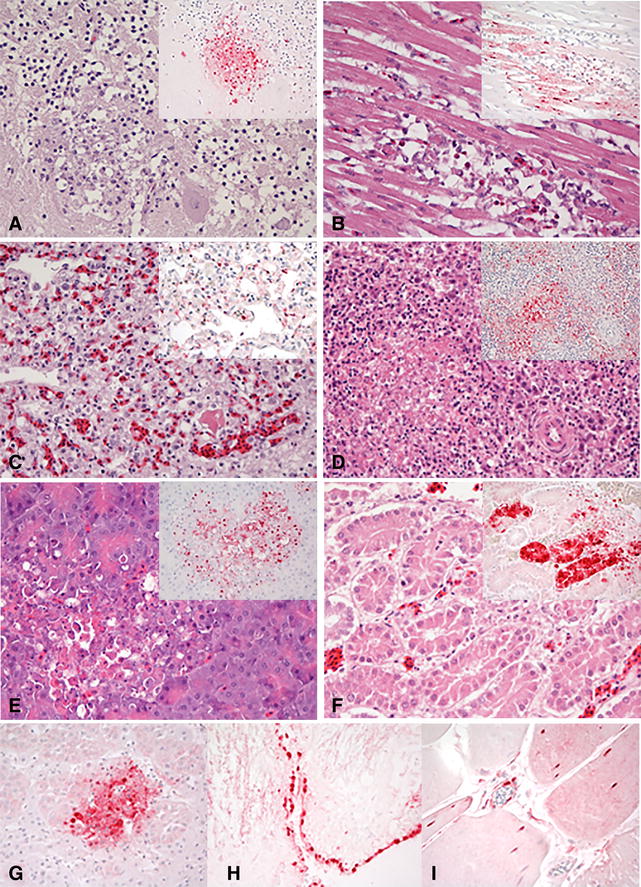
Histopathological findings in broilers intranasally inoculated with high dose of A/turkey/Minnesota/12582/2015 (H5N2) virus. 5-week old broilers (5w), 8-week old broilers (8w), >30-week-old broiler breeders (>30w); ×40; immunohistochemical detection of viral antigen staining in red. A Cerebellum, 5w. Vacuolation of the molecular and granular layers of the cerebellum with necrosis of the Purkinje neurons. Viral antigen present in the neuropil of both layers (inset). B Heart, 8w. Degeneration and necrosis of myocardiocytes. Extensive intranuclear and intracytoplasmic viral antigen of myocardiocytes (inset). C Lung, 5w. Severe congestion, interstitial edema, and interstitial heterophilic and monocytic infiltration. Viral antigen in epithelium of air capillaries and vascular endothelium (inset). D Spleen, 5w. Multifocal areas of necrosis and depletion of the white pulp. Viral antigen in mononuclear cells (inset). E Pancreas, >30w. Multifocal areas of degeneration of pancreatic acinar cells. Viral antigen in acinar cells (inset). F Kidney, 8w. Focal necrosis of tubular epithelium. Extensive intranuclear and intracytoplasmic viral antigen of tubular epithelial cells (inset). G Adrenal gland, 8w. Diffuse intranuclear and cytoplasmatic viral antigen in corticotropic cells. H Brain, >30w. Viral antigen in ependymal cells of the ventricles. I Skeletal muscle, 8w. Intranuclear and intracytoplasmic viral antigen of myocytes and vascular endothelium.
Figure 4
Figure 4
Virus detection in tissues of broilers inoculated with high dose of A/turkey/Minnesota/12582/2015 (H5N2) virus. Virus detection by qRRT-PCR. The limit of detection for Tk/MN/15 virus was 3.0 log10 EID50/g; therefore, qRRT-PCR negative samples were given a numeric value of 2.9 log10 EID50/g. Virus titers in each type of tissue were statistically similar among the three age groups (Kruskal–Wallis test, p > 0.7). Intranasally inoculated 5-week old broilers (5w), 8-week old broilers (8w), >30-week-old broiler breeders (>30w).

References

    1. Lee DH, Torchetti MK, Winker K, Ip HS, Song CS, Swayne DE. Intercontinental spread of Asian-origin H5N8 to North America through Beringia by migratory birds. J Virol. 2015;89:6521–6524. doi: 10.1128/JVI.00728-15. - DOI - PMC - PubMed
    1. Ip HS, Torchetti MK, Crespo R, Kohrs P, DeBruyn P, Mansfield KG, Baszler T, Badcoe L, Bodenstein B, Shearn-Bochsler V, Killian ML, Pedersen JC, Hines N, Gidlewski T, DeLiberto T, Sleeman JM. Novel Eurasian highly pathogenic avian influenza A H5 viruses in wild birds, Washington, USA, 2014. Emerg Infect Dis. 2015;21:886–890. doi: 10.3201/eid2105.142020. - DOI - PMC - PubMed
    1. Torchetti MK, Killian ML, Dusek RJ, Pedersen JC, Hines N, Bodenstein B, White CL, Ip HS. Novel H5 clade 2.3.4.4 reassortant (H5N1) virus from a green-winged teal in Washington, USA. Genome Announc. 2015;3:e00195–e00215. doi: 10.1128/genomeA.00195-15. - DOI - PMC - PubMed
    1. Lee DH, Bahl J, Torchetti MK, Killian ML, Ip HS, DeLiberto TJ, Swayne DE. Highly pathogenic avian influenza viruses and generation of novel reassortants, United States, 2014–2015. Emerg Infect Dis. 2016;22:1283–1285. doi: 10.3201/eid2207.160048. - DOI - PMC - PubMed
    1. United States Department of Agriculture, Animal and Plant Health Inspection Service (2015) Highly pathogenic avian influenza infected premises 2014–2015. https://www.aphis.usda.gov/animal_health/animal_dis_spec/poultry/downloa.... Accessed 9 Nov 2016

Publication types

MeSH terms

Substances