


Population health needs as predictors of variations in NHS practice payments: a cross-sectional study of English general practices in 2013-2014 and 2014-2015
- PMID: 27872085
- PMCID: PMC5198589
- DOI: 10.3399/bjgp16X688345
Population health needs as predictors of variations in NHS practice payments: a cross-sectional study of English general practices in 2013-2014 and 2014-2015
Abstract
Background: NHS general practice payments in England include pay for performance elements and a weighted component designed to compensate for workload, but without measures of specific deprivation or ethnic groups.
Aim: To determine whether population factors related to health needs predicted variations in NHS payments to individual general practices in England.
Design and setting: Cross-sectional study of all practices in England, in financial years 2013-2014 and 2014-2015.
Method: Descriptive statistics, univariable analyses (examining correlations between payment and predictors), and multivariable analyses (undertaking multivariable linear regressions for each year, with logarithms of payments as the dependent variables, and with population, practice, and performance factors as independent variables) were undertaken.
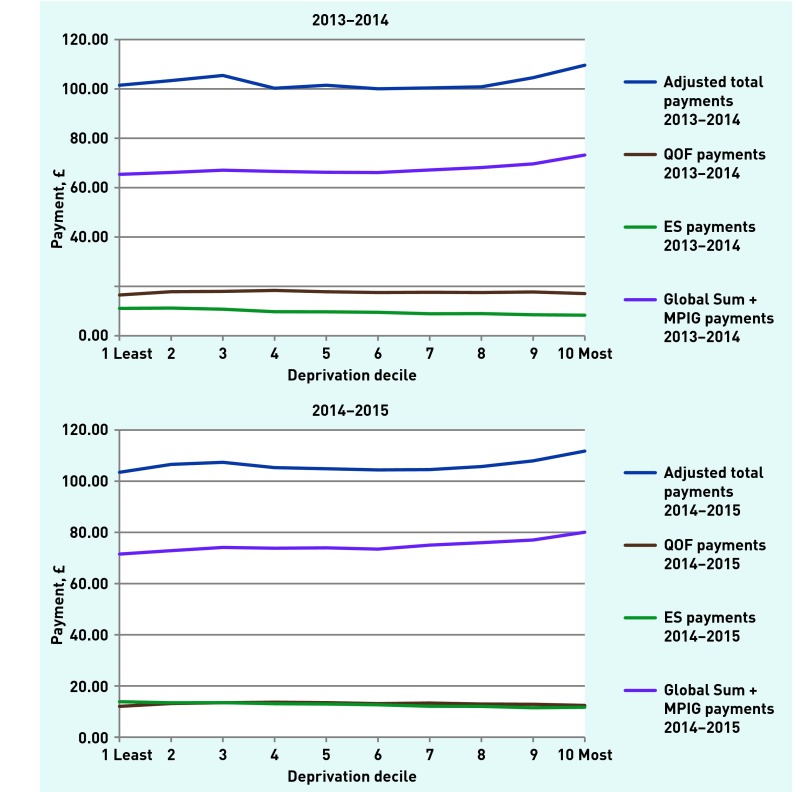
Results: Several population variables predicted variations in adjusted total payments, but inconsistently. Higher payments were associated with increases in deprivation, patients of older age, African Caribbean ethnic group, and asthma prevalence. Lower payments were associated with an increase in smoking prevalence. Long-term health conditions, South Asian ethnic group, and diabetes prevalence were not predictive. The adjusted R2 values were 0.359 (2013-2014) and 0.374 (2014-2015). A slightly different set of variables predicted variations in the payment component designed to compensate for workload. Lower payments were associated with increases in deprivation, patients of older age, and diabetes prevalence. Smoking prevalence was not predictive. There was a geographical differential.
Conclusion: Population factors related to health needs were, overall, poor predictors of variations in adjusted total practice payments and in the payment component designed to compensate for workload. Revising the weighting formula and extending weighting to other payment components might better support practices to address these needs.
Keywords: funding; health services needs; inequalities; populations, underserved; primary health care; workload.
© British Journal of General Practice 2017.
Figures
References
-
- Health and Social Care Information Centre Investment in general practice 2009/10 to 2013/14 England, Wales, Northern Ireland and Scotland. 2014. www.hscic.gov.uk/catalogue/PUB14900/inve-gene-prac-eng-wal-ni-scot-09-14... (accessed 13 Oct 2016).
-
- Health and Social Care Information Centre Investment in general practice 2003/04 to 2009/10 England, Wales, Northern Ireland and Scotland. 2010. www.hscic.gov.uk/catalogue/PUB01378/inve-gene-prac-eng-wal-ni-scot-03-10... (accessed 13 Oct 2016).
-
- Health and Social Care Information Centre Investment in general practice 2008/09 to 2012/13 England, Wales, Northern Ireland and Scotland. 2013. www.hscic.gov.uk/catalogue/PUB11679/inve-gene-prac-eng-wal-ni-scot-08-13... (accessed 13 Oct 2016).
-
- NHS Employers GMS contract changes 2003/04. http://www.nhsemployers.org/your-workforce/primary-care-contacts/general... (accessed 13 Oct 2016).
MeSH terms
LinkOut - more resources
Full Text Sources
Other Literature Sources
Medical
